How Virgin Atlantic Boosts Productivity and Near Real Time Data with Databricks
Summary
- Data foundation: Virgin Atlantic uses medallion architecture (bronze, silver, gold) managed by Unity Catalog to create discoverable, shareable data products for the organization.
- Democratization through governance: The airline ensures security and governance are intrinsic to each product, using masking, obfuscation, and tracking from compute to output.
- AI enablement: Genie, Assistant, and dashboards empower stakeholders across flight, customer, and commercial domains to discover and trust governed data.
How Virgin Atlantic Boosts Productivity and Near Real Time Data with Databricks
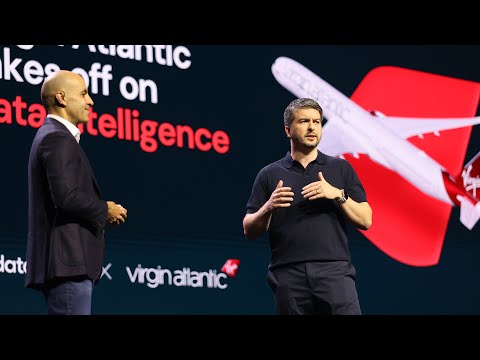
Richard Masters, VP of Data & AI at Virgin Atlantic Airways, spoke at the Data + AI Summit 2025 about how his team uses Databricks to pioneer data initiatives and accelerate decision-making across departments.
Learn more about how Virgin Atlantic uses Databricks: https://www.databricks.com/customers/virgin-australia
Presenters:
- Ali Ghodsi, Co-Founder and CEO, Databricks
- Richard Masters, VP Data & AI, Virgin Atlantic Airways
Chapters
0:00Data foundation at Virgin1:30Security and governance2:31AI use cases in aviation3:58AI disruption in software6:11Limitations of databases8:14The lakebase architecture
FAQs
How does Virgin Atlantic organize its data to make it discoverable across the airline?
The airline builds data assets using medallion architecture (bronze for raw data, silver for refined, gold for business-ready) and manages all of these through Unity Catalog. This creates visibility and shareability across three main domains: flight, customer, and commercial.
Why is governance important to Virgin Atlantic's data strategy?
Virgin Atlantic treats governance as intrinsic to each data product, embedding security requirements, data type specifications, observability, cost management, and compliance tracking from initial development through to end-user consumption.
What AI tools does Virgin Atlantic use to help employees access data?
The airline uses Genie (an AI analytics assistant), Assistant, and dashboards to help stakeholders discover and trust data. These tools make it easier for different business domains to find and use the right information.
How does Virgin Atlantic ensure users can trust the data they access?
Through Unity Catalog's governance model, data is tracked with masking and obfuscation applied as needed, ensuring that everyone sees trusted, compliant data without compromising security.
Full transcript
0:00 Data foundation at Virgin
So super excited about this. Data democratization is super important. Data intelligence is super important. Uh so uh I want to welcome on stage uh Richard Masters who's VP of data and AI at Virgin Atlantic to tell us about how he's democratizing data and AI at Virgin Atlantic. This is the biggest stage we've had. So the timing is a little bit off, you know, it's a long walk to the stage here. Hi. Super excited to see you again.
Great to be here. Um so I'm a little bit curious. So data is the foundation of all this stuff. Uh I'd love to hear a little bit at Virgin Atlantic, uh how do you get the right data foundation so that you can do all these exciting things on top of your data? Yeah, it really starts with my great team, really. We've got data product managers, data engineers, scientists that really build data assets and products on the medallion architecture through bronze, silver, and gold.
And then all managed by Unity for us that makes it all visible for us. We can see it all there on the on the on the left side of the screen. You've got the flight, you've got customer, you've got commercial. Um and it all becomes that left join with the organization, but it makes it discoverable. It makes it shareable so we can use Genie, we can use Assistant, we can use dashboards to really help our stakeholders out there in the different domains use the data, discover it, and trust it.
Awesome. So step number one, get the data in a great place and you need a great team for that, which you have. Uh that's awesome. So then once you have that in place, uh how do you deal with security governance? How important is that first of all, and how do you do that on top of all of your data? Yeah, it's it's super important. The way we think about governance is it's it's intrinsic to each product that we build. And whenever we have a product or or a problem or an opportunity, we start with the requirement, we build that out, and that's got requirements around the insight that has to come out of there, or or the integration that's to happen with enterprise applications.
1:30 Security and governance
But through that is the security, the sort type of data underneath it, the observability of cost, management of that. It all helps with Unity Catalog track that right through to the compute, right up to the to the output the way it's going to be consumed. And we can we can obfuscate, we can mask out, we can really track that and give trust in that data in that output through the governance of Unity Catalog. Awesome. Okay, so we have the medallion architecture, you have the data, your data teams fix it, and then on top of it you have the security, you've done your masking in Unity Catalog so that the data is ready to be consumed.
Are there any exciting use cases? Are you doing anything with data intelligence, AI? Tell us a little bit about the use cases. There's there's so many use cases and exciting problems in the airline industry. We've got a lot of traditional ML problems around predictive maintenance, around dynamic pricing, understanding drivers of experience for our customers, all great stuff. But some really exciting stuff we're doing more recently with language models is around triage, is around summarization and categorization of health and safety messages.
2:31 AI use cases in aviation
You know, super important for us as an as an airline to keep everyone safe, and we want to be able to we want people to report, but we want the teams that are dealing with those messages to really focus on fixing things or anticipating things that might come up. So what we're managing to do with language models is categorize, summarize, and prioritize those with the human in the loop. So this is where our visions really align Virgin Atlantic and Databricks where that human in the loop is is critical to how we really engage with AI in the organization, and it's saving those teams, you know, 1 to 2 hours per day, several hours per week.
And we also have an engine that we can reuse around multiple other customer care use cases as well. So that triage component can really be reused around everything in the organization. That's super impressive. So basically we can make the airplane safer using AI because the whole triage process can be automated with a human in the loop. Whether that's a big thing for us at Databricks, too. We'll be talking about it next few days, which is we think that for the AI there needs to be a human in the loop because they do make errors, and we need to make sure that we're supervising that and making sure that's correct.
So, super excited about this. Thanks for sharing this with us. Thanks. Thanks so much. Round of applause for. Thank you. Okay. So, we know that AI is going to disrupt things. I mean, you heard triage management, lots and lots of different use cases in every organization. You're seeing it. I'm sure it's the number one thing that's being discussed at your company. You can see some of the headlines here from the newspapers.
3:58 AI disruption in software
I mean, there's like every day. It's like endless number of these. Future of payroll, content management, CRM, IM, and so on and so forth. In fact, if you look at all the different categories of software that exists today, whether it's, you know, CRM, ERP, human capital management, contracting, and so on and so forth, it doesn't require that much imagination to see how AI is going to completely disrupt each one of these.
AI is going to be infused into this. You're not going to have to manually go and enter things into the system. It's going to be able to capture all of that. It's going to be able to organize a lot of that, and it'll be able to give you the insights automatically. Just like the triage example, you'll know which customers you need to upsell. You'll know exactly what you need to do in the supply chain, you know, where the bottlenecks are, where to place them, you know, which employees you're going to promote, who needs a raise, and so on.
All the software is going to be disrupted by AI. So, the question is, what's the foundation needed for each of these categories to be able to do that disruption with data? Okay? So, really at this conference, we've been talking a lot about data and AI, right? We said that's clearly two very important pillars of all of these applications. The future disruption will build on these. You know, every one of those categories, every one of those companies, companies that maybe you will start, or companies that you are in, will build on that data and AI foundation.
And at Databricks when we usually say data, what we really meant was basically data analytics. Okay, that's what we kind of meant, right? Data warehousing and, you know, the management of that data for analytics purposes. And then we had the AI. Uh but one thing that we haven't talked too much about at this conference in previous years, which underpins actually every piece of software that exists around the world, uh is the database.
Okay, so I'm here I'm talking about the traditional transactional, you know, database. You know, the SQL Server, Oracle, MySQL, Postgres kind of underpinning database. And we think that's going to actually change significantly and it's a really important area going forward with the infusion of AI and what's going to happen next. Okay? Uh so, if you look at this these databases, they were really built for a different era.
6:11 Limitations of databases
Um you know, tech technology in transactional databases hasn't actually changed that much in the last 40 years. Uh in my previous life at, we used to look at this paper called System R that was published in the '70s. It's a research paper by IBM and 90% of all the ideas that you find in a database today are already in that research paper from then. And not much has happened since then. Uh so, why is that? Why why is why are these databases looking the same as back then?
Well, number one is that because data is so sticky and once you've picked a transactional database and you put your data in it, it's just nearly impossible for you to move off of it or move it to a new thing. So, there's just this massive lock-in on all traditional transactional databases. And once you've locked yourself into that, those vendors also don't need to really uh innovate. They don't need to challenge status quo because you can't go anywhere with it, okay?
So, it's just such a sticky thing. Much more so than anything else. Much more than data warehousing. Much more than the kind of stuff that Databricks has been doing uh for, you know, the past decade. Number two, they're very expensive because of that lock-in. Once they have your data there, you know, they can raise the price. And also, the architecture, the way it was built uh in the '80s and '90s, these are, you know, big black boxes kind of maybe they're virtualized in the cloud, but still clunky big instances that you buy.
Takes a long time to spin them up, and, you know, they're not really elastic in their foundation. Uh and finally, they're really built for that on-prem era, right? They don't have cloud, they don't have AI in mind. They were built pre-AI, okay? So, what we're really excited about at Databricks, and this is another one of our big announcements, is that we think that there's going to be almost a new architecture for these databases going forward, like almost like a new category.
8:14 The lakebase architecture
Uh we call this the lakehouse. And, you know, might sound familiar, it's you split the database into a base and a lake layer. And you take the data that's sitting in these traditional transactional databases, and you store it in lakes, okay? In cheap data lakes uh in an open format, okay? So, basically disrupt that transactional database, you should own that data, it should be on the lake uh in your account, and then on top of it, you do the transaction processing in the base layer on top, okay?
So, that's what we're super excited about. A simple idea, but kind of hard to pull off, and we think this is going to be the future of all databases. So, let me tell you a little bit about the lakehouse. Um so, number one, we think it should be built on open source, right? Uh and we think that Postgres essentially has won as that lingua franca for uh open source databases. If you look at its traction, it's absolutely massive, and the best thing about Postgres is the extensions that the community have built over the years.
So, there's like a massive ecosystem of extensions that are available that let you do anything from, you know, if you want to do vector processing or key value store or whatever you want want to do it's part of Postgres open source extensions. That's number one. Number two, uh you should really properly separate compute and storage in that database layer in Postgres. And this is really hard to do because unlike data warehousing or the lakehouse, um you want this to be really low latency, okay?
So just doing every query and going to the lake would be too slow if you do it naively. So there's been previous attempts at doing this but you know they don't really properly separate it out. You want high QPS queries per second millions and you want to production SLAs because this is going to be underpinning your most important precious AI applications in the future. Okay? And then finally, um it should really be built for the AI era, okay?
It should be able to launch very quickly because we're going to see a lot of agents launching these uh and we want to be able to make sure that if they launch hundreds or thousands of these databases, you should only pay for what you're using. Okay? Like this should be able to scale to zero and most of the time you're just paying for cheap data lake storage. Uh so that's what we think is the lake base. We are super excited about this.
Learn more about the Databricks Data and AI platform.
The information provided herein is for general informational purposes only and may not reflect the most current product capabilities or configurations.