Summit Live: Women In Data and AI Conversation
Summary
- Women in AI leadership: Hear from Kate Ostbye (Pfizer), Lisa Cohen (Anthropic), and Pallavi Koppol (Databricks) on career trajectories and challenges.
- Defining moments: Learn how these trailblazers navigated career pivots, specialized in AI and data science, and found purpose in their work.
- Community empowerment: Discover how to get involved with Women in Data and AI initiatives year-round to champion diversity and innovation.
Summit Live: Women In Data and AI Conversation
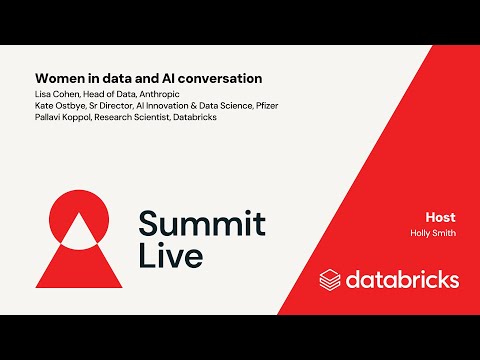
Each year at Summit, Women in Data and AI have a half day for in-person discussions on empowering Women in Data and AI Breakfast, and networking with like-minded professionals and trailblazers. For this virtual discussion, hear from Kate Ostbye (Pfizer), Lisa Cohen (Anthropic), Pallavi Koppol and Holly Smith (Databricks) about navigating challenges, celebrating successes, and inspire one another as we champion diversity and innovation in data together. And how to get involved year-round.
Chapters
FAQs
What are the career backgrounds of the speakers in this video?
This video features Kate Ostbye (Senior Director, AI Innovation at Pfizer), Lisa Cohen (leading data science at Anthropic), and Pallavi Koppol (Research Scientist at Databricks). Each speaker brings unique expertise: Kate works at the intersection of data and human feedback, Lisa builds systems for data science and analytics, and Pallavi specializes in reinforcement learning.
What defining career moments do these leaders discuss?
This video includes personal stories of career transitions and specialization. For example, one speaker moved from self-driving cars to reinforcement learning after realizing the importance of human feedback data. Another found fulfillment working on data and analytics challenges that drive organizational impact.
What challenges do women face in data and AI careers?
This video touches on navigating the male-dominated tech industry, finding mentorship, and advocating for diversity in data science and AI teams. The speakers share how they overcame obstacles and now champion inclusive environments in their organizations.
How can I get involved with Women in Data and AI?
This video encourages participation in Women in Data and AI initiatives year-round, not just at Summit events. The group organizes breakfasts, networking sessions, and discussions on empowering women in the field. Audience members are invited to connect with the community to support one another and drive innovation together.
Full transcript
0:00 Introduction
And welcome. Now, this week has been a showcase for absolutely fantastic work that has gone over across the tech industry. Something that's very close to my heart is making sure that of the fantastic work that goes out there. Uh we highlight people who are doing amazing work. And as someone who is a very visible woman in tech, I want to take the opportunity to speak to people who are also doing really fantastic work in the industry.
And so earlier this week, I sat down with three superstar women in the AI industry to talk to them about their experiences and their career. Hello and thank you so much for joining us for this segment. And today I am so thrilled to be able to sat with three very talented, influential women from the world of AI. And to get started, I'd like to say one hello and welcome to Data and AI Summit. Uh, and could you start by introducing yourselves? >> Sure.
1:07 Professional background
I'm a senior director for AI innovation and data science at Fizer. >> I lead data science and analytics engineering at Enthropic. >> Hi, I am a research scientist here at data bricks on our reinforcement learning team. >> Okay then. So wonderful. Uh you've all got very interesting jobs. Uh they are all quite specialists in their own areas. So could you give us a bit of intro about you know how did you find your specialism?
What is it that you liked about it and like what is it that like really kind of like drives you makes you passionate about your area? >> Yeah. So I actually right after undergrad I was working on completely different stuff. I was actually in the self-driving space and along the way I realized that one of the ways that we make our models so much better, the car is so much better is like collecting data uh from people and I became really fascinated by this question of how do we get data from people?
What is the right data to get and how do we leverage that as effectively as possible? So I went back to do my PhD on reinforcement learning from human feedback uh specializing in active learning interactive settings and I feel super fortunate to be working on this in this space at this time when it's such a huge question. >> Um and yeah every day I feel like there's different challenges, different things we want to continue improve on.
So I feel very lucky to work on this. >> So maybe just a quick question on like how does this uh interact with your day-to-day kind of role? like what does it uh how does it impact the work that you're doing dayto-day? >> Yeah, I mean I think I think a lot about what it means to get data from people and what it means to improve models and how those two relate to each other. So for example, my team recently worked on Tao um test time adaptive optimization which you might hear about uh during this week and one of the things there is that getting that type of data from people for fine-tuning is extremely uh time and cost intensive and so we think really careful carefully about things like how do we make this process easier method based on RL um and so I feel very lucky to get to understand these things deeply and think about how we can continue to make them better for people who use these techniques. >> Wonderful.
Thank you. >> Go on. And tell us about your specialism. >> Yeah, so I've been leading data science for the past few roles. Um I always had a passion for data analytics um kind of math and sciences growing up. Um I actually really enjoyed subjects like physics where you're, you know, really explaining the world's phenomenon in terms of equations and math. And then I went on to specialize in math through my schooling. Um, you know, the first role that I had was actually working at Microsoft um, on developer tools.
And so that was a great place to grow up in technology and really learn good engineering practices while we were developing tools for engineers directly. >> Go on. What kind of tools were they? >> Yeah. So I was working on Visual Studio at the time. Um, so code editing, debugging. Um, >> never would I have imagined like IntelliSense, um, edit and debugging. Now you can just ask the AI to write the whole program for you and find and fix the issues.
So a whole different world. >> Oh, wonderful. And then how did it carry on from there? >> Yeah. So I think in that point I was in a product manager role and so I really enjoyed kind of going through that full cycle of ideation of the features and then getting the feedback from customers. Um but increasingly I was interested beyond um not just the qualitative but also quantitative feedback to understand kind of at scale and in aggregation how people were using the product and how we could use that information to continue to evolve it and so we had a function called experience and insights that was before data science was a thing now there's a lot more programs and um foundation in this but that was what I started in and then moved into data science as it became a function and I led that role for Visual Studio and then later moved into Azure as cloud was growing.
Um, and then after a couple decades at Microsoft, um, I decided to >> go, um, beyond another company I worked at, Twitter. Um, I went from enterprise to consumer. Um, I went from kind of leading more internal machine learning models to the real-time um, external models for our users. And then as AI was growing, um, I went to Google to lead data science for Gemini and I was excited about how we could use data science to build better models and create better experiences and then finally anthropic. >> Yeah.
So in terms of kind of how this all relates to what your work is anthropic at the moment, do you want to tell us a bit about that? >> Sure. Um, honestly, we try to integrate data in all parts of the business. So whether it might be the way that we continue to evolve the product um and understand the use cases that customers are using so we can create better experiences for them there. Um, as well as the features. Um, we also engage with areas in our sales team.
So in sharing providing data to help us understand how we're nurturing and growing customers as they're adopting AI within their organizations. Um we use it for capacity planning and optimization. So >> okay that sounds like a lot of dog fooding I've got to say. >> Yes, we definitely use the tools internally as well. That's been I think a great part of the experience to learn how we can disrupt ourselves and like what this function will look like in the future over time. >> Okay, wonderful.
Thank you. Uh, and last but not least, >> yeah, so I started out actually more as like an arts and English kind of kid. And so I was in um in in my undergraduate uh I switched to more medicine based uh things. So I finally finished up my degree with a bachelor's of science and moved out to work in um cardiac imaging uh at a hospital Johns Hopkins. And so working on clinical trials and you know collecting the data and understanding some of the offshoots that we work with postocs on I ended up doing a masters in public health studying epidemiology and bioatistics and that was a really great way to sort of be hands-on with the data but also in a way that's looking at sort of um bigger more long-term impacts.
And so from there I went and worked in like pharmaccogenomics and then in clinical trials again. And so at a certain point I kind of hit this wall where I was like if we're not going to sort of implement more machine learning in our space um I feel like we're going to kind of miss out on something. And so taking the work that we were trying to do and make it more efficient, more um more productive but still in a way that is uh trustworthy and uh probably validating you know ability to validate it for clinical trials. uh came to a company a biotech company where we built out a data science and machine learning team and so we worked with research and development to understand what were their data needs were how we could improve the data for more ML and AI purposes um built out a couple applications there and then were acquired by Fiser so now at Fizer I lead AI innovation and data science for R&D group and again it's kind of the same thing what I love about it is again the domain is such that you're working with a lot of experts in the field you know if I do my job they can uh go far, you know, together but also go fast alone.
And so my job is really to find that right balance sometimes between a custom application that we can take time to develop together, but also maybe just provision the tools and the enterprise application and services quickly enough that they can develop quickly on their own. And so we try to find this harmony between those um machine learning engineers that are computationally intensive in the business of the researchers, but also provide them with additional support and needs that we can provide.
But also we have those wet lab bench scientists that aren't going to be computationally heavy and we can support them with more machine learning and more automation. So those are kind of things we do. We kind of spot check and find out small things that we can do but also take a big picture look of um you know how can we build a better data marketplace? How can we provision more AI tools quickly and efficiently for you?
How can we build you an application that's custom? And it should be custom because it's at the front edge of what we're doing you know within our own business. >> Okay. Wonderful. Thank you. That's uh that's all so impressive from all of you. quite humbled and feeling quite untalented right now, frankly. Um, thank you. Um, but you've all had a very full, very interesting careers. And if I were to ask you to pick like maybe the most intense or defining 24 hours of your career, what would you choose and why? >> Oh goodness, I feel uncomfortable that I have to go first on this Um, I would say the most intense 24 hours that I've had recently is, you know, working on a global scale, you do have hours that overlap. bomb, you know, from early to late.
9:16 Defining career moments
Um, and because of the fun things we get to do and doing a good job, you get called upon, you know, you know, there's travel and so the last 24 hours that were very intense was um was a bit of a juggling act. You know, being able to I was in a different country working with the team uh that I'm building out there, but it was still taking calls early in the morning and late at night because there's other projects in the hopper.
And so trying to find this balance in life where you're enjoying the fun of the sort of chaos and the good >> Uh obviously I'm not promoting work life balance when I talk about that, but you know, you have these days sometimes where you know, you start on one project and you end on another and you're touching different time zones and you know, making that impact. I think that's really what it is at the end of the day.
Are you making your customers happy? Are you is your team happy and enjoying it? And that was that was one of those 24 hours for me. >> Yeah. >> I think also in like a in a medical sense, in a medical field as well, it's uh easy to relate to people who kind of depend on this and the impact that your work is going to have. Uh so yeah, I'm sure that adds to it. >> It certainly does. Yeah. I think um from a scientist perspective, you know, we kind of joke if we've done our job right, they don't even know we're there.
Um customers quickly >> and same question again. Uh I'm sure anthropic you've got many interesting 24-hour stories for us. >> Um I would say working in AI probably the last 24 hours and also like the last couple weeks leading up to a model launch are definitely very exciting. Um I think compared to prior software development where you you know it's deterministic you write the spec and then you're checking do we complete the spec are there any bugs you know it's this nondeterministic space where you've built this creature essentially and then you're studying it and there's just >> a lot of suspense.
You're running the final reinforcement learning run seeing how good is this model going to be that we created and then trying to understand you know between the different model candidates how they compare. um running different experiments, seeing what capacity you have to fill all the slots to run those in parallel. Um and of course we use AI to do all of this as quickly as possible. And so using AI for the model evaluations, using it to diagnose the differences between the different candidates um and find the best solution, experimenting with different variations, etc. >> And I guess uh once once a model has gone out into the world, that also must be 10 to 24 hours because people are very opinionated about these things.
You find out very quickly whether someone likes it or whether they don't. Oh yes. Yeah. Train, but it's really day one for then everything afterwards because Yeah, of course. And you know, while we do have kind of early adopter programs leading up to the release, you get some early feedback and some experiments before that. Um, yeah, once it goes to the wild, it's a whole new ball game as well. Getting to look at the feedback at scale. >> Okay, wonderful.
Thank you so much, Puffy. >> This is a hard question. I was thinking about it. I was like, I don't I don't know. But I think especially after hearing um what you had to say, I kind of agree. So when I joined data bricks um we uh so we were I came in with the mosaic team. We were training the DBRx model at the time which is an open source LLM. >> And yeah I think uh like you said the just thinking back on it the week and the day leading up to just like wrapping up and being like all right we're done with this especially because the field moves really fast. um timelines get pulled and it's kind of whenever we're working in that case on pre-training a model but also like with tower or we're de developing an algorithm or something there's always this sense of like maybe we can continue to push this and maybe we can get better numbers and that kind of never ends until someone uh like at least on the research team it never ends until someone's kind of like this is when we're making the cut and whatever you have at this point is going to go out and I think that leadup to that whenever someone is like all this is the time.
Extremely intense. I think we work super hard because everyone wants to showcase, right? Like these uh yeah, it's kind of And then you sleep it off for a long time after the question is going to be um again you've all got to very kind of senior levels of what it is that you're doing. As you kind of rose through the ranks, was there anything that you had to unlearn that did you well at the beginning of your career but started to hold you back towards the end of it?
13:56 Career unlearning
And was there something you had to unlearn and what was it? >> This is a good question. I feel still fairly early. Um but definitely for me the thing that I had to unlearn was so I worked for a few years prior to deciding to go and do my PhD and that was a very difficult decision because I was doing really well. I was at a company that was and still is exceedingly cool. Um and I felt like I was on the cutting edge. I felt like it was gonna go somewhere and deciding to take a step that felt like a nonlinear improvement, >> okay, >> was very hard and I really was like it's very type A person who was like here's my plan.
I can see what the future holds here. I believe in this vision. Um, but I don't think I would be doing what I'm doing now, which I love, if I hadn't just said, I'm really passionate about this question. And even if this doesn't feel like a step forward right now, I'm going to trust in my gut that this will be something important. >> Um, but yeah, that was definitely something that I had spent some time on learning. Yeah, that like need for a linear improvement. >> Okay, then. >> Yeah.
Oh, yeah. I got to round the table there, I think. Yeah. >> Um okay then go on. Unlearnings that you've had to make. >> Great. I think for me it was the done is better than perfect. Um I think particularly in this profession where we have the techniques, we have the models where we can create really precise solutions um being able to balance that with the time to market um and find when are the places where an 8020 solution is really the best approach.
And so that might be anything from looking at a model and maybe there is a top predictive feature that gets you like 80% of the way. So just implementing it that way to start and then you can get early feedback and even validate the approach. Um and yeah and sometimes that's actually all you need long term. So there's still kind of a time and place. sometimes, you know, eking out that last percent of performance is actually worthwhile in a broad optimization problem.
But many of these solutions, I think, you know, finding ways that you can apply the 8020 solution and um works great. And I often ask myself, you know, are we making better decisions today than we made yesterday? If so, let's take that step. >> Okay. No, that's good advice. Thank you. I definitely identify with both of those and it will probably come out in my my answer as well. But um probably the biggest thing I had to unlearn was a hold on what the future exactly looked like.
A lot of my job is coming up with an idea of that future and being sort of future proof. Like looking over the fence and seeing what else is out there once I get the team up and running on sort of the current, you know, uh field post that we're trying to get to and then looking out ahead and seeing what that next finish line is. I've had to let go of things that I'm good at. You know, I'm no longer a coder, unfortunately.
I'm a really great leader and having to learn those leadership skills is is also practice that you get to invest back into yourself. So, trying to similarly, you know, take a leap of faith in a new direction, but also putting that um you know engineer mindset to learning a new skill or a new practice because again the frontier is changing. Those you know, finish lines keep moving further out. And so that adaptability is something that um I've had to embrace by sort of unlearning the kind of some of the pride I had and maybe being an expert in something else in the past.
Yeah. To regrow. >> Okay then. Thank you. They are some wonderful answers. No, thank you so much for your honesty uh being able to talk about your experience uh and your work. So thank you so much for joining us today. >> Thank you. >> No worries. Uh so that's all we've got time for unfortunately. But again, thank you so much to our guests who have been joining us today. Uh we hope you stay tuned for many more of our segments today.
Thank you.
Learn more about the Databricks Data and AI platform.
The information provided herein is for general informational purposes only and may not reflect the most current product capabilities or configurations.