Stellantis: How a Global Automaker Deployed AI Agents at Scale
Summary
- Multi-agent architecture: Stellantis built a multi-agent system with process agents (for business use cases like Optima) and personal assistants, orchestrated through secure gateways.
- Supply chain automation: Optima, an agentic supply chain planning system, cut plan creation time from one week to one day and delivers 4.5% annual savings at scale.
- Governed AI platform: The system leverages LangGraph orchestration, Genie spaces, Unity Catalog governance, MLflow, and Lakebase for secure enterprise AI deployment.
Stellantis: How a Global Automaker Deployed AI Agents at Scale
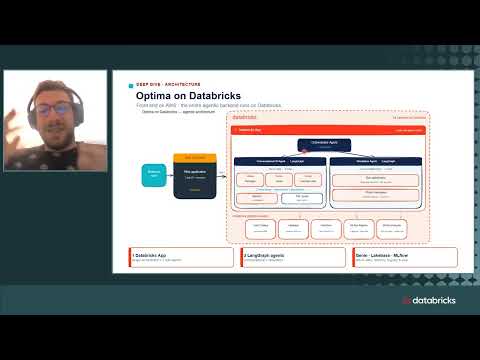
How does a company running 14 automotive brands and thousands of suppliers put AI agents into production? Watch the full session → https://www.databricks.com/resources/webinar/agents-work-shipping-agentic-apps-scale
Hugo Sechier, Head of Agentic AI at Stellantis, shares how the automaker built Optima — an agentic supply-chain planning system that cut plan creation from one week to one day and delivers roughly 4.5% in annual savings at full capacity. He walks through the production architecture on Databricks (LangGraph orchestrator, sub-agents, Genie spaces, Unity Catalog, MLflow, Lakebase) and closes with lessons learned deploying multi-agent systems in a large, regulated enterprise.
Full session → https://www.databricks.com/resources/webinar/agents-work-shipping-agentic-apps-scale
#AIAgents #Databricks #Stellantis #SupplyChainAI #EnterpriseAI #AgenticAI #CustomerStory
FAQs
What business problem does Optima solve for Stellantis?
Optima automates supply chain planning, reducing the time to create plans from one week to one day. At full scale, the system delivers approximately 4.5% annual savings.
How does Stellantis organize its AI agents?
Stellantis has two types of agents: process agents built for specific business use cases (like Optima for supply chain), and personal assistants that any employee can access for daily productivity.
What role do MCP and 8-Way protocols play in Stellantis' architecture?
These protocols create a secure, standard, governed gateway between agents and business tools/platforms at Stellantis. This ensures agents can safely interact with enterprise systems.
How many automotive brands does Stellantis operate?
Stellantis operates 14 iconic automotive brands, and the agentic AI strategy spans all of them, coordinated through the AI Garage and governed by a centralized semantic layer.
Full transcript
Hi everyone, we just seen what is possible with Agent TKI on Databricks. Now let's see how Stellantis is doing that in practice. So I'm head of Agent TKI in Stellantis and I have the pleasure to present you during 10 minutes the Agent TKI strategy at Stellantis firstly, Firstly, then a really concrete example, the business impact and the user of Databricks with the supply chain use case that we named Optima. And finally, the lesson learned and the adoption.
So just one slide, Stellantis, who we are. So we are one company composed by 14 iconic automotive brands. I hope you know at least one of them that you can see into this screenshot. So this is just who we are. Now let's deep dive directly into the first part of the Agentica strategy at Stellantis. And when we talked about Agentica into Stellantis, I usually use this slide to represent our vision and landscape. So how to read this schema?
You can see on the top, the first layer that we call the AI Garage. It's our main product, the entry point where any Stellantis employee will start their journey. When we talked about AI, it's here that they will discover some AI product, asset, machine learning model, agents that they want to use and they would like to access. So AI Garage will rely on the agents that we have in Stellantis. So we go to this second layer where we can see two types of agents into Stellantis.
We have on the left side what we call the process agent. Process agent is some agent built to answer to a need of a business use case. So for example, you can see Optima. It's the one that I will show you just after this slide. And you have on the right side another type of agent, our personal assistant. the personal assistance that any employee can access and to discuss with for their daily productivity. We have a first version that we named Metabot and we are moving forward, perhaps thanks to Databricks that you will see at the end of the presentation.
Those agents are really powerful because they are able to access to all tools, agent platforms that we have in Stellantis, like for example with Databricks. And how to make the bridge between the agent and the tools and our action? It's through this gateway that you created to be secure, standard and governed way, with two famous protocols, the MCP and 8-Way. Then at the end, we cannot do AI without data. So that's why we have at the end this semantic layer to have this global governance and understandable data to help the agent understand the semantic view.
So now let's go in practice and present you a concrete use case that we have, Optima. So Optima is an AI-powered inbound transport plan optimization for the maturing flows. Okay. It's how materials move from 4,000 suppliers to 40 plants every day. So why it's really matter for the business? Because today to create this plan, it takes one week, one week to build and to validate the plan. even if the data are already ready.
It's manual, there is some operator that needs to work on it, it's hard to repeat, and it's costly to create this optimization. So the approach is to reimagine this inbound transport planning, thanks to a mix of two approaches. Operational research method based on some mathematical algorithm to answer to the question of what is the best decision based on the constraints, to pick the efficient route, minimize the cost and honor the constraints.
And a mix of another type of method, an agentic method, to do some conversation with the business user and also to ask and simulate and replay on demand the optimization in a natural language. So why does this matter to the business? Because there is a direct impact at full capacity and the process that was manual and slow. So we save now per year at full capacity 4. 5%. We are able to reduce from one week to one day to create this plan cycle in full automated way.
And we are able to manage all the complexities that we have your supplier and our plant. So what change for the business is three stuff, the speed, the cost and the robustness. Now let's deep dive into how we are doing them thanks to Databricks. So the business user is relying on a web application hosted into an AWS account. And after the entire agentic backend runs on Databricks. So what we can see here. On Databricks side, we are using mainly Databricks app service that is hosting the main orchestrator, the orchestrator agent or the master agent based on Longgraph, this famous Python SDK that will rely on two sub-agents.
The first agent is the conversational AI agent that will talk to the data and the second one is the simulation agent that will launch the optimization. This conversational AI agent is relying on five tools. Three of them are for the talk to data, thanks to Genispace. We decided to use three instead of one because of the ways that we are managing the data in the semantic layer and to have also a better accuracy. We split also per subtopic sub-area of our supply chain.
So one for packages, one for the cost and another one for the transport plan. We also created two custom other tools, one to manage the memory under the using LegBase to manage easily the same type of question and answer to be sure that we are relevant in terms of question and answer to the business user. And another custom tool to generate the plot and the graphic to help the business user to understand the data. On the simulation agent, we have two tools.
One to run the optimization, so thanks to an execution of the Databricks workflow that will execute the operational research algorithm. And another that will perform the what-if simulation also will execute the workflow, but before create synthetic data set based on the natural language discussions that we have with the business user based on some contracts. What if this plant has this? What if my material has this? In a transversal way, we are using for sure other different services of Databricks. the Unity Catalog to govern our data, Lake Base for the session memory of our web application, Workflow for the optimization RAM, and MLflow for the registry of our two subagents and the optimizers, plus the Evaluate for the LLMAT judge and the golden dataset that we are doing across our three different Talk2Data tools to have a monitoring on our accuracy.
We used also other services that help us to move fast in the PUC. So for example, concrete example, we didn't start to create from scratch our orchestrator in Python. We used Agent Bricks for the orchestrator. It was easier and faster to test it. We used also the playground of Databricks to interact with the agent, to see the behavior, if there is a good reasoning, if the agent is enough proactive, if it will execute the good tools, etc.
And GenieSpace UI to check our talk to data, the result, and to have the out-of-the-box graphics that we can have through this GenieSpace UI. On the production side, to make it robust, as I said, the usage of PlankGraph into Databricks apps, We used also Genicode to help us to generate the code and to wrap all the code thanks to the standards that we have embedded in the skills. So we created some custom skills based on our standard of Stellantis that Genicode is able to rely on.
So the skills that Markdowns that we know. And finally, Databricks Ascent Bundle to help us to deploy all the architectures that you saw so in a CI-CD way with our framework, all the components in our production Databricks instance. So, lesson learned from this project, four parts. Split, don't centralize. We don't use one genie because genie space could not handle the data complexity. We split it into three genie space, one per subdomain.
Second, we let the platform hold the memory. We use LakeBase, something out of the box, to manage the history and to have a reliable answer reuse. It was easier. Third, we use Genispace as a tool, not as a final product. For us, it's not a final product. It's integrated in our agent and sub-agent, thanks to the API of Genispace. space. And finally, Databricks apps pattern are still maturing for us, meaning that we have different agents and subagents.
We are not sure if we have to deploy one Databricks apps, two Databricks apps, if we have to use Under the Woods Endpoint. So it's something a convention are still forming for us. To conclude and to have beyond optima what's happened, if you remember about the introduction, Databricks is connected to this 8-way and MCP gateway of Stellantis. So thanks to that, if for some reason we need to reuse some blocks coming from Optima, for example, a subagent or a specific tool of talk to data, we will be able to do it into another project because of this connection between Databricks and this MCP and 8-way gateway.
Last, we are expanding the usage of Databricks on three points. Firstly, we are trying to do the combination with this MCCP connector and agent bricks to increase the discoverability and to help us for some POC to move forward. We also use genuine discoverability with the connection of the MCP Gateway to have a broader usage. And finally, to answer to our vision of the personal assistants that we have, we are exploring three components that could help us in our daily productivity to put at the end of end user, or end user, I would say, employee of Stellantis, some skills, for example, we are using, we are testing Omniagent, the sandbox runtime of Datavix, and the Unity AI Gateway to manage the token consumption per employee, for example, and also to help us to route close to route the different LLMs that we have through our LLM gateway.
Thank you for your attention and I will hand it back to the DataRx team. Thanks, that was an amazing story, a great innovation. Thanks for joining us today. We'd love for you to join us for an upcoming webinar on AI governance as well, where we'll dive into Unity AI Gateway and the new Omnigent meta-harness. You'll see live demos of how developers can move quickly and build safely, while admins and enterprise decision makers maintain control and manage costs.
We hope to see you there. And to get hands-on while building agentic apps, please join us for the Databricks Data and AI World Tour in a city near you. Scan the QR code for more information on keynotes, sessions, and workshops where you'll get practical guidance and get building. Hope to see you there.
Learn more about the Databricks Data and AI platform.
The information provided herein is for general informational purposes only and may not reflect the most current product capabilities or configurations.