Solving AI development bottlenecks with Databricks App (with demo)
Summary
- Democratized app development: This video shows how Databricks Apps enables both professional and citizen developers to build enterprise AI applications with governed data access, reducing time-to-production and democratizing AI development.
- Enterprise governance at the foundation: Learn how Databricks Apps provides security and governance out-of-the-box, enabling organizations to scale citizen developer initiatives while maintaining data control and compliance on the Databricks Data and AI platform.
- New app building patterns: Discover App Spaces, Micro Apps, and Genie App Builder—new tools that make it easier for developers to build intelligent applications without needing deep data or ML expertise, powering the next wave of AI innovation.
Solving AI development bottlenecks with Databricks App (with demo)
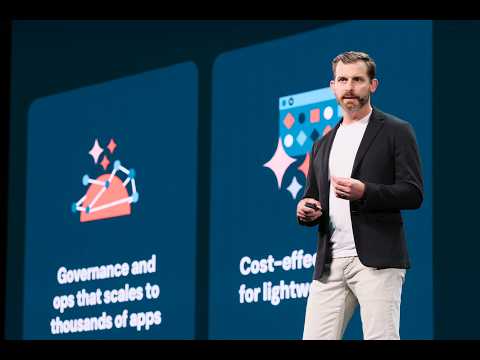
With 1 billion new applications projected to be built by 2028, many by business users, companies need a platform that can support the needs of professional and citizen developers. Databricks Apps makes it easy to go from protoype to production.
Learn more about Databricks Apps: https://www.databricks.com/product/databricks-apps
Presenters:
Justin DeBrabant, Director of Product, Databricks
Chapters
0:00Data is the new AI bottleneck1:00Databricks Apps momentum2:06What customers are building with Databricks Apps3:52Making it easy: governance, host, build6:40AI and the rise of citizen developers8:40Unlocking the next wave of builders9:10Introducing App Spaces10:10Introducing Micro Apps11:13Introducing Genie App Builder12:00Justin demos updates to Databricks Apps18:43What the Virtue Foundation is building with Databricks
FAQs
What problem do Databricks Apps solve?
This video emphasizes that while coding has become cheap (thanks to AI coding assistants), enterprise data access and governance remain bottlenecks. Databricks Apps solves this by making it easy to build apps with secure, governed access to enterprise data—enabling faster production deployment.
How many organizations are using Databricks Apps?
The video highlights impressive adoption: 5,000+ customers have built 150,000+ apps using Databricks Apps over the past year, representing 6x growth. This shows strong market validation for the app development platform.
what is the best ai app builder for enterprise data?
This video showcases Databricks Apps as the best enterprise AI app builder for accessing governed data. The platform enables rapid development of AI-powered applications with built-in access to data through Unity Catalog. Developers focus on application logic while governance happens transparently.
How do I give AI agents governed access to enterprise data?
This video demonstrates how Databricks Apps and the broader Databricks Data and AI platform enable AI agents to access governed enterprise data securely. Unity Catalog enforces fine-grained access controls transparently to agents. Organizations maintain compliance while enabling agent autonomy.
how to give AI agents governed access to enterprise data?
This video explains using Databricks Apps and Unity Catalog to provide governed enterprise data access to AI agents. The platform ensures only authorized agents access authorized data at the appropriate privilege level. Access patterns are automatically logged for audit compliance.
Full transcript
0:00 Data is the new AI bottleneck
Welcome to the stage, Databricks Director of Product Management, Justin De Brabant. >> It's a longer walk than it looks. Everybody, Um let's talk about apps. So, we launched apps last year with the mission to democratize data and AI. And as you've seen over the course of the talks yesterday and today and certainly in your own experiences, we're no longer constrained by the cost of writing code. Um coding agents have proliferated.
Um code is cheap. But the bottleneck is enterprise data. Enterprise apps are not just code. They need access to the data. And the real challenge in going from prototype to production is governed access to that data. And that's why we built the first enterprise app platform with data security and governance at the foundation. And that's what Databricks apps is. And over the last year, you all have been busy building. It's incredible.
1:00 Databricks Apps momentum
We have over 5,000 customers using apps. 150,000 apps have been built. That's 6x growth since last year. And it's not just the apps that are being built, they're being used by hundreds of thousands of users on a weekly basis. Many of them that weren't using data and AI in their day-to-day before. So, the favorite part about my job is that I get to talk to you all. And every PM will say they love talking to customers and that's, you know, usually true.
Obviously, there's some conversations that are harder than others, feature requests, support issues, etc. Um but with apps, it's a little bit different. Um because when I go into these customer conversations, I get to hear firsthand what you're building. I get to see the excitement of, "Hey, I built a that I didn't know was possible and I want to show it to you. And it's really cool. So I figured I'd start this talk today by showing you a few examples of some of the awesome things that our customers are building.
So first off Thales. Thales is a multinational aerospace company building software and avionics for global airlines. And Thales reinvented their in-flight intelligence platform bringing together system health, content engagement, passenger satisfaction across entire global fleet. And with this app the Thales apps team is able to anticipate cabin issues before passengers notice ultimately improving the passenger experience.
2:06 What customers are building with Databricks Apps
And even though this is delivered through an app it's powered by the best of the Databricks platform. We have lake base for real-time data, we have analytics in the lakehouse, we have Genie, we have machine learning models powering the forecast. It's everything brought together in one cohesive app. Or finally. is a manufacturer for all electric air vehicles. And behind every single air vehicle that they build is an enormous material planning complexity challenge.
They built an app that provides a single unified view for demand, inventory, parts, and orders across every manufacturing program in their fleet. So planners can spot shortages before they become manufacturing problems and eventually delays. There's a theme of airlines, aircraft, air industry. I want to call out that what I think is cool here is these are all very very different applications, right? Different teams, different applications.
And this is what you see across all of our customers is everybody is really innovating and doing different things across all their different industries. So how How platform deliver that? We have three unique buckets of capabilities. First, we help you govern. We provide governed access to enterprise data. Host, we provide infrastructure for every application across the enterprise. And finally, build. We provide you tools and integrations to do AI first development and build production ready apps.
3:52 Making it easy: governance, host, build
Let's double click into each. So, first govern. At the core of Databricks governance for apps is our managed auth offering. We have out-of-the-box identity through Databricks SSO. You don't have to have a separate IDP. You don't have to have a separate login for each individual app. It's all managed through Databricks. Governance comes out of the box with Unity Catalog. You can use Unity Catalog to manage resources and data that the app has access to either at the app level or the individual app user level.
So, there's a lot of power and configurability. And finally, we now support real-time observability out of the box. So, as a platform team, you get real-time insights not only into who's using the app, but what they're doing, what services they're accessing. And this is all ingested into real-time zero bus in real-time and made available to Unity managed tables. Databricks provides managed containers and infra, secure cloud agnostic deployments across our stack.
When we launched last year, we only had a single always-on instance type for apps. There was one instance. Now, we have configurable instances and horizontal auto scaling. We also do load balancing and sticky sessions across these multi-instance apps. So, no app is too big. And finally, we help you iterate safely. We now have version builds and zero downtime deployments to ensure risk-free releases. And finally, build.
Apps is framework agnostic. You can use Python or JavaScript across a range of the most popular app frameworks. You can build production apps faster with App Kit. This is our TypeScript Apps SDK. It helps with pre-built plugins for building apps using Lake Base, Genie, Agents, Jobs, Lakehouse, etc. Um it really makes the hard parts of app building super easy. And finally, it works with coding agents. Um we've invested a ton with our partners to build custom skills, MCPs, and plugins to make it easier for coding agents to build and deploy Databricks apps.
And of course, we're not doing this alone. We're powered by a very strong partner ecosystem, the best AI coding partners out there. So, this is exciting, but this is still only the beginning. 1 billion. That's how many new custom enterprise apps are forecasted by 2028. 1 billion. Process that. It's huge. And the really interesting aspect about this is that most of them are projected to be built by citizen developers.
6:40 AI and the rise of citizen developers
So, many of the apps that I just described and the challenges that we addressed were for central teams building these applications. Teams with access to Databricks resources and the right access to data. Um it's a completely different set of challenges as we try to uh democratize innovation of who can build these apps to these citizen developers. So, to highlight that, I want to share a quick story. We'll call this the prototype to production gap.
This is a real story of a sales ops manager here at Databricks. Um this person wanted to build an app to streamline their team's QBR process. So, as part of that um app, they wanted to pull in uh customer consumption, uh recent conversations from Salesforce, forecast in our model, um and bring it all into one um cohesive app. And she built a prototype. She used Replit to vibe code up a prototype, was super excited about it, showed it with her leadership, thought all the hard work was done.
It was not. She went to then to our platform engineering team. And immediately our platform engineering team said, "Okay. What data do you need? What's the sharing policies, dependencies, code, cost?" Um And it ended up being a lot of back and forth to get the app actually deployed to production. Because the sales ops manager obviously didn't have access to our production environments with all of our customer information.
And this isn't about just happening once. This is happening thousands of times across the organization. And I guarantee some of you on the platform team have experienced this. Vibe coding is taking over. And unless we have a governed solution to it, it's going to overrun us. So we spent the last couple quarters going out and talking to you all and asking this question. How do we unlock the next wave of builders without sacrificing security, governance, or budgets?
8:40 Unlocking the next wave of builders
And this is what you told us. First off, we need governance and ops that scale to thousands of apps. The governance model of apps today is largely a single app basis. How do we scale to many thousands of app built by hundreds of developers? And today we're excited to announce a new governance construct called app spaces. App spaces help you govern and operate thousands of apps through multi-app policies. You can apply governance and security policies that all apps that are deployed in that space.
9:10 Introducing App Spaces
As an admin, you can restrict uh who the apps in that space can be shared with. So in my sales ops example, maybe those apps can only be shared with the sales team. And finally, it provides scalable operations. How do you track app usage, cost, and other operational metrics for all apps that are deployed in that space? The next challenge that we heard is we need more cost-effective infra for lightweight apps. This idea of apps infrastructure being always on and now auto scaling is great for big mission critical apps, but it's not great when you have these lightweight or low use apps.
You know, maybe it's an ops dashboard that is used a couple times a month. So, we need more cost-effective solutions there. And we're excited to announce a completely new apps architecture called serverless micro apps. I love it. Uh so, serverless micro apps helps you run lightweight cost apps effectively. Um it does it through fractional CPU and memory with dynamic scale to zero, which many of you have been asking for.
10:10 Introducing Micro Apps
Uh it has fast startup, so it starts back up when the app is used on the order of seconds. And even though this is shared infra, it's still with full isolation. So, we're providing kernel level isolation using micro VMs. And finally, the last thing that we heard, the last major challenge, is that we need vibe coding tools that understand your business. Not just your data, but the whole context of where you're deploying these apps, the resources, the environment, the sharing policies, etc.
And that's why we are super excited to announce the release of Genie app builder. Genie app builder is vibe coding that understands your business. It's context aware. It leverages Genie ontology to vibe code with a deep semantic understanding of your business and your data. It's embedded. It's 100% Databricks manage. Um so, it provides the strongest security and governance guarantees. And finally, it's production quality by default.
11:13 Introducing Genie App Builder
It uses the App Kit SDK and custom skills to ensure that high-quality apps out of the box. So, all the best practices are baked into all the apps that Genie App Builder creates. Okay. Let's see all this in a quick demo. So, for this demo, I'm going to be a supply ops manager for the Brickster Cup. And what I've done is I've created an app that's going to be my inventory command center. So, it's going to help me track inventory levels across various sites, demand forecast, how that's changing as certain teams advance or not.
12:00 Justin demos updates to Databricks Apps
And then it's going to let me actually take action directly from the app to adjust my inventory levels, trigger new production runs, etc. And what I'm going to do is I'm actually going to start from a prototype that I vibe coded using one of our vibe coding partners. And I'm going to use Genie App Builder to integrate this into my production environment, connect it to live data, and ultimately deploy it. Okay? So, let's get going.
Okay, so here we are in the Genie App Builder homepage. You can see the kind of prompt-based text up here. Here we have a set of templates. So, these are per app space. You can configure custom app templates. These are configured by your admins. If we go up here and look into the app space, we can see the list of app spaces that I have available to me, the amount of apps that are deployed in each. I can go into my supply chain ops app space and see the resources that are allocated to this space.
So, what data, what computes, what OBO credentials and scopes I can use, how this apps can be shared, any sort of external connectors. So, it's all the governance settings for this app space. I'm going to go back out um and we're going to build an app um and we're going to build it in this supply chain app space. So, now as an app builder, I can select the space I'm trying to build in and I have all the resources available to me in that space.
Now, like I said before, we're actually going to start from an existing prototype that I've live coded. Um this is available in this GitHub repo here, so I'm just going to import this. It will attach this as context into Genie app builder. Um I could also add additional context. So, down here if I had documents or screenshots of prototypes, I could also attach those. Um for simplicity, I'm just going to use this GitHub prototype and say let's build an app based on this.
Okay? So, now we're going to kick off the builder UI. Okay. So, as this populates, you can see um a the prototype app that I have over here on the right, there's no live data attached to it. Um it's just kind of the layout. It has my inventory, recommended actions, demand across my different sites. And I'm going to go ahead and say let's connect this to my Databricks environment. So, now what Genie app builder is doing is it's going through all the resources that I have available to me in the app space um and it's attaching those to the various components of the app.
So, I found a SQL warehouse, the serving endpoint that I need for my my inventory forecast, Lakehouse instance for the real-time inventory data. Um it's also looking at the data that I need. So, I now have my warehouse inventory and you can see it's actually uh over here on the right, it's starting to propagate this data in real-time. So, now the app preview is being is being uh propagated with the real data. Um over here, I have a Genie agent and now it's gone into a set of default questions for this Genie agent.
Um and over here, you can see I have a slight issue. So, this is my production manufacturing data. Um it looks like I don't have access to this in this space, so I can go over here and actually request access to the admin. Now, this isn't going to happen immediately. Um, the admin needs to approve this, and you can see that I need this data for this chart here. So, what I'm going to do is I'm going to remove this manufacturing data.
And what it should do, there we go. What it should do is, um, now it's removed the graph and the manufacturing data from this. Um, and I can go up here and we also have this preview capability, so I can actually see the current and the proposed preview. And what's actually happening under the scenes is we're actually using these serverless micro VMs to spin up multiple instance of the app and visually preview them side by side.
Um, I'm going to go ahead, this looks fine. I'm going to approve the changes. I don't need this data for the V1 of the app. I can also, it's not just about the integrating the data. I can also go up here and make simple visual changes. So, here, uh, let's just say, uh, let's turn this graph green. There we go. Should update. All right. Um, so now the graph is green. So, and then what I can do is, let's test the boundaries of the app space.
So, what I'll do is, I'm going to ask Genie App Builder to send me a Slack summary based on the recommendations from this agent. Um, so let's see. Custom agent, and I I I essentially want a daily summary here. Now, in order to do this, I need the Slack connector configured at the space, and unfortunately it's not available. So, this is Genie App Builder respecting the governance boundaries of the app space that's I've set up.
Um, same thing, let's check the sharing policies. So, let's say we can share this app with, oh, every everybody at my company. Probably not the best thing to do. And yes, this app space only allows sharing apps with the supply ops group. So, Genie App Builder is enforcing the governance boundaries of the space that it's being deployed in. I can also go up here and see the inventory that is attached to this app. So, what the app is actually using um and also what else is available in this app space to me that the app is not using and you can swap out these um as necessary.
Um and then I can quickly go up here and press deploy. And now you can see this app is deploying and I knew now have this app deployed in production. And it spun up fast on the order of seconds. So, that's it. Um that's how we go from Thank you. >> All of what I just showed is available today. So, talk to your account teams for how to get access. Um The other thing that if you want to get started to check out is we have a new developer hub, developers. databricks. com.
Check it out. There's prototypes, uh prompts to get going. We have a bunch of sample apps, how-to guides. It's really going to help you kind of get going and get the wheels turning with apps. So, hopefully I inspired you, showed you some customers building some really cool things. Um on the note of customers building cool things, let's take a look at a video from one of our customers at the Virtue Foundation and what they're building with Genie. >> Virtue Foundation is an NGO.
The mission is to deliver clinical care to those in need in low- and middle-income countries. Genie has allowed us to build custom that's specific to us. The agent has the skills and the tools that utilizes your own proprietary data. my clinical experience. All members of our team who have traveled and worked for years. And this becomes data we can all action upon because it becomes a source of truth. I am most excited about Using Genie has allowed us to take what would have taken a research assistant months.
18:43 What the Virtue Foundation is building with Databricks
We're now able to get answers to questions in seconds. this is connected back
Learn more about the Databricks Data and AI platform.
The information provided herein is for general informational purposes only and may not reflect the most current product capabilities or configurations.