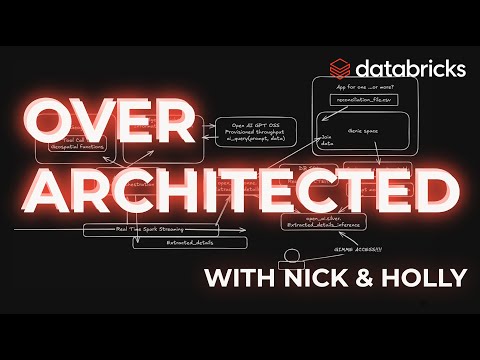
Over Architected with Nick & Holly: Databricks updates for October 2025
Summary
- OpenAI partnership: GPT-5 models are natively available on Databricks with no data egress and integration with AI agents and SQL.
- Real-time streaming: New capabilities enable scalable real-time data processing and analytics on the Databricks Data and AI platform.
- Governance enhancements: Unity Catalog access management improvements streamline data discovery and permission enforcement.
Over Architected with Nick & Holly: Databricks updates for October 2025
OpenAI https://www.databricks.com/company/newsroom/press-releases/databricks-and-openai-launch-groundbreaking-partnership-bring
Databricks platform release notes: https://docs.databricks.com/aws/en/release-notes/product
SQL release notes: https://docs.databricks.com/aws/en/sql/release-notes/2025
AI/BI release notes: https://docs.databricks.com/aws/en/ai-bi/release-notes/2025
Hated this podcast? Why not replace us with an RSS feed: https://docs.databricks.com/aws/en/release-notes/#databricks-release-notes-feed
Chapters:
Chapters
0:00Intro0:52OpenAI4:19Real Time Streaming10:53ALHF AI Research paper15:55Geometry and Geography data types19:09Genie25:16Recursion (also see chapter 7)26:59Assistant improvements29:46Unity Catalog access management31:31Rating
FAQs
What does the OpenAI partnership bring to Databricks?
This partnership makes GPT-5 models natively available on the Databricks Data and AI platform. Importantly, data stays within your Databricks workspace with no egress, and models integrate with AI agents and SQL queries for secure, governed generative AI capabilities.
How does real-time streaming benefit data analytics?
Real-time streaming capabilities enable organizations to process and analyze data as it arrives. This allows for live dashboards, real-time anomaly detection, and faster decision-making on streaming data.
What improvements were made to Unity Catalog?
Recent updates enhance access management, making it easier to discover data, manage permissions, and enforce governance policies. These improvements help organizations maintain data security and compliance at scale.
Why is native integration important for AI models?
Native integration means models run directly within your workspace, keeping data private and ensuring compliance. This eliminates data movement and enables seamless use of AI in queries and agents without external API calls.
Full transcript
0:00 Intro
But you could also send it to like Slack or to Teams uh or to a web hook. You could have it What are you doing? This is usually what most requests look like just for the record. >> Wow, that was a I think that's a first for us. I managed to draw it before you finish describing it. >> Okay, I'll take the hint. Fine. >> Hello. Hello. and welcome to Overarch Architected with and, where together we're experts in AI and data engineering, but separately, not so much. >> This is the podcast where we talk about new features in data bricks and then try to shoehorn them into a single architecture to see if it's actually realistic.
And here are our favorite features from the last 60 days, not 30, because I had the audacity to go on holiday. Uh, but we are going to start off with a big AI announcement. , do you want to tell us what it is, >> dude? Dicks X Open AI it's happening big partnership just landed I guess last week depending on when you watch this and um it's that the GPT5 model suite so GPT5 mini nano all available natively on data bricks >> so my GPT usage is now free >> excellent >> I mean this is huge um for everybody it's huge for everybody not just me >> yeah so I think We're also one of the first providers to or first partnerships to be able to provide models like this.
0:52 OpenAI
Is that my understanding? >> With that you get the governance aspect. So now no egress everything's in data bricks natively. Um it can be used in agent bricks. It can be used as part of AI query in your SQL queries. It's all built in. Um this is like really really exciting. And then I think there was one other element to it as well which was uh they have also announced as part of this that they are also a customer of data bricks as well.
Um >> oh really >> we're allowed to say that. >> Sorry I really took us on a detour. you know that. >> But you know here the point is and this is the big I I would argue this might be the best part of the announcement since we have this partnership one and two customers now everybody at OpenAI can use GPT5 through data bricks. >> I mean come on. >> I guess we should caveat this by saying um we don't actually know how open AAI uses data bricks.
Funnily enough, they don't share that information with and myself. So, um, frankly, anything we say is, uh, guessing. >> Wait. Okay. So, there's that partnership, but there is one more thing. This was because, uh, went on day. Um, we did miss a chance to speak also that the GPT OSS models are also available on data bricks. So, uh, both things are bundled into one. >> Pardon my ignorance. Like these are a bunch of models.
I don't think I understand the difference. Like I understand like a small model versus a less small model, but in terms of like the opensource aspect of it, I don't think open AI had an open source model. >> The differences are the GPT5 mini um and um nano are proprietary models and those are new as part of the partnership. The GPT OSS models um there was a bunch of different sizes like a 120B and I don't remember specifically uh the other ones. um those were as as far as I recall synthetically trained on or trained on synthetic data uh using a lot of the new reinforcement learning techniques.
So they are reasoning models. Um but they're they're obviously not as powerful as the proprietary models. >> Okay, awesome. All right, then. Um is it time for me to try and put this onto a diagram? >> Uh yeah, it's just like, you know, an LLM thing. It's just a box, I think, right now. Uh >> unless you want to go for like you want to go big >> llm done. Uh no like so has it got like provision throughput and stuff like that? >> Uh yes I think so. >> I think the open source one does >> the oss model for sure has has that.
Yes. >> Open AI GBT OSS. Let's pretend that we're going to use it with something like I don't know AI query. We'll see what we're going to query later but >> yeah sounds good. >> All right. Should I go to data engineering one? >> I want to I want to add something to this. Oh, >> real time mode in structure streaming is now available in public preview. No more micro batches anymore. Uh this is uh uh processing everything concurrently.
4:19 Real Time Streaming
So you don't have to necessarily wait for the micro batches uh to finish. And the way that they do this is actually they make the batches bigger. So you've got long running batches but ultimately um the need to have that complete has been removed and everything is processed now concurrently within those particular slots of your cluster. So there are some real advantages of this ultimately you are going to get like super like subsecond sub like millisecond level streaming.
You are going to get some >> nancond. >> Yeah like really really fast. This is going to like pass all your tasks within memory. uh and then instantly uh process those and write those out as well. Now, there are a few big changes compared to how if you're used to structured streaming into Spark um how this has changed. There are a few things that don't exist anymore. Um so your checkpoints and your metrics now exist per like long lived batch as well.
Um which means recovery cat time can be a little longer. Um you also don't have like batches or watermarks anymore. So things like for each batch doesn't exist anymore. Or if you're like doing drop duplicates with watermark, that doesn't exist anymore. Like those concepts don't exist. And that also impacts the output mode as well. So uh there's no um complete anymore unsurprisingly. Uh there's no append because that is dependent on watermarks.
Um it is update only. Uh which was a bit of a surprise for me. I thought like append would be easy but apparently I don't know what I'm talking about. Uh it is update only. There is also a bit of like dependency jeno in terms of like the sources that you're using um or some of the like if you're using like specific UDFs or if you're using some like uh particular syntax. So I do really recommend going and having a look at the documentation if you're thinking this is something that you want to use. the feature parity is not as the coverage is not as high compared to something like structure streaming but you've got that massive advantage that you are now able to process your data so quickly and you're not dependent on those batches or those microbatches completing anymore >> amazing amazing and so if I understood you correctly it is if if your if the API if how you're using streaming is within uh the supported uh features it's literally just a configuration change in your and you're set. >> There was now a real-time trigger.
Um, and that is available. There's also a suite of other things as well to help you with this. So, things like um there's like an obser uh observe API uh where you can get the latency measures for this. So, you'll get like the average, the maximum, P50, P99. Yeah. Um of how well things are processing. Uh and then also a bunch of other things have been updated to help with it as well. Well, so if you're using like um event time timers, they are supported.
Um if you are using like display, that also uh works with the real-time mode as well. And also things like rate, if you've ever used that for data generation, uh that is also supported with real-time streaming mode as well. That came out in 16. 4. Um it's part of the LTS um runtime. So that's super nice. If you want something to use today in production, it is ready to go. My key question before I put this on our diagram is does it support our custom state APIs like the new transform with state like can I use it in real time? >> Yeah, you can use transform with state.
Um there are um a couple of nuances with that. There is not a onetoone match in terms of the exact feature and there are a few little nuances. So yes, that's possible. Um but again check the docs if you've got a particular stream in mind uh to keep in mind. So, for example, like there's no stream stream join anymore because you don't have watermarking. Um, but you can do um a stream static join if you're doing a broadcast.
So, again, for the third time, please read the docs before you're like, "Hey, I'm going to delete all my code." >> Okay. Okay. Okay. I get it. Sorry. Sorry for making you keep going. >> I'm not leaving you. I'm giving everyone a >> read the docs. Okay. So, we have this endpoint. We don't really have like a business use case yet. So, we're still kind of in technical land, but I do think we need to say there's some kind of stream and we're applying our new model in real time to the stream.
I just think that makes sense. So, we have >> I guess uh this arrow. >> Okay, >> that's going to be our stream. And can I just uh do uh stream real time streaming? >> Real time spark streaming. How's that? >> Um um >> and we are going to do some inference uh using uh the endpoint. How's that? But what is it? What is the stream of data and what are we >> I know what we should do to really extend the olive branch to open AI.
I think what we should do is we should design some architecture for open AAI now that we are obviously BFFs uh and they're obviously going to be watching us to listen to what our ideas are um about how to use data bricks. So maybe um we uh make something for them and think about what are the stuff that they would like to have real time streamed in. >> That was a nice word salad. The use case is a use case. >> All right.
I don't see you coming up with any better ideas. >> We are doing inference. Um I have no idea. I'm really sorry. Did you want to add add anything to the just just real time streaming? Just >> No, I don't know. >> Okay, fine. Right. Legs feature. >> I mean, did you think that we should have something? >> I'm just saying I listed a whole bunch of features that it does and a whole bunch of interesting things. >> Uh, actually, you said it's a new feature.
It doesn't have full coverage of the existing features, aka boring. And and that it's just really fast. My go the feature is fast. >> Yeah, that is Yeah, that is pretty much it. It is fast. Yeah. Um, okay. This is why they don't let us do the press release notes. >> Oh dear. Back to the AI side of the house. Um, few features to talk about. They're not exactly new features, but we did release some interesting research uh for both of them, so I thought it was worth uh speaking about.
10:53 ALHF AI Research paper
So um the first one is the knowledge assistant and the second one is information extraction. It's called ALHF. So agent learning from human feedback and um it's built into our knowledge assistant little tile um for agent bricks that makes it really easy to create like a Q&A type bot knowledge assistant. Um and the idea there is that you can use natural language to improve it. Um and it's very very good and the research paper is really interesting goes into all the gory details.
So that's number one. Um and then number two, and this one uh just released, we announced and shared some results having to do with uh automatic prompt optimization. Um and kind of the summary is that you can use an uh open source model and you can use uh DSpy. Have you heard of DSpy yet? >> Yes. >> So it's a framework for automatic optimizing. Uh >> I I always thought it was pronounced DSPI. DS DSP. >> I've been saying it wrong this entire time. >> DBD.
I'm sure if we I don't know. Maybe Omar will send us a note be like, "You guys are stupid." >> Yeah, >> it's called It's called Neither. It's neither of those actually, dummies. >> Really, the big insight is that you can get a much smarter model to help optimize the prompt for a um kind of quote dumber model. So you could use like a proprietary sonnet to help optimize the prompt that you would pass to a GPTOSS. And by doing that you uh can not only uh get the quality of responses that are as good as the proprietary models, but you can do it at up to 90x cheaper.
Now 90x cheaper is a huge kind of uh statement. And so the real um the real place this happens is at scale, right? So, it's just simply because when you're doing inference and you're doing it, if you're doing it enough, that's where the savings really add up. So, like on a single, you know, prompt call, like it's not going to be that much different. But if you have a a use case where your agents are calling a lot, um, in that case, it would be extremely helpful and the savings are tremendous while maintaining the quality that you would receive in the much more expensive uh, proprietary uh, models. >> Ask a really dumb question. >> There's no such thing as a dumb question. you haven't heard it yet.
Uh >> how is this different from distillation? >> Well, in abstract I suppose it's uh similar but in particular distillation is a technique for um taking taking the existing kind of one very very smart model taking its outputs and then fine-tuning or training a a quote stupider model um on that. So it's just really kind of taking it's it's that natural training step. >> Whereas this is all about prompt optimization. So it's so you don't have to retrain the model.
This is like taking an off-the-shelf model and making it so much better simply by updating the prompts. >> So if I've got my diagram here and I've got AI query within that I have like my prompt and then I have my uh my my column my data that I'm putting in in there. And so what this is going to do, so this has to be part of agent bricks. So do I need to make an agent bricks box? >> I think if you if you want to include agent bricks in here, then I think what we should do is say like uh that the inference from the real-time spark streaming is no longer going to uh directly to this endpoint.
What it's going to is an agent bricks endpoint and that agent bricks endpoint is supported by let's say uh GPToss. >> You are now agent uh bricks and it was information extraction, right? >> Yeah, let's do information extraction. I think that's kind of that's a that's a really nice one. >> Okay. So, it's information. >> I think we we now we now actually have a real use case. >> And so, we can use this in here like this.
Is this how >> pretty much? Yeah. I mean, you can put it inside or you can put it kind of outside because agent bricks will like uh technically the endpoint for the oss model will still exist outside of that as like a logical entity. So, it'll call it at some point, but doesn't really matter. >> Oh, so is it more like uh like this and then like this? Mhm. >> Yeah, >> exactly. Um, yeah. So, maybe our stream is like a real-time stream of PDFs or, you know, whatever.
Something something that needs information extracted out of. I'll note that like I don't know if OpenAI needs to do this. So, I don't know if we're still doing it. Is this Are we still trying to do this for Open? >> I think this is a beautiful gift. It's really It's really helping. It's going to solidify our partnership. >> Hey, don't use don't use your internal proprietary models. Instead, use agent bricks with your open source ball. >> You know, I bet no one has had this idea at OpenAI.
Like, we are truly innovators and unique thinkers. , I'm looking forward to seeing how you're going to shoehorn the next one in. Uh because the next thing we've got in data engineering, um is spatial geometry and geography data types. Uh if you're not familiar with the difference between the two of them, so they are data types. Um, a geometry is like an XY Z coordinate. Whereas a geography is like a latitude and longitude.
15:55 Geometry and Geography data types
So don't necessarily think about like an integer or a string. Think more about like a variant where you can get like really complex things within a data type. And now you can get all of this kind of geography information um within that data type. And to go with it to manipulate that data, we've got about 80 brand new functions that are there to help you with this. And you might be saying like, "Hey, what's the point of all of this?"
Um, you're now able to run this kind of natively on a data bricks. Um, in terms of speed, it's like 20 times faster than maybe it would have been previously. So hopefully you should be able to see some real performance improvements. But in terms of the types of things that you can do, uh you can create shapes, you can create points, you can make lines, you can say whether a shape is valid or not. You can add shapes together, you can say what what is the distance, what is the area, but you can also then say things like does this point um is this point like within this particular shape that I've made or does this line intersect this particular shape um that I might have?
And like I said, there's like 80 different functions because there's loads of um you know, nice features like try catch uh to see if actually going to work or not, like dealing with invalid shapes. Uh and then also the source that you can use as well. You've got like gojson text and then some things that I did not hear about until today, which is WKB and WKT. >> Nice. Yeah, you're right about challenging to uh shoehorn this in.
Um, >> could the information that we extract be geography in like uh information? >> I will make a new box and this will be our uh agent bricks model orchestration. So, uh since we haven't talked about that specifically on this episode, uh agent bricks model orchestration allows you essentially to connect a bunch of different agents together. Um so we'll so we'll have um the agent bricks information uh extraction which will work with this.
We're going to create a custom agent another one here. This one will have a tool call to geospatial functions and this will be what do we call this agent our geo a geogent Watch out. >> This is the minds that OpenAI didn't hire. >> Well, this is like kind of like the universal use case, right? We could just keep extending it just a nation. Um Oh my god, it's ATI. Um >> yeah, let's call it that. Okay, we're going to go we're going to go deeper and deeper now into how to Wait, are you happy with this? >> No, never.
Let's go. some new features um in the AI BI genie space. So, Genie has some uh improvements to uh the file upload interface. Uh so, now the file uploads that you make to Genie are scoop scoped just to the Genie space. There's improvements to some of the join relationships. So, you can get more expressive with the SQL expressions within the Genie workspace. Um which is very nice. Um and then the this is kind of genie and data bricks apps adjacent.
19:09 Genie
So the data bicks app now supports a genie space as a resource. So um it'll do the permission linking automatically. So when you deploy an app it will have like the service principle will already be configured to have access to the genie space. So what that really means is the genie space has an API and now you can call that API in a governed secure fashion from the app. So if your app needs to access intelligence that's in a genie space that's on some tables and you need a catalog um that's easy peasy. >> Okay.
So I think I know how I'm going to put this in. So I think >> we need to have like a reconciliation step in here where we're going to upload a file uh and then we're going to do a bunch of stuff uh and then we're going to use AIBI to figure out whether it's reconciled properly. But we're not the experts so we'll put it in an app uh so they can get access to it. How does that sound? I have no idea what you mean. So I like that's It doesn't sound dumb.
It doesn't sound smart either. >> Uh right. So I reckon I've got a reconciliation uh file uh CSV. Um and that we're going to upload manually uh because I think you said file upload had been improved, right? >> Yes. It's scoped to the genie space. >> Yeah. So, we're going to have that for like a G-Space and we are also going to surface this uh within an app. Uh I'm going to put an app here so everyone can ask their questions about whether their reconciliation has worked or not.
Uh and in terms of what we're going to have in this genie space, oh, we have we have the output from like AI query, don't we? It's included. It is one of the features and one of the ways that you can use the OSS model, but I don't think it was actually part of our use case. >> Could be now. Um, all right. >> It is >> extracted uh details. Does that like come out of here or does that come out of the orchestration? I'm confused. >> Well, the extracted details are returned ultimately to the caller which would be the real time Spark streaming. >> Oh, so it goes back in there.
Yeah, like imagine you have rows that are coming in and each row is like, you know, the binary of a PDF or something like that and it makes like a a UDF type call and that UDF type call calls agent bricks model orchestration endpoint. Um, and then the return value is going to be your extracted details. >> Okay, cool. So, that's going to go into my stream. Oops. Oh, okay. Wait, I see. Uh then uh this table this is going to be a delta table anyway.
Uh so I can take this uh stream and I can point it at a genie space. >> I don't know about that. >> You could write the stream to a table in Unity catalog and then have gen. So yeah, we didn't really create like a where does the stream go scenario. We just kind of >> sorry I just assume >> go do all this work. Don't store it anywhere. Don't send it anywhere. Just do the work. >> Just do the work. spin up a cluster. >> Mhm. >> Use as many as many nodes as possible >> and then delete it >> details.
Uh right. So what we're going to have a catalog open AI uh as the catalog name. Uh and then we're going to have um real time uh this would be bronze data, wouldn't it? Bronze dot uh extracted details. And now we can put that into our green space. How about that? >> Yes. Perfect. Great. >> That actually in theory works. No, no comments about the actual use case, but it technically works. >> Uh, we can also join these as well, can't we?
Now, we can, we've got fancy joins that we can do. Um, joined data. Uh, which I did notice actually because previously I had to like prompt it and ask it really super duper nicely to um union all of my data sets that I wanted uh for and now you can just specify and be like, hey, this is exactly how I want you to join my data. You don't have to prompt it anymore, which is nice. And I should clarify that the CSV file that you have this file upload thing I think the key thing is that I kept saying it was scoped to the Genie space >> but it's uh the file will only be visible to the user who uploaded it which is very key. >> Oh completely ruined my uh >> just keep okay it's a oneperson >> the architecture works.
Ah, it's like app for one. That's what we've got here. >> App for one. >> Well, see, no, the thing is, okay, so I haven't tried it. So, um, the release notes mentioned that it's the only the person who uploaded the file can access it. I'm not entirely sure that means that, uh, anybody who has permissions to the Genie space can't get uh, something from that comes from that file. It seems to imply simply that the data itself like the actual file whatever the CSV file cannot be accessed in raw but if you query Genie then perhaps it's still included otherwise that wouldn't make any sense right like it wouldn't make sense if it was scoped only to the single user >> what if our app allows us to like upload the CSV file and then be part of the genie space I don't think this is possible actually >> we are now in purely the territory of like making things up so Okay, then we can put a pin in this and come back and see if it's actually feasible. >> All right, it's my turn to suffer. >> Okay.
Uh I really don't know how you're going to do this. Uh and that is recursive CTE uh which are now available uh in data brick SQL. You can now do with recursive and then name your table and then say as um you've got sensible things in there like a max recursion level as well so it doesn't go completely uh wild. But you can also do like nested and like triangular recursions as well which is quite nice. So it's not just like limited to one level of recursion.
25:16 Recursion (also see chapter 7)
You can have like multiple levels of recursion if you really fancy doing that. >> Oh dear. You couldn't have chosen a different feature, huh? I just had to do that one. Uh there was no there's really nothing else that you could have talked about. Uh okay. I have no idea where to put this. I think our one key area where this even technically could potentially work is um the bronze table, the extracted details table. >> So, you know, we have DBSQL.
Um and obviously DBSQL is where you're going to be doing uh kind of your analyst type work. So we have our new new CTE uh recursive. I guess we can just you know if you need it to in theory uh work with this table I it's the only place where it literally technically won't error everywhere else. Everywhere else I can't even see how it makes sense. Are recursive CTE available in Genie Space SQL? Doubt it. Uh, actually you'd have to prompt really hard to make it do that, but you could have it as maybe like as an example query. >> All right, so last thing for me, uh, improvements to the assistant in the notebook experience.
Um, few months ago when we were originally going to make this episode, it would have been the new edit feature and um, the edit feature in the data bricks assistant could edit across several notebook cells. So the the like notebook experience with the assistant is really turning into its own little IDE. It's really fantastic. Um it's like I'm no longer having two windows open and you know doing something copy pasting trying it with HTP or whatever and then like pasting it back.
26:59 Assistant improvements
Um but since then in addition to this edit mode is the new agent mode and the first agent is the data science agent. Um, so it's an agent that's available into the assistant uh interface right next to your notebook and it's capable of creating kind of multi-stage um data science workflows. If you've heard of the Titanic data set and the flows like that, things like that are now possible with this data science agent that can break everything into steps, do all the prep work for you, run all the calls uh into multiple different cells in the notebook.
It's really uh I think it's a it's a great start and um in the future um the model will literally just do everything for you. >> Wait, so hang on a minute. So I'm like, "Hey, I have this data set. Can you build uh can you do some feature engineering and then do a linear regression? Will it do that?" >> I think so. Yeah. >> Huh. >> How crazy is that? >> That is crazy. Has that just made AutoML completely obsolete? >> I doubt it.
No, not quite. My presumption would be that it uh it can leverage AutoML because like AutoML is um right to make a uh like an ensemble of a bunch of different models and like you know try them all try them all out you know average the best results and things like that. So, um, not quite the same thing, but yeah. Um, the point is it's very useful to bootstrap your workflow, right? So, if you're just coming into some data set, you're just trying to work with something, throw it in there, let the agent try, >> um, and go from there. >> I know exactly what I'm going to do.
I think I am going to take all of the responses from our genie space and predict what's not going to reconcile. So, a genie space system table and that's got the results in here. I'm going to build a model. Uh, and then what are we going to do with that model? I don't really know. Uh, maybe we then use uh the model from that to then feed back into here. I don't know. Yeah, I'm going to make a silver table uh which includes this feedback.
So, uh we got more inference. Excellent. But classic inference. There we go. And now idiots like me can build models all over the place. What's not to like? >> That's just what we need. >> Look what we've unleashed onto the world. Okay. Uh final feature for today. Unity catalog now has the ability to have a bit of a workflow in it. And if you don't have access to something, you can now request through data bricks. You can press a button, you can send a little message, and then it goes to the owner to say whether you can get access to the thing or not.
29:46 Unity Catalog access management
So, previously, I don't know about you, but at data bricks, if I wanted to find the owner of someone of something, uh hopefully I'd have access to it so that you can at least see the metadata of who owns the thing. But if you can't even see that, it is impossible to find the owner and you just kind of have to hope for the best. Now, anyone um can send these messages um but you can not only request access for yourself, but you can also do it on behalf of another user, for a group or a service principle. and oh look your little person drawing.
How sweet. But you can send it not just to an email, but you could also send it to like Slack or to Teams uh or to a web hook. So if you've got something like Service Now, you could have it What are you doing? This is usually what most requests look like. Just for the Wow, that was a I think that's a first for us. I managed to draw it before you finished describing it. >> Okay, I'll take the hint. Fine. >> But that's I mean that's an awesome feature.
I actually uh it's funny. I noticed that and when I noticed it in the workspace uh I was confused. I was like did this always exist? I feel like this should have always existed and I just started noticing it. So glad to hear it's a new feature. >> Cool. All right. So I think that's us for features this month. Okay. >> Out of 10, how would you rate our architecture this month,? >> Two. >> What do you not like about it? >> It doesn't have a coherent like use case.
31:31 Rating
Like there's like a there's no real use case. We haven't identified that. And it technically also I think like doesn't really make any sense. >> Okay. >> And um yeah, it's pretty awful. I'm just like giving room for us to be even worse in the future. So that's why it's a two and not a one. >> But I mean in terms of like a technical perspect I know we have no use case for this whatsoever and no sane person would build it.
But if we did build it would it work? >> Like I mean each box is like an input and an output you know and a return. So like yeah will it not crash? Yeah. But like it's you know it's literally meaningless. >> Okay. Yeah. I'm also not sure how well this Asian bricks integration with like real time streaming how well that would work either. So I am a little bit about that too. >> It's it's it's funny because it would be sufficiently slow that the real time aspect this like would not really be that very useful.
Like oh my god >> you're we can process your data extremely fast except if your step takes a long time. >> Okay. And I think for that reason um because one of the things with real-time streaming is like yeah it is more compute heavy because you constantly need to have like the slots always available um and because of that I think we have just made this so much worse. I think I'm going to give this um a one for being >> a one.
There's like nowhere to go from there. It's that bad, huh? Okay. >> Yeah. I think this is pretty terrible. >> I'll take it. That's fine. >> All right then. That's it for this month. Let us know if you agree. 1 out of 10, 2 out of 10, zero out of 10. Don't be scared to tell us the truth. >> With that in mind, hopefully there's been some features that have piqu your interest. I'm going to put all of the documentation links in the notes below.
So, if you want to have access and go and look at this in more detail because you want to use this seriously, then please do. Thank you so much for watching and we'll see you next month.
Learn more about the Databricks Data and AI platform.
The information provided herein is for general informational purposes only and may not reflect the most current product capabilities or configurations.