Over Architected with Nick & Holly: Databricks updates for June 2025
Summary
- New releases covered: This podcast reviews latest Databricks features—Lakebase, Lakebridge, MLflow 3, and updates from Data + AI Summit June 2025.
- Lakebase launch: Managed PostgreSQL for Databricks enables OLTP workloads on the platform with storage-compute separation and cloning capabilities.
- Architecture thinking: Nick and Holly architect modern data systems by combining new Databricks tools—declarative pipelines, Iceberg, Genie, and more.
Over Architected with Nick & Holly: Databricks updates for June 2025
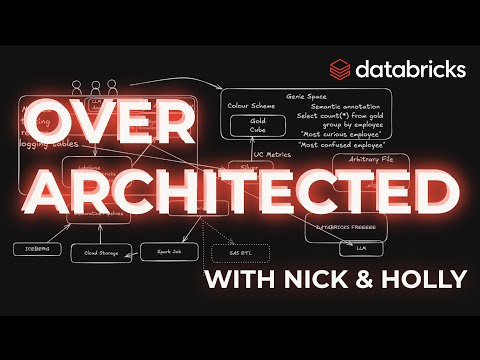
These are the latest big features from Databricks from the last 30 days straight from Data + AI Summit in San Francisco ...recorded with the worst audio setup we've ever had.
Databricks Free: https://www.databricks.com/learn/free-edition
Lakebase: https://www.databricks.com/product/lakebase
Lakebridge: https://databrickslabs.github.io/lakebridge/
All release notes: https://docs.databricks.com/aws/en/release-notes/product
Chapters
0:00Introduction to podcast0:56Lakebase announcement3:53Building the architecture5:38AI advancements and MCP8:35Future data app potential10:00Declarative pipelines12:04Iceberg developments13:18Data migration with Lakebridge16:45MLflow 3 features19:04Tracing and modeling22:12Migration technicalities23:38Unity Catalog updates27:31Genie AI improvements30:26Dashboard interactivity32:21Finalizing the architecture35:01Databricks free edition36:27Free edition use cases38:01AI Gateway GA38:59Conclusion
FAQs
What is Lakebase and why does it matter?
Lakebase is managed PostgreSQL on Databricks for OLTP (online transaction processing) workloads. It separates storage and compute, supports database cloning for testing, and integrates with lakehouse ETL and reverse-ETL workflows.
When should you use Lakebase versus a lakehouse?
Use Lakebase for operational systems requiring fast point queries and row updates (apps, model serving). Use a lakehouse for analytics, batch processing, and large-scale data transformations.
What is Lakebridge and how does it help migration?
Lakebridge simplifies data migration into Databricks by handling schema mapping, data type conversion, and incremental syncing—reducing migration complexity and time.
Who are Nick and Holly and what does this podcast cover?
Nick and Holly are Databricks experts in data engineering and AI who review new features released in the past 30 days. They architect systems combining features to solve real problems.
Full transcript
0:00 Introduction to podcast
So, what if I use my OLTP for feature names of data bricks because they update all the time and so we're app built on lakebakes with our knowledge assistant to help us understand what the new names of all of these features are. I'm sure we're going to get some real correspondence about this from the conver Oh yeah, we're we're in trouble. Hello. Hello and welcome to Overarch Architected. with me is Together we are experts in AI and data engineering but separately not so much.
Uh this is the podcast where we take our favorite features that have been released in the last 30 days and try to shoehorn them into a single architecture to see if it works. And we've had a very busy past 30 days because and I spent a lot of time uh in San Francisco this year at data and AI summit where we released so many things add so many so many features and we're excited about it. Aren't we? Really excited about it.
I'm stoked. So first up we have lakebase which is managed postgress for data bricks and there's two things that make this quite special. So one it is separated storage and compute uh which is very on brand for data bricks and the second thing that's really good about it is the ability to uh to clone your database to be able to make a child instance. So if you need to do some testing, some development testing um but then you don't want to mess around with your production instance then you can absolutely do that.
0:56 Lakebase announcement
I should probably say kind of how Postgress is different to a lakehouse. So Postgress is OLTP that's online transaction processing. So think of that as kind of like the back end to an operational system that you might have where you want to have like a point query in terms of where you'd want to use um Postgress or lakebase that is something that you want to use for things like apps. Um if you're doing things like model serving that is where you'd be using it.
Now I'm going to be honest um you know is now the time to rip out your production ERP at scale and use lakebase? No. This is probably something more if you're serving kind of analytical data somewhere and you want it to be snappier in terms of the responses that people are using. That is a great use case for lakebase. One of the things that makes it great about having it within data bricks now is also being able to have unity catalog integration but also being able to do like ETL and reverse ETL with your lakehouse as well.
So if you've got some tables in your lakehouse, you want them always synced to be in uh lakebase in Postgress, you can do that. And the reverse is true as well. That's awesome. Wait, so you're saying that Wait, those last two pieces, the sync. Yes. Is that built? That's built in. Yes. So that's built in. Okay. Sometimes you hear this called like reverse ETL as well. So sometimes the ETL is kind of taking it from your operational stuff, putting it in the lakehouse and then pushing it back into it once you've done your ETL or built your model or whatever it is.
Um you can instantly sync it there. All right. No, this is awesome. I mean you did say it's not time to rip out your ERP, but you should if you are you know uh brave uh give it a try, right? I mean why not um figure it out. Well, I'll stop you there. Although it's yeah it's not qu So it's a very early days in terms of the product. So I wouldn't necessarily um you know does it scale? Yes. Should you put your online business um you know and use this as the back end?
Probably not. Just face don't get me wrong for now. Okay. Awesome. So it sounds like if you have like a like something new something new a new use case that's small um it's a good good time to try to test it out. see how see how you like it. Basically, that's what I'm hearing. Yeah. And if you're using Postgress for something else anyway, it's kind of like a step to another analytics thing. So, if your pipelines at the moment are like bronze, silver, gold, and then you take that gold data and then you push it out to Postgress, now is the time to try something that's a bit more managed.
3:53 Building the architecture
Okay. Awesome. Awesome. All right. Let's put this in a diagram. You did say that um a good use case obviously is apps. So I think I mean I mean data bricks is now uh basically a mini full stack solution. We have apps we have an underlying data store this like neon thing base postgress and we have the lakehouse so you could conceivably see a future where you can do everything on data bricks. I love that. Um, all right.
Let's draw myself a full stack engineer despite the fact that I only know data bricks. Now that data bricks is full stack. You can say that. So, all right. Let me let me let me put it down. Let's do it. Lake base. Lake base. Uh, it's a shame Excalibur doesn't have these like built-in uh nice icons so that we could do, you know, like the little database icon, but that's okay. I'm going to put lake base down. And I'm actually just going to add apps since you did see that.
And so is it data bricks apps? What are we calling these things again? Apps. Yeah, apps. Data bricks apps. Yeah. Okay. So I have an app. I don't know what the app does, but the app absolutely needs the database. So this will be the start of our architecture. Are we reading from lickbase? Are we writing to or we got we got this is like birectional? It's uh it's birectional. Uh and um I mean it writes and it reads, right?
Okay, I like that. Let's do that. Hold on. Let me since you were keen on identifying whether this was birectional. Boom. Cool. So that's a big one in data engineering. Do you want to tell me about something in AI that was announced last month? Few things. So first one is the um MCP support that we have now in beta in data bricks. That's the first thing. And then the second piece is going to be the agent bricks a new agent bricks tile uh knowledge assistant right we're saying what MCP is yes of course so MCP stands for model context protocol so um LMS all the modern LLM support something called tool calling the model has knowledge of tools that you give it so you say hey model I have you know tool A b and c which are specific and I tell the model hey you have these functions you can run them if you feel that you need to so then when I um issue some kind of query, it calls that function, it returns a response and it works with it.
5:38 AI advancements and MCP
So that's tool calling in an LLM. The issue or problem that comes up with this new feature and this new ability is that everybody's basically writing their own tools. Lots of overlap, no standardization, no way to share those tools. They all live like they live in my context, yours live in your context. Um and so the model context protocol um it's essentially a standard um protocol and it was designed in order to uh make it much more easy to share these tools.
So the protocol allows you to stand up a server define the tools in that server and then you can uh tell your LM hey here's the MCP server that I have all the tools that are in there are available and now data bricks specifically also has support for MCP model context protocol and uh kind of two pieces. The first is that datab bricks has uh exposed built-in MCP servers. Um, and I believe those are for vector search for genie and one more that I forget.
Sorry, another one. Oh, I'll just edit this and I'll just right now. Yeah, perfect. Uh, and then it also supports custom MCP servers through apps. So, um, you can essentially write your own server and deploy it as a data bricks app and then expose that. Can I Can I just like Can this app be an MCP app? Does that work? Wow. Yeah. Is that really lazy? Uh, no. No, it's not lazy. Smart. You know, those are those can be those can be highly related.
Okay, the next one is uh agent bricks. So, agent bricks um I forget the previous name now for it. We apologize. There's a lot of renaming going on. The new tile is for knowledge assistant. So you essentially give it a corpus of data. All you have to do is bring your data. So let's say I export the data bricks documentation and I give all those files to this special tile called knowledge assistant. Um and then it will automatically generate a knowledge assistant chatbot for me um or agent I should say but could be used through chat or whatever interface that you'd like.
Um to really simplify it, it's like if you had to build your own rag solution for some knowledge assistant type of thing. Um, now you can just do it in a in a few clicks basically. So what if I use my OOLTP uh for feature names of data bricks because they update all the time and we need it real time and so we have an app built on lakebase with our knowledge assistant to help us understand what the new names of all of these features are.
8:35 Future data app potential
I mean I like it. Obviously that's a good one. Uh I wonder if that's already um a feature. Okay. If it if it's well no because you you you should be able to point it at uh you know an underlying context that can that can be queried and is dynamic and changing. So obviously an OLTP database makes a lot of sense or a vector search or you know what have you. It could be anything. So I would say keep the keep the arrow. Keep the arrow.
Either it's a supported feature that I'm just not aware of or it should be a supported feature. So, let's shove it in there. Cool. Okay, then. So, uh new uh new data bricks feature next. Cool. I'm sure we're going to get some real correspondence about this from the cover. Oh, yeah. We're we're in trouble. I know. This right. Cool. Okay. I think we're we're officially power users of Excaladra. We are. Maybe we should go work in Devra for them.
Cool. Speaking of things that have changed name, um let's talk about Delta live tables and declarative pipelines. So, one of the big announcements for um last week was well, Spark 4. 0 O technically came out the week before but one of the big contributions to open source this time around has been declarative pipelines which is ultimately Delta live tables for open source. Now if you are not familiar with delta live tables and you've been nodding along to the acronym this entire time think of this as an abstraction layer above your spark code that you've been writing.
10:00 Declarative pipelines
So up until now you have to say kind of in fairly granular detail like this is what I want it to do. this is how I want you to stick it together. This is how the retries to work. Uh with Delta live tables, there is significantly less that you need to do to be able to build a pipeline. So there's, you know, single syntax for using combining batch and streaming, which is quite nice. So if you have been using the paid version of data bricks, um but you're like, well, I don't really want to get, you know, vendor lock in because I'm using delta live tables.
Well, now you won't be because Delta live tableables now declarative pipelines are open source. I mean, this is really exciting because I was, I admit it, I was a longtime critic of DT. Um um it's changed a lot and matured a lot in the last year, more than a year. Um and seeing it hit open source is is just fantastic. I know we use it a lot to build our demos for Summit. Um, and that was like my that was my opportunity to really experience the kind of the state-of-the-art version of it because I hadn't used it in some time.
Um, yeah, and I'm I I was really impressed by it. It did make developing things a lot easier. And I just love I admit it. I just love the graph. Like I love the graphic. I love looking at it. I love seeing how many rows were updated in each execution. Uh, I'm simple. I'm a sucker for those things. So, um, oh, sorry. I do have a few more other things in open source that have come out that I would also like to warn in at this point as well.
Uh so we've got some iceberg announcements as well. So we've got managed iceberg um is available in unity catalog um now uh for read and write uh which is exciting. There are managed versions of iceberg as well. So in terms of the things that is managing is things like um snapshot exploration and compaction. Uh you can also use a things like delta sharing confusingly but with iceberg tables now which is not the outcome I expected but I am happy that it exists.
12:04 Iceberg developments
Um and if you don't have manage tables maybe you want to be able to read something that's in a a foreign catalog. Um you've got read iceberg tables from a foreign catalog. Yeah. Also, if you're using something like Hive Meta Store, Glue, if you've got Snowflake Horizon or like the um IRC for uh Unity Catalog, um you can use that with uh catalog federation as well. Okay, awesome. I was wondering when you were mentioning this one.
Okay, cool. I mean, hey, I have a long-term relationship with relationship in quotes with the with the Delta iceberg battle. So, uh, I'm I'm just looking forward to a world where I don't have to say either of those words. Um, so that's the that's the future for me. Okay. So, I got to shove all this onto this diagram. You did so I actually have a question before I do. You did mention something about DT's relationship to uh, lake base and the ETL reverse ETL situation.
13:18 Data migration with Lakebridge
So is it uh feasible for me to do something like I'm going to just write my declarative pipeline and that this is somehow related to lake base is that can I can I feed my lake base with this reverse ETL the other way around. Uh so in terms of extracting from lake base uh that doesn't use delta live declarative pipelines underneath. Wait say that again. Sorry I did not understand what you just said. Uh so the sink is um birectional but only only one direction I think uses um the casual pipelines underneath and that is the extraction from lake base.
Okay. So if you have, let's say you employ a good few thousand people who are confused by all of these names, you don't want thousands of people querying your um lake base uh to do all the analytics on it and try and kind of understand it in aggregate. What you'd want is to be able to extract all of that data and then put that into um a delta table so that people can do their analytics on it. Okay, so I'm going to do this.
I'm going to say that this feeds into declarative pipelines. Um the end the end result though of this pipeline is some table and however that table gets synced to um lakebase. Uh like this should uh be possible otherwise I don't really understand. Why do you always throw your arrows the wrong way round? Like no no hold on I'm going to explain this. This makes total sense and it works with the use case that you said agent bricks right knowledge assistant right it needs it needs new knowledge right it draws that knowledge from lakebase lakebase draws that knowledge from the declarative pipeline the declarative pipeline draws it from random files on cloud storage which could be additional new documentation okay uh so do I have to add in all of our users here as uh oh I didn't say anything about users hold We've got like a thousand users thousands of users speaking using agents and uh well they wouldn't use the MCP app right the MCP app is a server so it doesn't have they would be using some they would be using an LLM just just you know gloss over that detail write LLM somewhere that is a very good drawing that was sweet I'm telling you we should quit and go work It's kind of cool.
You should have kept this thing and wrote LLM. Okay. Whatever. All right. Okay. Bricks at all. H. Okay. There you go. Um, okay. Well, I mean, our source in another source table in the declarative pipeline could also be an iceberg table. Um, so let's just do that. There we go. Yeah. So, you could read that in uh and then you could set up a it's declarative pipeline and then have that go into to like basic. Okay. My turn.
What do we have next? MLflow 3. Yes. More open source. More open source stuff. So, taking a little step back, um previous MLflow had to deal with the fastmoving LLM geni space. So MLflow, it comes from an era where that stuff more or less didn't exist. So as you're iterating on a model and getting results and trying to improve it um kind of in the classical ML space, not exactly the same concepts worked for the workflows that were being developed around language models and gen models in general.
16:45 MLflow 3 features
So MLflow 3 reintroduced kind of um a new architecture or a new organization. So everything is neatly organized into um models. Those models have traces that are uh associated with them. Um they can be part of experiments. Um and everything's really organized much neater, much better. Um we also use that for our demos at uh data and AI summit and it was fantastic. Um I do want to point out that not on the open source side cuz it's not really relevant on the open source side but within data bricks the previous versions of MLflow and tracing and all this were quite slow.
So there was a big lag. So the new MLflow release um as part of that at least on the data bricks side um it's wicked fast. So as soon as you deploy a model um those traces are available basically in real time. As part of it of course there is the new uh review app. So you can so as soon as soon as you have traces available you can um deploy a review application and share it with your other other users in your workspace and the review application reveals the trace and a bunch of expectations and things like this that you can define like hey was this answer good?
Was the agent uh reaching out to the right sources? Were the tool calls correct? Score this one out of five or something like this. Um and then all that built in the results of the what they're called assessments. So those assessments get logged as part of the trace as well. Um so you can use that all together to improve the model. So um I really love the new fe the new uh release of MLflow 3. I'm very excited for me really it was like the speed uh aspect uh cuz I used I used to be I used to sit around and wait for these traces to come in and that was really frustrating.
Um so having it uh all work in real time very nicely organized uh in the new ML flow 3 has been awesome. So awesome. Okay. Hello. In terms of adding this to our diagram, so this would sit around quite a few things that we've got in here. So we've got an LLM and is this Oh, I see. We've got an LLM, but we don't have an app to serve the LLM. Is that what we need? And then we could put ML flow around the LLM. Yeah, sure.
19:04 Tracing and modeling
Yeah. Okay. Hang on. What if I I mean in some sense actually you could I mean I I'm I don't mean to be a glib but you actually could wrap this whole thing in a rectangle and say MLflow because if you are tracing a pipeline um right like you could conceivably trace all this with MLflow. Yeah. Right. Oh hang on. Oh that's bad. Uh background none. Okay. So um I think I want to point out the bits of ML flow that going to be used for what though.
So uh your ML flow uh I never remember whether that L that F is capitalized. Okay. So we've got ML flow and then but we also have um so tracing tracing covers quite a lot of it though doesn't it? Yes. Wait. Oh, tracing covers all of it. So, that goes in there. Um, and then there's also, so tracing does kind of like the multi-step uh auditing of what's happening where. Um, it also does the uh like the response times and things like that as well.
Um, that's all very much on the like the serving side of it. What are the other newer areas that have come in? Uh, well, the review application that I mentioned. Oh, the review. Okay. Tracing isn't a a new feature. Yeah. But it's uh but it's it is reorganized to be more neatly um together with models. So, okay. So, the review the review step would go for the last step, right? Yeah. I mean, I I personally if I was drawing it, I would just write like all the features that are available.
I don't think we have to worry too much about uh kind of where they are in the diagram because the truth is this is another aspect of it. Um like for instance you could wrap that LLM just that one LLM thing that you have right there that could be an MLflow model on its own right. Uh the MCP server could also have tracing agent bricks could is also actually probably its own MLflow model um with its own tracing capabilities.
So it's just kind of to say that you could use this suite of MLflow features um on all of these things that are within this box. That makes sense. So yeah, you'll go crazy if you start doing this. Okay, there we go. You can be my ML flow model. Yeah, that works. That works. I'm positive that the agent brakes knowledge assistant is already uh out of the box uh traced with MLflow. Oh, okay. So we don't need to add this in.
Could we No, no. I mean, it applies to all of it. Yeah, sure. All right. Okay. Fine, fine, fine, fine. Cool. All right. So, I have another data engineering one. And how you're going to fit this in, I've got absolutely no idea, but it does have a new name, and that is LakeBridge. So, you might have heard a while ago that data bricks acquired a company called Blade, and they focus on migration. So if you had a um a bunch of code that was in a other system in a legacy system and you wanted to move it across, Blade does um assessments of your code.
22:12 Migration technicalities
So it analyzes the code to see um how hard the conversion is going to be. It will do the conversion for you in a vast majority of scenarios. Um and then it also does the validation as well. That has now been uh integrated with data bricks. It is available on our GitHub for us for you to go and have a look. Um, in terms of migration, let's be honest, no one really loves doing a migration. No one likes spending more time than is needed.
Um, Lakebridge will help you speed up your conversions by or your migrations by about twice the speed as maybe they were before in terms of the automation. They've got around 80% in terms of the coverage level of the things it'll be able to automate. Um, and we've also got 40 partners that are trained as well. So, if you are working with I'm not going to list all 40 um lots of the major providers of um staffing that will help you with migrations.
Uh they probably have people trained in how to use this. Um I do have a list of supported dialects in front of me. It is quite large. Uh do you want me to go through it or should I save this for another time? So, the word migration, I mean in the old world that I'm used to, right? You have a spark job. That spark job is running somewhere else and migrating it is pretty straightforward at least in in thinking about it, right?
23:38 Unity Catalog updates
You have the spark code, you have some data, you want to deploy that spark code elsewhere on a different cluster within data bricks. That part I understand. So like is that like take me from the old way like what I just described into migration in the new world like what does it mean to migrate? Sure. So you mentioned smart code that was written elsewhere. Uh, what if it was written in SAS? Uh, do you know SAS? No. There we go.
We've established that I don't know SAS or SAP. Okay. Uh, well, SAP is also on this list as well. We've also got like different uh flavors of things as well. So, if you are using Oh, god. Do you remember scoop from the old days? SQL for Hadoop. Yeah, I don't want to talk about that. Like if you were migrating from that like Yeah. It's kind of SQL and data bricks and spark does SQL stuff but it's not one to one. Um and you want to be careful about that.
You can't just copy and paste the code over. So it will do the conversion of the language for you as well. Yeah. Okay. I do have an idea then. In that case let's do this. We will take and write lake bridge on this square. Lake bridge. Laker bridge. Lake bridge. Okay. And I'm going to put it right here. And then I'm going to draw a dashed line here. And then I'm going to make a spark job here. Spark job somewhere. It was running somewhere else.
And this is going to copy over here. And I will change this to a consistent thingy. And then we will uh say that Lake Bridge took this and moved it here. And that this spark job right to the cloud storage. How's that? Wow. Well, they should have got you to do the marketing deck for this. Wow. I feel like you're being sarcastic, but I am quite proud of this. All right, there we go. Yeah, good enough. Um, and also in a very circular way, Lake Bridge can also go into our cloud storage of names that have changed or into lake base of names that have changed because it went from Lake Bridge to Lake Bridge.
So, we will also find it within our data as well. We should rename the company Lakear. Back in my domain, two things. First, Unity catalog metric views. I'm going to put it in the convenience bucket. It's not something that you couldn't have done uh kind of without this feature. So let's say you need to define some metrics uh for your for whatever like you know some some measures or some categorical things um you had to define them for your entire organization uh based on the data flow.
So you know you have a bunch of pipelines going uh you want to measure something uh within those pipelines. To measure them you have to write a view. That view has to query your pipelines either the data or some metadata about that. Um and then you define this view and you expose that as a view and then you need a catalog. The issue with that is that um there's really no uh kind of it it's just a view. So it doesn't have like an elevated status as its own entity, right?
It could like it's just a view. It depends on you knowing like what the heck that is. Um so Unity catalog um metric views metric views is that what it's called? Metric views um allow you to specify these things as a YAML configuration um uh and attach them uh centrally within Unity catalog and govern them with Unity catalog um and define them for your entire organization. Yeah. So I think um so if I wanted to have like a cube of data which is constantly updating like that's a good use for that's the that's exactly yeah in fact that's explicitly called out in the documentation right okay it's almost like I no I did not read the documentation all right so I'm I'm going to explore this I'm going to get regular updates for uh for this uh and I'm going to put the uh I'm going to put these in a uh silver table.
27:31 Genie AI improvements
Uh, and then I'm then going to use metrics and yeah, I want my cube of data. And to do that, I'm going to use UC metrics uh to calculate all of this. Excellent. I'm going to call this gold cube. Hang on. And then and then my users can also then query my gold table as well. My gold cube. Lovely. Okay. What not to like? All right. So second second thing uh AIB genie. So first thing usage guidance addition. So in um genie right you can define uh that genie a genie space depends on um like custom text.
So like some kind of information that you wrote down. um it can work on existing tables and views and assets in Unity catalog and then it can also depend on SQL queries that you write in line which are I mean I I like to still think of them simply as views um but they're just in line with the genie space and the genie space actually owns that entity. So in addition to those SQL queries now you can also add arbitrary text.
So, you know, let's say you want to expose to your genie some select blah blah blah blah blah blah blah. Um, if you or you almost certainly will want to say something in English about what you just wrote in SQL. And so, now you have that ability. So, it's a small quality of life improvement, but the the impact could be quite large because that SQL query now has some uh kind of semantic uh definition as well. Um, second thing, huge thing, customizable themes.
Okay. You're Why aren't you Why aren't you like jumping up and down? When you say theme, do you mean like color scheme or do you mean Yeah. Yeah. Yeah. Like the dashboard? Yeah. The dashboard theme that does IoT data. No, it's it's color schemes. Yes. Dashboard. Okay. Now you're thrilled. Okay. Excellent. And then the last la last piece is um that you can directly in a dashboard upload a file. So I mean that kind of is a big one in terms of the user journey that was required before like let's say I'm have a dashboard.
30:26 Dashboard interactivity
I have you know some data that's just sitting on my laptop and I want to add it to this dashboard. The process at which you would have had to go to get that into the dashboard was quite laborious. You'd have to leave the dashboard. You'd have to know that there's a data import. You go to the data import. You upload your file. It gets defined in the catalog. Then you go back to your dashboard. Blah blah blah blah blah.
Define it. Right? So that's like 10 steps. Uh now directly in the dashboard, upload the file and then have access to it. So I think it's uh pretty awesome. Usually dashboards are like dynamic, but for a static asset like that you can just throw in uh very useful. I will give you that. Yes, that's that is useful. All right, I think I know where I'm going to put this in my in my diagram. So, this ML flow uh this has also got logging, hasn't it?
Yeah. Well, yeah. I I mean logging and tracing are synonymous, but that's okay. Oh, but I want to write to like logging tables. Yeah. Yeah. So, that is definitely So, these logging tables, I'm actually going to lie. I'm going to have these logging tables uh go to my silver table and then I'm going to have this to my gold cube. And now now I'm going to make uh a genie space out of this gold cube. Uh and this is going to have all the usage metrics.
So ask things like how confused are my employees now that I've renamed 90% of my features. Okay. So, I love that when you uh start like when we start the call um you like when you when we begin the diagram, you're pretty like, "Okay, this has to like work. This has to be real." And then, you know, like 30 minutes in, you're just like, "I'm going to lie. I'm just going to draw this right here. It's going to work. I don't care.
32:21 Finalizing the architecture
This will work. I don't the criticism." Um we're going to have So, we've got spaces, but we've got um a color scheme now. Um, so, uh, we can make this a gold color scheme because it's gold tables. Um, what else do we So, we've got our metrics. Oh, you you didn't spell color correctly. Oh, I did. And I think if you rewatch this and look at the captions, it will also be spelled correctly there as well. So, there we go.
Semantic questions. Uh, and so, uh, well, I would say annotation because like the you you wouldn't say the question in English, so to speak. So I have a SQL query and I just need to it's like a comment, right? Like a comment on a SQL query. Okay. And so I can give an example of like um select uh count from table from gold uh group by employee. Uh and whoever's making the most questions is ultimately the most confused employee.
So I think we can have this and say like don't we annotate this and be like this is the most confused employee. No, it's the most curious employee. Most lost employee. I like this. We should we should debate what this means. Okay then. Uh well why don't we have both? So why don't we have lost? We could have uh Okay, go most curious employee uh and most confused. And we can have it as both. How about that? That's good.
See, this is this is genius, right? Uh and then sorry, the third thing was uh file upload. Come on up. How could you forget you? You were actually excited about that one. I I had to convince you though. It was you you were figning fing excited file. Uh and maybe uh I was going to say we should have a bunch of employee IDs. Maybe that's not the right thing to do. Um what should we have as our arbitrary file? Um actually just like employee to uh department mapping or something like that.
Uh done something. Okay, hit me. Next feature datab bricks free edition. So if you've ever used data bricks community edition, especially if you've used it recently, I'm really sorry. Uh it is not on par with the full data bicks platform at the moment. Um, and so this is where Deja Bricks free comes in. This allows you to use a modern updated version of um, community edition. You get $20 of daily credit. So, no longer do we have monthly allowances.
35:01 Databricks free edition
You know, if you go over your budget, you just have to wait until the next day and then you can get started. Uh, in terms of the features that are available, uh, you have um you do have apps, you do have a few um, model things as well. You have ML flow. Um it's serverless, it includes jobs, it includes declarative pipelines. Um but this is for personal projects only. So keep in mind it is not a replacement for like the trial version.
Um it's obviously not got enterprise features like security. So you don't have like CMK or private link or anything like that. Um because the daily limit is quite small. Unsurprisingly, you do not have access to GPUs uh in data bricks free edition. Um, but this is meant for something that's a lot more like personal projects. It's also meant for kind of like self-paced training or if you want to teach yourself something, you want to get up to speed, data bicks free edition is the best way to go ahead and get started.
Yeah, how you going to turn this into a personal project? No GPUs. Um, that makes sense. It would last like an hour. Um, so that I appreciate that's not allowed. Uh well 20 bucks a day it's pretty solid in terms of L uh can I use that towards LLMs? Uh yeah so you can have like model serving in there. Maybe we do that. Maybe uh we want to give people access to the MCP server that we wrote and we say hey use free edition and uh hit us hit our MCP server.
36:27 Free edition use cases
So where would we put it? This is well I see the gap that you that we have is small so bricks let's make it tad bit bigger and then uh we do lm and kind of like that and then it wait now you're going to complain which arrow which way does the arrow go Uh, well, you're reading from the MCP app and return the information to the LLM, so surely it goes from left to right. Oh, surely. Hey, now it's surely. Okay, there we go.
Someone who is a professional arrow drawer. You started it. Give me criticism. Uh, okay. There we go. And you thought I couldn't do it. It couldn't be done. And lo and behold, and the last thing is we have um AI gateway which we've also mentioned previously um on the pod and um it's now generally available. So that's really exciting. So AI gateway reminder I have a list because I can't possibly remember all these things.
38:01 AI Gateway GA
Um governance monitoring, production readiness to model serving, uh permission and rate limiting, payload logging, usage tracking, traffic routing, and fallbacks to external models. So, um it's actually an amazing feature. We should have led with this, but uh I was vetoed. Um gateway which unifies them in a single endpoint um allows you to log them all together. Um the failover features are fantastic. Um, it's really I mean I think it's kind of like a sleeper a sleeper feature honestly.
Really good stuff. So I've I've drawn it around here. I've drawn it around our LLM app. Yeah, that does work because I feel like that's probably way more of a enterprisy type feature that you need um to be able to track all of these things and log all of them and prevent things from going out, prevent things from coming in. Wait, I have a question. But going back to data bicks free, is 20 bucks a day, is it use it or lose it or is it like accumulative?
38:59 Conclusion
No, it's not cumulative. It is use it or lose it. That would be sweet. Sign up for your accounts today. Okay, awesome. Well, that's it for our Wait, do you have one more or are we done? No, I don't. But, uh, that is a lot for this month. We tried to only talk about things that were either generally available or in public preview. Um so next month we will have the next um trunch of things that are uh slowly becoming available in public preview as well.
So I'm thinking things like data bricks one is announced but it's in private preview at the moment and next month we'll talk about those new features that have gone public preview. So you will probably hear more about those then. Yeah, shout out zero bus. Make it happen. Can't wait for that feature. All right then. So we'll see you next month. Bye. Bye. Bye. Bye. Go on. Uh, do you the button? No. Subscribe. Subscribe.
Subscribe. Subscribe. There you go. Perfect. Thank you.
Learn more about the Databricks Data and AI platform.
The information provided herein is for general informational purposes only and may not reflect the most current product capabilities or configurations.