Over Architected with Nick & Holly: Databricks updates for Feb 2025
Summary
- Python execution tool: LLMs can now generate and execute Python code in isolated environments, enabling arbitrary computation beyond simple tools on the Databricks Data and AI platform.
- Lakehouse federation: Seamlessly access and query data across multiple cloud platforms and third-party systems through federated data access on the Databricks Data and AI platform.
- AI gateway and evaluation: Enhanced AI Gateway features plus custom evaluation metrics empower more sophisticated AI workflows and better quality assurance.
Over Architected with Nick & Holly: Databricks updates for Feb 2025
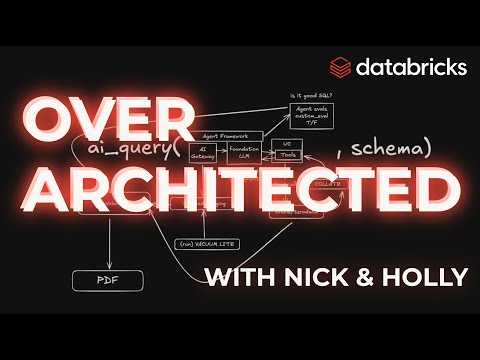
Databricks Release Notes:
Platform: https://docs.databricks.com/en/release-notes/product/index.html
Runtime: https://docs.databricks.com/en/release-notes/product/index.html
AI/BI:https://docs.databricks.com/en/ai-bi/release-notes/index.html
If you hated this video, why not try a blog instead:
Nick's latest article: https://community.databricks.com/t5/technical-blog/live-video-transcription-lessons-from-brickbot/ba-p/101661
Holly's latest article: https://community.databricks.com/t5/technical-blog/data-engineering-sql-holiday-specials/ba-p/104905
Chapters
0:00Introduction0:30Python execution tool2:51Designing the architecture4:33Lakehouse federation7:59Federating data with AI10:43AI gateway enhancements13:54Vacuum lite for data17:58Custom evaluation metrics22:02Collation for sorting24:31Collation in architecture27:27Structured AI queries30:52PDF exporting dashboard34:07Rapid fire feature recap
FAQs
What is the Python execution tool in Databricks?
The Python execution tool allows LLMs to generate Python code and execute it in an isolated environment, enabling far more complex computations than traditional single-output tools.
What does lakehouse federation enable?
Federation allows you to query data across multiple cloud platforms and third-party systems through a unified interface, without moving data or sacrificing governance.
How does lakehouse architecture integrate with Tableau and Power BI?
This video demonstrates that lakehouse federation enables seamless integration with BI tools by allowing direct queries across multiple data sources without data movement. Through Unity Catalog governance, teams query Oracle, MySQL, and other systems as native tables within the Databricks Data and AI platform. Performance optimizations including caching ensure BI tools maintain responsiveness.
What is the best BI tool to use with Databricks?
This video illustrates that the Databricks Data and AI platform works effectively with multiple BI tools, providing flexibility to use preferred analytics platforms. The key is implementing proper governance through Unity Catalog ensuring consistent access controls regardless of tool choice. Teams can standardize on Databricks while selecting the BI layer fitting their workflows.
Full transcript
0:00 Introduction
I oh yes I actually really like that excellent no that's terrific uh I just absolutely love this hello hello welcome to over architected with and together we're experts at data and AI but separately not so much this is the podcast where we talk about new features in data breaks and then try to Sho horn them into one architecture to see if it's actually realistic here's the latest release is from data breaks for February 2025 and as our resident AI expert nick uh do you want to kick us off with a new AI feature yes absolutely so this feature is um I think it's kind of one of the one of the most interesting features in the LM space and what it is is the python execution tool um and so what the python execution tool allows you to do is to have the llm generate code for you and execute it in an isolated environment um all hands off so kind of when you would want to use this really is for instance if you had a sum tool so you attach a tool to an LM that does the sum um that's great like a tool is the thing that you get your like llms tap out to so that you're like because the llms aren't great at everything there's some things that they kind of suck at um and so the idea of tools is that it's something else that can help the model do something in a better way is that right yes exactly so the so the LM predicts tokens that's all it does so it doesn't so although it looks like it has maybe capability to do arithmetic it actually doesn't so if you want really consistent results um you do need to jump out of the LM call it call a tool and get a result from something that you can actually depend on so actually an example would be like the sum tool you jump out of the LM you go calculate 2 plus 2 it returns four and then the LMC oh it's four and then it repeats the answer back back to you in it's you know whatever the kind of semantics or and question happen to be um the limitations of something like the Su tool is that you can't use it for anything else so this python execution tool is kind of for arbitrary things so if the LM will go and figure out I can achieve this by running 2 plus2 in Python so let me tell python to print out the results of 2 plus 2 and then I'll have it and the LM does it for you so suddenly you can do basically arbitrary things and the LM really drives it extremely powerful feature the key thing here is that it's now built in unity catalog so before you'd have to go you'd have to create this python Tool uh your and figure everything out Stitch it all together but now it's just part of unity Cog so it's just available in the system name space system.
0:30 Python execution tool
A um and you'll just see it right there python exact and the challenge here is or what we've challenged ourselves to do is to take these features and then put them into one architecture diagram to see if we could kind of shoehorn in something that's mildly realistic and see if it makes sense so has explained the AI feature and now I as the non aai person I'm going to try and implement it so we have EX SC draw here open so that we can start doing some diagrams so just to check my understanding like would we have like I'm I understand kind of what it does I don't necessarily understand how it works in the whole like scheme of things so like is it part of the agent does it does it sit as part of like the agent framework and then so you've got like I don't know you've got your llm here and then it's going to tap out and toss it in unity catalog right so let's say that this is Unity catalog uh and then within Unity catalog we also have uh the tools like is that is that roughly right like I think it's I think it's totally right the one I would just take that UC box Unity catalog and tools box um and just take it out of agent um since it is Ian Unity Unity catalog of course is um kind of the central catalog and governance tool for the entire platform so yeah I all right okay I see we're not putting all of unity catalog within our agent okay fine maybe one day H the most jacked version of metadata driven you could imagine and then so that just that kind of reads from here and then the tools kind of return something yes and then it goes off into do our other LM things all right then pretty good pretty straight forward all right I love our architecture perfect it's the best thing up ever seen um okay I think it's time for data engineering feature and I'm super excited at the moment about lak house Federation now this used to be called crew Federation it has been around for a while the idea is that you can connect data bricks to other data sources you can query them and you can bring back the data and so you've been able to connect to things like my SQL for a while now but hot off the press uh you can now connect to Oracle and data these are absolute Monsters of kind of the Big Data world this is where a lot of data is sitting and the idea is that you can connect to it through Unity catalog so you can govern it like you would any other table in terms of like who can get access and who's got read access and all of that kind of stuff but then you can just query it like it's any other table and for me the real power here is that like as an admin you can set up this particular connection and then anyone you know if you want it to be anyone can then read this data as if it's like another table in your um in unity cath log and so that's kind you know you don't have to kind of them worry about kind of like overnight replications or anything like that and you know you can have it direct query that if you want and with some of these as well you also get a few performance improvements as well so there are some things where you know you'll get faster scans you get faster filters things you'll cash results for you as well so that if you read something in once and you read it again like if it's cached in your um in your Compu then it'll read from the cache as well so there's there's a few kind of performance Improvement things here as well does the execution of the query happen in data bricks or it happens elsewhere right it happens it happens on the on the end database yeah so there is a bit of load on both sides so you will be using um you know a a warehouse or to seress Warehouse or cluster maybe to be able to query the data there is a bit of load on the other side to be able to do this um I think think of it like a jdpc connection so there is kind of work happening on both sides in the same way you also might get a bit of um you know execution planning optimization from Spar on a jdbc query you get something kind of similar for uh lake house Federation as well so what you're saying is you should absolutely use the limit Clause um yeah so you don't want me writing select all from uh transactions uh this is true but I think it's part of a data bricks thing like it secretly puts limit in there anyway so because it only supports 10,000 records so you don't have to worry too much about that if you are worried about that there are actually two ways that you can solve this um you can either set up a materialized view um and that'll go through regularly and it'll make a view so if you wanted that table to be updated every hour and you want to only have that one kind of connection to the data you could you know set up that Unity catalog and then make a materialized view on top and then that's how everyone else access it or you could uh treat it like any other data source and have it as an append only table um it's forever growing and you can put in a time stamp there and so that's how you'd go through and you can audit what the latest version is and then if you wanted you could then treat it like any other kind of streaming Source or any other kind of only data source you'd have as well awesome does that make sense I'm just trying to yeah I yeah I think it makes sense um I mean I've used query Federation before and uh now we have Oracle and teror data does Oracle and teror data become part of our architecture uh yeah do let's just do it that is bar ter teror data that right one R yeah no I'm a Frog okay a teror data expert anymore sorry uh okay so we have this data and we can query it Federated I think we could do something like this so the agent has this tool right this arbitrary python execution tool so we could actually I'm just going to draw a single line and say that this can query this via the tool so now our agent is Agent is super smart and I'm GNA have to select all this individually and manually oh no okay forgive me I will just simply not do that um so I'll just say that uh this tool goes here actually so the tool can also generate code um that goes and queries Oracle and ter data on our and then Oracle and I think so this is the uh tool call let's just call it yeah so it's G to some sequel what yeah but then at the same time I mean I don't know if you want me to add this but I I I think we should mention it so this but the reference to Oracle and terod data lives in UC right so we're having our uh we're saying to our agent go find me some data this is in unity catalog our Tool's going to go and have a look through Unity catalog see what it can query go and query that and maybe do like a select star from our particular uh you know new sources that we've got here and maybe it could filter on a particular customer that you're looking for so maybe it's like search through this you know the different data sources that I have and try and find poly curving I'll find myself in my data yeah I don't know all my terrible credit card decisions I heard I heard you actually have to travel across the planet to find yourself sometimes so I can do with my data it'll be stored in so many different data source store okay then and then the response where does the response go that go back to the agent or does it go yeah it does go back to the agent yes well I mean the tool executes um in this like isolated environment it will go R the data and then it will return that result to like the tool because the tool is a function um and then the tool also have like a return statement which uh goes back to the LM um so I think this is fine no more lines are necessary all right then awesome so that's uh my big data engineering feature for this month do you want to tell me about another AI feature yes another AI feature so um the next one that I'm really excited about is I mean it's kind of a it's a it's a small Edition but it's I think it's an important Edition so we have this feature called AI Gateway are you familiar with it yes okay great so the so um the AI Gateway allows you to do things like payload logging and Pi filtering and things like this it's it's basically a proxy that sits in between all your LL calls and uh several external models so you know you can connect like your open AI uh API through there your anthropic API basically anything you want um and one of the limitations up until now was that it actually didn't support um the foundation models so you couldn't apply it to directly through the foundation models that have Vision throughput so our foundation models are like you know our llama like uh offering mistol offering things like this typically if you want to deploy in production uh and have a reliant endpoint you want to deploy those uh in a dedicated way and that's called provision through put and so now a AI Gateway this is like this new subtle new part is that AI Gateway now supports those provision through put end points oh um so it's a so it's a I think small but really great really unlocks anybody who wanted to use the foundation models yeah soone understanding for AI gateways it answers a lot of the really difficult questions around kind of like governance how do we know that our AI is not going to say mean things to people and you can tell it what it can and can't talk about um I think you put like rate limits on there as well so that like no one person is hogging anything so it's like a really kind of practical way to be able to deploy something and now you can deploy something at scale um because you can do it at scale where you can say like here are the topics you're allowed to talk about and the ones that you can't talk about and you know if people are putting their insurance number in you can get it to kind of slap the hands away and say no stop it and like the data doesn't go anywhere all right you can also you can also split so you can so you have a single end point you can split traffic to several different uh places that's nice so in terms of this diagram I'm a bit confused about where this would go um because we've got our our serving and I guess the Ln AI Gateway sits between the output right I mean this brings up a good question so we put llm inside uh the agent and in some sense we could bring agent out agent is like it's a it's its own construct and then llm will sit outside of it and then you could put AI Gateway in between agent and llm I think I mean I'm not going to say this is the best thing in the world but I think this accurately represents uh kind of the flow of things uh I always like the agent was like the orchestrator um so AI Gateway sits in between here and in between here and it's the llm that's now got provision throughput isn't it yes so that llm now supports kind of provision throughput uh for our foundation models um and so this is a foundation yeah perfect all right yeah okay Foundation I'm better at this AI stuff than I thought I was so uh next thing I wanted to talk about was just a I think kind of like a quality of life thing so similar to what the AI Gateway was um but for data engineering which is vacuum light so for those of us who've been doing kind of Delta stuff for a while you can end up with lots of small files that aren't used anymore when you do things like optimize it takes all those small files it combines them it compacts them and it doesn't do it in a way where it like literally kind of opens those files and then combines them it takes those small files and then it just writes out bigger files based on what's already there and so then all of your queries are going to be using the more optimal file sizes but then you've got all these kind of tiny ones left lying around now you've been able to use vacuum for a very long time um to get rid of those ones that haven't been used in like 7 days or 30 days but for some of you out there the idea of doing vacuum at like the end of the pipeline fills you with absolute dread because it can take 15 20 30 minutes to run and you want to get your data to where it needs to be you don't want to have vacuum in the middle of your pipeline but you know it's got to be run but if you don't run it then you're get a really bad performance some of you has been a bit of an Balancing Act vacuum light has now been bought in um whereas previously vacuum did a very thorough job of going through not just old files but like directories clearing up empty ones of those arbitary files that might be there from kind of old Delta logs um and that was you know the long tale of things were kind of taking the longest time so vacuum light has now been bought in it uses the Delta log to be able to kind of whiz through all those files that aren't needed anymore and it will be I don't want say like a halfway house but it's kind of um it will be a good enough interin solution for those of you who have been spending a long time uh waiting around for vacuum so where would you like to put it in our architecture diagram um well you said it's a d thing yeah I was going to say now that we've got AI Gateway in here that's got like payload logging hasn't it some or um it's not system tables what's it called it does right it does I mean let's do that makes sense it I I have to do have to admit it doesn't make sense in the sense that uh no it does see this is the my my my brains my brain is a I'm like the reasoning llm where I'm bouncing back and forth uh trying to figure out the answer um because like the payload logging is like a a pend only kind of situation no I think it works because if we got Prof eventually you would optimize it and then you'd want to run vacuum model perhaps okay I like it I'm going to do that so yeah so if you've got a workpace it's got predictive optimization running on it some of these things are going to be optimized anyway I guess trying to think tangent how this might Ur in real life and maybe if you had very uneven traffic to your LM maybe you've got like a peak time for 1 hour day and then you've got kind of like other trickles of the data coming through and so maybe the logs are maybe I'm ready straws here is it light is this correct is this light as in like light soda rather than a light bulb yes there we go so yeah so if you are using predictive optimization um this might even happen in the background for you um and it will make a decision for you on whether like this is the best thing to do now again this has to this depends on kind of huge huge quantities of data that I think for most people like I don't even notice how long a vacuum takes to run and like maybe this isn't for you um but for some of you this is going to be a real nice way to keep on top of you know the number of old files the number of stale files without having to really interrupt the pipelines that you're running that's I mean I thank you you basically figured this one out for me so I appreciate it I didn't have to do much it was your idea had to do payload logging so thank you uh I like looks good I'm liking this I'm liking we're going I didn't kind of Mak sense it wasn't as uh I thought we'd get a real Frankenstein but this is all somewhat feasible just cuz you can do it doesn't mean you should all right what's our next AI feature that we've got so the next one is a custom eval metric support in the agent evaluation framework taking a step back that we have something called Agent evaluation which is uh it's part of our broader agent framework Mosaic a agent framework um but all these pieces of this framework are kind of modul so you can can you don't have to use the whole thing if you want and so in specific we have the evaluation framework and this allows you to kind of in like classic ml world like run your LM or your agent uh that you defined on some historical data um and get some results so you can have like llm judges Custom Custom judges say this this question and this answer look correct that's good they'll give you like safety scores relevance scores um whether it's grounded you can so you can add you can modify this but this a built-in feature agent evaluation that does all this for you now um the new the new part that I was playing around with I was doing this for Brick bot actually is that we now support custom metrics it's a great feature it could exist so I'm not going to be like oh my God this is the most insane thing ever um but I'm really glad it does exist now so custom metric essentially allows you to Define I basically what it says you can Define any metric you want um on your evaluation set so you have like a bunch of questions a bunch of responses and you want to evaluate you know maybe give them a pass or fail score based on some kind of criteria so you create this new function you call you know my custom metric you write whatever evaluation you want to do within that metric and then you return a pass or fail and you attach this custom metric to uh to the agent evaluation when you run it and then it kind of gives you this like pretty UI it's part of it's like natively integrated into the entire experience so um a really great feature really nice feature so could I make it to test whether my tools are generating sensible code like yes absolutely like is this a I would put it actually on the agent oh but then oh yeah cuz like this confuses me because like we don't have anything going back from here oh oh oh hang on what what if I would you object if I slightly rehashed This and like hand because you said the agent was like the orchestrator so if I just put this as like uh agent framework because that's also doing like some of the AI stuff yeah that's reasonable and then that goes up here yeah all right okay then um and then this could give us like a um is it good squl does it squel good and that will give us a binary and it was a yes or a no wasn't it in this case yes but you could so yeah you can do you can I think numerical metrics if you want okay uh you can do p you can I think you can do like yes or no if you want it to like pretty print in the uh UI as a yes or no um or you can just return true or false um and this actually like a really good example uh for instance we could hit the point of why this is particularly useful and why llm judges are reasonable um is that for instance you could create an agent that uses like a very small llm that's less capable generally speaking and then the eval and then the agent that is doing the evaluation on that model could be a much stronger model so you could have like the best model evaluating the results of a much smaller model and then you could be tuning what you're defining in your agent framework so that's why I mean that's kind of principally why something like agent evaluation or llm judges is is really powerful okay so if you wanted to make like the smallest model possible because of like inference costs I hear it's expensive because we've got this provision through put and we want to have like the smallest fastest model possible we could have a much more powerful model evaluating it and saying like yes or no this is good or this is not so good what all right okay then good I like it I like it the next one that I want to talk about again kind of in this theme of like if you have this pain it's going to really help help you but for everyone else is going to completely pass you by and that is collations so like think about the word collate it's kind of like to bring stuff together like you might leaflets on something I don't know um but the idea is it's about text standards and if you have ever been in that kind of utf8 hell you know what I'm talking about so if you have a name that's got like an accent in it like an ear cute in it um if you don't use the Latin alphabet um that makes things really difficult for you um so you know if you have text that is in like Greek or um cilic or you know Arabic like text processing suddenly becomes absolute hell and particularly when it comes to things like sorting so deciding kind of what order the letter should be in if you're trying to sort something kind of alphabetically depending on the kind of alphabet that you have you might have inconsistent not inconsistent yeah inconsistent ways of ordering the alphabet like if I ask you to say the alphabet but then if if I asked you where does the E CU go in the in the alphabet like would you put it consistently the same place and you know not every single language does that and the idea with Galatians is that you can handle the Sorting of a lot of this text in a much better way and not only can you kind of Supply your own rules on how this is done but you can also specify things like how uppercase and lower case is then handled um so yeah so for those of you who feel this pain we hear you this is going to make a huge amount of difference um for those of you who have never come across this probably never will um for the rest of the rest of your careers yeah I probably take I I I think when you when you when you uh when you first started I didn't really understand but when you said the Sorting aspect of it um I yeah it makes total sense so it's like like the letters the encoding of the letters in the first place is already ordered that's how sorting that's how you can sort by letter because they're numerically ordered uh but now I can see that the letter e with an accent does not follow the letter E in in the encodings so uh brilliant makes total sense uh I'm surprised this didn't exist before yeah I think beforeand you'd have to like H like hand crank it and really really horrible cool well that is a huge quality of life feature mhm very exciting for all the folks out there who have experience uh okay right so now I challenge you to put this problem that you've never across before onto our diagram oh oh dear um yeah this problem I don't have never come across before well wait um it's a squl feature yes yes uh not exclusively but very heavily yes okay got it oh not exclusive so it's like available in like P spark type of thing so like our our other apis yeah so it's uh it's kind of an odd one so I think it's um so sorry it is for spark and it's also for Delta as well um that it's available there is SQL but I've seen other examples that are kind of like a bit bash shaped so that if you want to okay yeah so if you need to do something before you get into um kind of python then oh uh would it work on a Federated call yeah do see why not cuz it's applying the collation and then it would be sorting by it so oh okay I see because and I think this actually ties back to the questions we had earlier about um you know Federated queries and like where they run uh of course A lot of it happens on the destination but this is probably an example of where like hey maybe Oracle or what I don't know but maybe whatever you're federating doesn't support um so that's why I'm curious if it's uh if it would work by retrieving the data and then already sorting it um Lo quote locally on the datab break platform yeah yeah yeah so yeah if we were searching for Nam so instead of trying to find we were trying to find sorry the only non-latin name that I can think of is dread which is very oldfashioned is spelled with one of those that sound's very specific I'm not going to lie it is it's that with like you know the letter that's like an A and an e smushed together yeah it start oh yeah yeah I mean I don't I don't I've seen that before I have no idea what that's called um okay how do you spell colate c yeah yes um I really don't know how to draw this I mean we could just put it here and be like it's the arrow back going viate so I don't know where the result goes but yeah that and do a next little and then Super excellent see excal skills really really shine ha really really shining okay cool all right perfect yeah and then we can make our custom eval test how well it's sorted eth actually yes I'm actually now that I'm looking at it I'm not sure at all that this is how it would work but that's okay we're doing our best it's fine we are and we tried that's the only thing that matters okay so is that is that it or do we have do you have something else uh I think we've got a few more AA ones oh yeah it's my turn yes okay so I do the last AI feature um that I wanted to highlight actually um so we have a a collection of functions that we support um kind of like in the in the SQL editor just on the data Works platform across several different surface area um these AI functions so like aior query um and there's a lot of other custom ones and what they do um is they allow you to easily specify an endpoint so that endpoint could be an existing Foundation model so something that's posted out of the box by us it could be the end name of an agent so that could apply here and then an actual query that you want to send to it so it's a really easy way to query some kind of LM or agent directly from a SQL like world so for instance like select all from name and then like you know by the way map this function or map an AI query on the results of all of whatever maybe this entire row maybe a specific uh column things like that um that's uh so that's the actual AI query function um and the new feature in it uh very useful is it that it now supports uh the actual format return and so you can specify as I believe it's like the third or fourth parameter uh the schema of the response that you you expect that so if you wanted for instance Json and you wanted reliably to for the LM to produce you Json you can now specify hey you know for when I ask you the sum of two numbers I expect you to return key sum and then the value should be the result um and thank you what's a great question here is the answer to your question exactly that right okay so uh so it's so it's a really great feature um basically structured outputs for your uh for your various AI end points um natively in kind of a in the SQL surface areas in within platform awesome feature I think um so very I query everything that we've got here with AI query and then make it have a special response make it respond in adjacent yeah absolutely well when you say everything here you could you could I mean it's kind of like agent the agent framework box basically ties everything together and query I make this quy oh yeah yes yes brilliant I actually really like that excellent right and then then brackets and oh no because I need to put some extra parameters in don't I no that's terrific uh I just absolutely love this this is I need to zoom out to see the whole thing uh so what do I I need to specify like output or whatever yeah there's uh sorry I do forget the exact um the exact parameter name but uh you you put your stea there in some kind of I think you can Define it as a Json object um a string there there are a few different op let's do a map because it takes up less words Let space there we go okay I don't know about map but it does take up less work so fine f fine fine f fine fine fine I think it's a format you can just WR or schema perfect M lovely okay um they should get me to write more of these this is just great yeah right like this the visual the visual was topnotch honestly now now it looks I mean now it's got a creative handle so I like it I got to print this out and put this on my wall all right there on Final data engineering thing that I wanted to mention and I think this is really going to put the on the top of what it is that we have made here so AI it has also had some kind of quality and life improvements so if you've got data sets that aren't being used anymore it'll show you in the UI that you're not using it and so that can save you some pain in kind of dependency management um you can also now use I think it's natural language for more visualizations I think dual access has just come in but the real kind of thing that I think is going to take our architecture to the next level is the ability to download your results as a PDF so now that we've got this provision Trooper I'm in shock we've got this provision Trooper we've got this huge amount we know we've got so much payload that we need to log it we've got that vacuum light and to make this more realistic we need a stakeholder who demands everything resulting from this in a PDF format email to them oh that's brilliant uh it all starts with PDFs and also ends with PDFs perfect um okay so I guess technically uh aibi would apply to the actual tables um uh I think it also kind of is in this AI query type of thing it just kind of replies to the whole thing now so you would have to make a dashboard out of it first now that dashbo could be un original it could be a table um so you could have uh so maybe about like the evals you could have it on that or the most exciting dashboard ever around payload logging that could also work uh we could do lines that the dashboard includes the payload Ling but why stop there sorry why is our dashboard going into payload logging surely we're making a dashboard of this data what's your objection the direction of the ARA yeah oh wow okay I thought we were being a the fundamental oh dear okay the architect diagrams are left to right but sure and also this and also that okay that goes into the dashboard and the result results of the agent evaluation could be part of the dashboard because this is all the data you would want to see in a single dashboard yes it is the everything dashboard all righty okay this went from something being quite sensible to being absolutely crackers but it's still not it's still technically somewhat correct I technically correct the best kind of correct okay then so we have our dashboard all this stuff in a PDF yeah okay I mean there are limits to the size of the PDF but sure we can just limit 100 for all of this stuff okay and then we export it to a PDF I need to write that export to PDF yeah it is optional you don't have to build a dashboard that exports to PDF despite what your state cers might say this is this is probably the most important uh piece of our architecture now I mean they're probably paying the bills so you know extra large I feel like that I should wrap this whole thing in a PDF this should all just be the first one of these uh that we have done how would you score this out of four okay do I have to give reasoning it's your show you can say what you like it's just my show uh 10 out of 10 then dang you would recommend every it's a four because I think everything we we drew through with maybe some slight of uh like edge cases kind of just basically could work like these things can be stitched together like the cables fit um but you know I will leave the results are you know subject to interpretation I guess yeah I I feel like the uh the tool to call Oracle and teradata is probably my oh if someone were to do this in real life I would say that would probably need some rigorous testing um to stop you from doing anything really like you definitely want your llm generating arbitrary codee and executing it on yeah it's just kind of like select star from terod dator Cross join Oracle what's not to L I can see it's like uh find uh and then the LM is going to return oh drop it did it great perfect sequel love it okay then highly relevant response I know this is silly actually you could put AI Gateway in here to like block words like Drop so if your end user instead of being like it's like fine up off you could say the AI Gateway prevents any bans the word block and the word block could not get through oh sorry uh drop could not get through it's slightly less stupid now I don't know okay my fear my fear is that the tool will run before AI Gateway does anything oh I see I see okay it'll go do its work and then it'll return it and then the Gateway will be like okay then that's I think that's a good question we should follow up on that all right I think for that reason I'm G to give this a two to be honest like engineer admin side of me are just sweating quite profusely right now all right so those were definitely not all the features right we got a lot more so many more but we had to uh uh okay and uh hold on okay I'm looking at them here there is a lot so here's what here's here's what we should do all right H you ready I'm going to challenge you I know you already see what's coming I'm going to challenge you to Rapid Fire say as many of the feur possible in 30 seconds we have so many features uh 30 seconds 30 seconds so hold on I'm going to start I'm going to start a timer okay and I'm looking at this list it is not small um okay are you ready no okay too bad all right so uh on go okay take your marks uh subus environments I've got a version two which now include a progress bar uh CLI support for DB no dab support for data breaks apps also un analog Sports Duffer dabs got column comment on column for tables and Views got automl weight sampling for forecasting which I quite like you've got try code oh God uh null of zero zero of null uniform R string Arro improvements for schema and to and from AR schema am I done am I have time oh dear uh once your trip up right it's it's G it's G over it awful awful uh if you would like a much better way to see what has been what has come out in data in the last 30 days um we do have the release notes we will link them below um they can be a little bit pickier on adventure because you've not got you've got not just the runtime updates but also have the platform updates aibi and uh ML and I think mosa AI as well now um so yeah so we have tried to kind of pull everything together our highlights from the last 30 days so thank you everybody for joining us uh and I had a lot of fun please let us know what you thought about the architecture right I think what what do we decide two out of 10 I said two four three so we think it's the three if you think differently please let us know please leave us a comment uh and especially if you like this video please leave a comment and like um if you didn't we also write blogs so you can definitely check those out
Learn more about the Databricks Data and AI platform.
The information provided herein is for general informational purposes only and may not reflect the most current product capabilities or configurations.