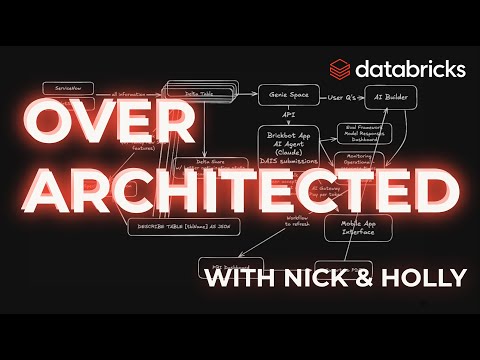
Over Architected with Nick & Holly: Databricks updates for April 2025
Summary
- LakeFlow Connect Expansion: New integrations with ServiceNow and Netsuite expand data source options for ingesting operational and business data.
- Genie Spaces API: API support enhances Genie's accessibility and integration capabilities for self-service analytics.
- Multi-Feature Release: This video covers Delta Sharing improvements, AI agent framework updates, SQL scripting features, and Claude model integration.
Over Architected with Nick & Holly: Databricks updates for April 2025
Databricks Release Notes: https://docs.databricks.com/aws/en/release-notes/product
DBR 16.3: https://docs.databricks.com/aws/en/release-notes/runtime/16.3
AI Agent Framework https://docs.databricks.com/aws/en/generative-ai/agent-framework/build-genai-apps#agent-framework
Chapters
0:00Introduction0:20Lakeflow Connect updates2:47Genie spaces API6:18Delta sharing improvements8:10AI agent framework13:14New SQL scripting features16:45Claude model and gateway19:02JSON table description22:04AI builder for extraction28:01Workflow dashboard tasks30:13Feature lightning round
FAQs
What new LakeFlow sources are available?
LakeFlow Connect now has integrations with ServiceNow (for operational and service desk data) and NetSuite (Oracle's ERP and CRM platform for business data).
What does ServiceNow provide as a data source?
ServiceNow provides data about operational things like service desks and IT desk operations, including information about requests, resolution times, handoffs, notes, and SLA performance.
What are some Databricks features discussed in this update?
Features include LakeFlow Connect updates, Genie Spaces API, Delta Sharing improvements, AI agent framework, new SQL scripting features, Claude model integration, and JSON table descriptions.
What format can be used for data ingestion with these new sources?
Data from ServiceNow and NetSuite can be landed as Delta tables, supporting analytics workflows and further data transformation.
Full transcript
0:00 Introduction
And then we could pretend that this is all part of monitoring. Maybe we then like combine it with the monitoring. It's always part of monitoring. Yeah. Then you need to monitor the monitor. Why stop there? I mean, I could do this if that's what you're asking for. Please don't. So, we've got circular monitoring. We have an of monitoring. Hello. Hello. And welcome to Overarch Architected with and. Together, we are experts in AI and data and engineering, but separately, not so much.
0:20 Lakeflow Connect updates
This is the podcast where we talk about new features in data bricks and try to shoehorn them into the architecture to see if it's actually realistic. Here's our favorite features from the last 30 days. All right, so I'm going to start uh with I know we've had a lot of lakeflow connect, but that team just keeps on delivering. We have two more integrations uh with lakeflow connect if you need to ingest data from places.
So we've got uh service now as a source. We also have Netswuite as a source as well. Now do you know what either of those things are? I know the service now stock and I know do not know Netswuite. No. Okay then. So, uh Service Now is a lot about kind of operational things. So, if you've got like a service desk, you've got like an IT desk. Uh that's all the data that comes out of the back of that. Um Netswuite is Oracle's kind of erm or like CRP.
Sorry, I should say what those things are like uh enterprise platforms um and uh kind of customer data as well. Does that make sense of what they are? Could I ask? data. Okay. Well, I guess these are just data sources, so I don't have much to much to say so far, right? Uh we have service now. Hope that uh camel case is correct. Is netswuite also camel case? Yes, it is. Now, all right. So, we have these two. These are LakeFlow sources.
Uhhuh. Let's just land them. Let's just land them in in data bricks into a table. Let's do that. Wait, so Netswuite is uh like kind of business data service now like help stuff. Yeah, like a help desk. So you might get things like not just the requesttor, but things like how long did it take, how many handoffs were there, what kind of notes were added, what kind of tags did people have, did you hit your SLAs's? Uh we're going to put this into a delta table.
Delta table. And here I'm going to make this slightly more descriptive. Uh tickets per product. Okay. So you can know how good or how not good your product is. Okay. And we'll put delta table in here. Um I don't know what products we make yet, but I feel like we should figure this out as we go. Um we'll let the data decide. Okay. So in the AI world, um, Genie spaces, data bricks, Genie spaces now has um API support. Um, what does that mean?
2:47 Genie spaces API
Yeah, exactly. Uh, actually I'm I'm I really love this one. So, ever since we released Genie, um, for those of you who don't know that Genie is basically you point to a table in your catalog and you create this like new workspace that just you get to chat on whatever table you pointed it at. So or whatever name space. you can have many tables um and you can just ask it questions and it'll generate the SQL for you. It'll run it and um so it's it's absolutely amazing feature.
Takes a lot of kind of like the manual stitching um out of the process. So um great feature but you have been limited to just data bricks. So you have to use like the conversational interface for it. So you can't like really uh take it out. Um, so now it's supported through an API. So you can make requests to a genius space from external places and I think that's just amazing. Um, I'm going to experiment using it for Brickbot this year.
So I'm really excited. Yeah, me too. So I think for a lot of people they saw Genie I was like, "Oh my god, this is great. Great. I can give this to all of my non-technical users so they can ask questions about it." But the problem is they'd always have to log into data bricks and like if you're not already a data person it's quite an intimidating experience. It's like what are all these buttons on the left hand side?
You're like no no no just just ignore those. It's like oh but what are all these notebook things? What's all this code? Oh no no no just ignore those. Well I think there's only really one place that we can put this isn't there? So, I think what we're going to do uh we've got all of our data from uh from Service Now. And next week, I think we're going to have uh some conversations. So, let's make a let's have a genie API.
Uh um Oh, I'm not sure how to like describe this. Like so we've got like I don't want to call it like a genie brain but like genie logic and then I want to have that served by space. Sorry that's Yeah, there you go. I didn't want to. You were getting there. And then and now we can have this with an API. Uh and now is it any web app or does it have to be a datab bricks app that you can use it with? No, it's just it's an endpoint.
You can you can call it from wherever you like. Um, oh maybe ah maybe we have this as like our brickbot um app um and people can ask questions um about their data and AI summit tickets or like their and so now you could have things like uh has my talk uh been accepted maybe or like uh has um Can I get uh a group discount or something? Yes, you can. You can. Don't tell you don't know the answer to that. The answer is yes, you can.
I think you've got to It's either like five or 10 people you can get over a discount. So, there we go. Um I like it. Yeah. I I was wondering how you were going to tie it to Service Now, honestly. All right. Hey me, um we have a few delta sharing updates. So for uh there's a couple of quality of life improvements here. So for delta sharing, we now have query optimizer. Um it's got the statistics for that. So it will do some query optimization for you.
6:18 Delta sharing improvements
So you're saying so as part of the delta share, we're not only sharing like the files, the underlying files and everything that's there, but we're also sharing some kind of statistics that will help an external query optimizer. Yes. Yes. So, so you'll have faster queries uh for delta shared tables now. Okay, sweet. Well, we only have one delta table, so it makes sense to share that. The question is who are we sharing it with?
But maybe that doesn't matter. Uh let's say it's it's another team. Or maybe it's like a third party provider. I don't know. Maybe it's a catering and they've got to know how many how many lunches they got to make. I'm not saying that's a good idea if you've got a B. It's a It is a good idea, but we put tickets per product here. So, it's like this is a little too specific. Okay. So, uh it's okay. We changed it. We uh we changed all the upstream data and I'm sure all our downstream users are going to be thrilled about it.
Um um Okay. And we're going to do a delta share. That's some real scope right there. Delta share with uh well, I just want to be specific. So, uh better optimization stats. Also, I'm really sorry. I'm going to be an absolute pedant here, but this this is this is the wrong way around. We we share we share the delta table. Let me go. You know what? I have a good case to disagree with you, I think. But okay, for another podcast, another time.
Okay, fine. I mean, and you could argue that you make the share and then you put the delta table technically in the share. Oh, so you you want to get into it? You know, we can have this fight. I'll put it. It's fine. Fine. We already gone too long. Do you want to go on for what I know is a big uh a big one for AI? AI agent framework. Mosaic AI agent framework is now in public preview. So is AI agent evaluation which those two things work together pretty closely.
8:10 AI agent framework
We we talked about them in previous podcasts. Um and then additionally um the agent uh framework monitoring. I know it's kind of like it's getting a little confusing. All those three things kind of sound the same. And the monitoring in specific um is great because now you can have like a a built-in dashboard to see um like request volumes uh latencies um kind of all the kind of operational metrics having to do with your agents.
I'm still confused. I'm very sorry. So uh we have uh so we've got the agent framework, we've got the agent evals, and then we've got the agent framework monitoring. And so like the the framework is the like the name of like the all-encompassing thing and within framework we have evals and then within the framework as well we have monitoring for the framework. Yes. Correct. Okay. We can just say agent framework and it supports evaluation and has monitoring.
But I I do want to be uh truthful to our docs. They kind of call them all these things out separately. So um like 10 out of 10 for clarity and pedantry uh not 10 out of 10 for understanding. Okay then. So um we could we should just drop the word agent since it's clearly redundant. It's just framework evals and monitoring. Well, I'm going to need an agent, aren't I? So um let's let's make us uh an agent. And we've got our brickbot thing.
So I'm going to make an agent for that. And maybe we can't use genie spaces for something because we need to like go to the internet or something. Um, so we've got our AI agent here. Um, and maybe can I make a suggestion? Yes, the AI agent. Let's make make that is Brickbot. But Brickbot and then we switch we switch some lines. Brickbot is its own AI agent and it can also uh make other calls to the genie space itself.
So it's a wait for it. It's a compound AI agent. Oo. So it's a pretty cool one actually. So you could have Oh, so this could be like you could consider this like a tool basically. Uh well, yeah, in some sense. Yeah, absolutely. It's like it's another call that can be made by another, you know, whatever. So So yeah. Yeah. All right then. So I think so uh we have evals which is going to come out of this and like this is this is like performance monitoring really isn't it?
Yeah there's like I guess the two sides are like operational and then actual um model training if you will. Okay. So like so so eval are really around probably kind of like an offline thing that you'll do uh to figure out how are things going blah blah blah LLM judges I I so and then there's the operational metrics aerial curve balls. How does this differ from MLflow tracing? Um so tracing would be part of an operational metric.
So you could tracing is just giving you more specific timing for sub spans of kind of a greater call. So good questions. here. Another another way to answer it is it's just another tab in the UI. Oh, I see. I'm guessing doesn't use it at all. That's it. Okay. Uh, okay. So, we've got the Yeah, eval uh is it called an eval framework framework? Eval or is just Yeah, the evaluation framework. The mosaic AI agent evaluation framework.
Say it five times fast. Sorry, I thought eval and frameworks was two separate things. So, the AI agent framework. Yeah. Yeah. See, no, I'm with you. I'm I'm going to be very honest. The naming is confusing. Um, but I'm sure, you know, it's a it's a fastmoving space. There's a lot of things going on. There's a lot of changes, innovations. So, you know, it's just the situation. Okay. We might wake up a year from now and it's all just one word.
Okay. Excellent. So, the monitoring, which is separate from Evals, what does the monitoring cover? response times, latency, these kinds of things, volume of volume of requests. It's really um think I think you just think of it as as model like you're you're uh looking at the metrics of the model serving endpoint that's hosting your agent. I know you're just itching to create another one that's dashboard of all this. I don't know if we have any dashboard, but it's actually important to note that the dashboards is some of the dashboarding is built in.
So that and that's kind of the point. Well, evidently I did go to the docs this month, so That was my job. That's that's totally fine. Uh that's an AI feature. Can I tell you um about some new SQL updates that we've got? My favorite language. We have new ways of writing SQL in data bricks. So we've got um persistent stored module scripting now and we've also got pipe syntax as well. So we have new ways of writing SQL for you. and I thought I was a strong SQL user and turns out I'd never used this style of syntax before.
13:14 New SQL scripting features
Um, so maybe I should talk a little bit more about it. So this is very much for those who are used to doing things like loops, conditionals, kind of like nested things uh within SQL. So you've got things like begin and end uh fork statements. You've got leave to kind of break out those nested statements. You've got uh iterate and signal and reignal as well. So all of these things mean that you don't necessarily have to kind of use Python to do your looping and then do um Spark.
SSQL to then write your SQL within your statement. You can now do a lot more nested looping, conditional statements, logic, uh control flow within SQL. Oh my god. This one is more about migrations to be honest. So if you want to take something from a legacy SQL something something but it's all written in a piped uh SQL syntax you can now move it over for example maybe it is something kind of like Christo and you want to move over to data bricks you don't have to spend a lot of time rewriting SQL when the saleserson from data bricks told you that it supports SQL my turn my turn to put this in our architecture I hope this isn't a copout but I'm basically just going to say yay new SQL features and point to the delta table because that's basically all I can think of unless Okay, I'm going to ask you a dangerous question.
Does DT support any of this stuff? Uh, no, not at the moment. So not so I can't make a DT pipeline but I can make a classic workflow defined by some SQL and process all information and turn it into another delta table called specific information and workflow aka formerly known as jobs RP um and workflow uh with fancy new SQL features. Uh, so I'm gonna call you out on not being quite right here. So these fancy new SQL features, um, so we do have conditional logic within workflows like as a task type at the moment.
This is not that. This is within an like a notebook. So for a statement that's like within a single SQL statement. Yeah. Okay. So it doesn't have to be as part of a workflow. You could just have like a maybe maybe instead of workflow I'd call that a notebook. But a notebook like you know we ran it once we ran it like what do you mean just a notebook because it's confusing again we have been hit by the confusing terminology of data bricks.
So all right we'll let the audience decide. All right so hey if you're watching this please make a comment if you made it this far. Um which one made more sense notebooks or workflow? Who's right? Who's your favorite? Is it me or is it me? uh and to put a pin on it so I understand the uh this isn't a like a new SQL thing. This is this is something that other SQL systems support. We now support it as well and that's why it also helps with migrations that yes that's the Got it.
Okay. Do you want to confuse me now with an AI topic now that I've confused you? And first Claude sonnet enthropic model. We have a new partnership and we now make it available through data bricks which is awesome because I no longer need to pay for that and I can just use data bricks because I work at data bricks. Um no but seriously it's uh I think it's pretty incredible. Um I I actually uh know some friends in other companies who um you know are limited to what kind of LLMs they can use and what kind of in what kind of places.
16:45 Claude model and gateway
Um and one of the reasons for that is like uh is governance uh you know everybody has their own um like kind of legal framework around it. So um if you already have data bricks suddenly and you you know you couldn't use enthropic before because of whatever your policies are uh now you have access to enthropic by way of data bricks and um I think that's really cool. Um and then the second second and third thing um are related to AI gateway.
Um so uh AI gateway now supports pay per token uh billing. So that's pretty awesome. Um basically more granular is always good. Um and then the second thing is that we now support a fallback model for uh when your requests to the primary model are um you know returning like you you've reached some limit or there's some error or something like that. So small thing, but previously, you know, if you had if you needed to fall back because one model stopped working, uh you would have had to make that logic yourself, now it's built into AI gateway.
Um so that's pretty awesome as well. Am I um right in trying to draw this? So I've just put Claude in here as our as our kind of agent. Uh, and then maybe I feel like what I I should do is um have uh this as AI gateway and so it was it paper token and so this is going to be served on our mobile app um which is using our brickbot app which is confusing cuz now we've got different different versions of the app. This is kind of like the interface.
This one's kind of like, you know, to your heart's desire. Perfect. Obviously, that's that for now. That's it for me. So, yeah, hit me. So, uh when you do some more SQL, when you do describe table on uh table that you have in Unity catalog, uh you normally get a table of results back. You now get the results back as a JSON if you want, which is very useful. Wait, are you kid? Okay, cool. You're not joking. I was waiting I was waiting for like the So, if you have something that is good with JSON data, maybe it's some kind of web app that you've developed or some kind of app that you've made uh and you want to get the responses from this uh table.
19:02 JSON table description
Uh you absolutely can. You can get it as a JSON format rather than as a table. Meaning that if you want to, you know, it's one thing to do describe table as a human and see the responses, but if you want to have this as part of a bigger automated system, this is going to make it a lot easier. Um, not limited to SQL, I imagine if I call it from like a pispark type thing. Well, the keyword is describe table. So that's uh that's SQL syntax.
Okay, I'm going to investigate that one. I I hope there's a a more native API because super useful feature actually. Um I can see it being super useful. Not that I've used it before, but yes, historically, uh calling describe table and getting back, you know, a data frame. Uh then you basically have to do another call to convert that to a JSON. So for example, you could see you could do describe table on your uh your delta table that's part of your delta share or maybe even your specific information uh to see if anything about it has changed uh and then get a response back.
Maybe you've used some brand new SQL um syntax. You're not really sure whether it's going to respond uh the right information. And so if it comes back all zero, uh maybe we shut down our entire app. Whoa. now. Describe. What is it? As JSON or something? Yeah. So it's describe table and then the um options uh you respond with JSON. Okay. So this the syntax and but it's hard to put on an architecture like why I'm running this.
Um it's you know this is just generally applicable to anything. Oh it's a brand new feature and we just have to use it obviously. Yes. Bonus for you if you get to use this feature. Um okay. Well I mean can I just keep it like this or should I be a little bit more specific? Uh where should we send that? To the mobile app. Hey, this is the closest thing I could find. All right, there we go. I think this is a rare miss for us so far.
This is like, you know, usually I feel very confident about all the all the features we put on this diagram that they make sense. This this line right here, this doesn't make sense, but okay. It Sorry, breaking the fourth wall here. Did you want to talk about AI builder? Uh, I would love to talk about it. It's actually very brief. So, um the general idea behind AI builder is to make it really easy to create new models um uh I think for the most part uh supported by agents and LLMs.
22:04 AI builder for extraction
Not exclusively by LLMs but for the most part. And the idea is to make the interface super simple such that you provide a bunch of source documents. Uh you provide um uh kind of the expected type of response and then you let fancy magic create the model for you just based on those two pieces of information alone. So uh the actual example the actual first release the first beta uh AI builder uh that's available is for information extraction.
So, uh, that's kind of like your if your use case is information extraction that like you have a bunch of, you know, markdown files, text files, CSVs, like whatever, some kind of files. Um, I don't think PDFs are yet supported, which is why I'm kind of staying away from them. Um, but I'm sure they will be soon. Um, so you have some kind of files you want to extract, um, the data from those files into JSON, our favorite format.
Uh, so some kind of structured format. uh all you have to do is basically provide the source documents provide an example one example of what kind of response you expect. So like I I don't know you have you know a bunch of data and you give it like you know I want a JSON with like you know these three keys and some data in it. Um you give that to AI builder. AI builder will go do its magic and return to you an agent um that does that for you.
So uh pretty awesome feature. Okay then. So I I think I know what I'm going to do here. So my understanding is we can take pretty well I was going to add in an age and basically so we've got um I was going to have multiple ones of these and basically just go through our entire uh tech stack uh and go through and describe tables because realistically if you if you take something from um Service Now or Netswuite realist Realistically, you're not just going to have one delta table.
You're probably going to have absolutely loads. Oh, realistically now. Wow. Okay. Yeah. Well, that's a new requirement. So, yeah. So, let's say we're getting out loads and loads of uh delta tables uh from Service Now or wherever. Uh and so, uh we've got all of these and this is making loads and loads of uh JSON data that we that we need. And then kurd from that I then make um an agent. Sorry, what's it called? AI builder.
Mhm. AI builder. And that's going to take all of our JSON responses. And maybe what we're doing is we could we then say it's not been updated in the last hour or so. Um then we flag the responses to Brickbot to say these responses might be unreliable and have that as something that comes in the app. It is a good use case actually. I'm going to I'm going to burst burst the bubble at the moment. AI builder the first like templated templated uh AI agent that you can build with like a oneclick provide source documents provide sample output um is information extraction.
So the expectation is that you know I'm going to put it in like PDF terms. Bear with me PDF isn't supported yet according to the table that I just read. But you know, you have you have, I don't know, you have a bunch of invoices, a bunch of receipts, and you want to uh that you're getting them in PDF because that's the world we live in. Um, and you actually want a JSON representation of it, right? I see. Okay. I think what you could do is I and I wouldn't be surprised if JSON is actually supported as a source.
We are really stretching it at this point. And now we are we are entering fantasy land. Um, I'm sorry. This was all so serious up until now. I think well you know and um I think what you could try you could do is you could say uh you could build an AI builder AI builder information extraction agent um by pointing to all these source described as table as JSON. So those are the source documents and you could uh if you wanted to like rename the fields or something like that would be technically information extraction.
I mean technically I think a use case would be like uh not describe table as JSON but if you had a bunch of describe tables the old ones right and you use those as the source documents and you said you created an AI agent on top of those source documents to extract the you know maybe the path of the table like the underlying uh thing into a JSON keyed uh structure then that would work. Oh, wait. How about this is an idea?
Can I take the responses from my Genie space, take the responses from the API, which I know is there, and then use AI builder to structure that data and then ask it to give me like summaries about what everyone spoke about. The summary part would be not the summary part, but you could extract all the data. Yeah, it's kind of like let's call it like one step of you know because like a summarization would require you to actually say you know something to do with summarization.
In this case, you've only given source documents and an example of the output. So I don't I don't think it would magically summarize things for you. Um but it could certainly reformat them. Okay, then I'm going to have this as a user questions that come from our genie space. Um and uh that is available through the API. I did check that. So you could get every single user question um and you could extract all of that.
You could have that in AI builder um and get all of that information. Awesome. Cool. All right. Uh then we could pretend that this is all part of monitoring. Yeah. Then you need to monitor the monitor. Um well, I stop there. Yeah. Oh, let's have five monitors. All right, then. Uh and I have one final final final final thing for you. I know you said there's no dashboards yet. I mean, there technically are. We could do more dashboards now because workflows now has dashboards as a task.
28:01 Workflow dashboard tasks
Um not just data bricks dashboards uh from DBSQL but also PowerBI online dashboards as a task as well. So you can choose things like the warehouse, the connection, you can choose the semantic model, you can choose the query mode um whether you want um direct query or not. Uh you've got the tables and you've got the whether you want it to refresh after it's been updated as well. So we can now have this as part of orchestration.
Okay, you where do you want to put this? Sorry, I'm I'm processing. Uh, so did I understand this correctly? We have a new type of task in workflows that allows us to do kind of the refreshes and all these kinds of other things for existing dashboards. Correct. Okay, cool. Well, I guess to start, we need a dashboard. Yeah, PBI dashboard. I want it of the D of these and workflow do refresh. Keep it nice and simple. Okay, then.
No, I could do this if that's what you're asking. Please don't. Okay. Uh, yeah. And then we could send I don't know that dashboard. We could put it on a big screen backstage data and AI summit uh and as people are walking past they could see how people are using it the app and what their experience is. We're going to actually do export to PDF and then and then we're going to do uh also AI build there. There you go. So we've got circular monitoring.
We have an of monitoring and then that goes back to the dashboard. Oh dear. Okay. Well, up until that last point, how do you feel about this architecture neg? Three out of 10. Yeah, I feel like this was a dud, wasn't it? Okay, then. What do you think is wrong with it? I think for the first time it doesn't make any sense. No, it's kind of like missing like an overarching like, you know, real business case. Uh, I think the last ones we were actually pretty successful at making it make sense.
30:13 Feature lightning round
Uh, we've also messed up some of the like you would never do this. you some arrows shouldn't be here, you know, and it's questionable whether they can even exist in the first place. Let's let's call the boxes correct and the arrows no dious. Okay, what do you think? There's a few places we fell down. So, first of all, the service now and the Netswuite I feel like my selection of data and AI summit use of these products first of all just doesn't fit anyway.
So, as a premise, it doesn't work. I I feel like we've not really got the most out of our our data so far. Um until we put it into some AI. Uh so I like the genie space. I think that could be useful. You know, that's quite nice. Oh, I've just realized the AI side of the house kind of makes a lot of sense, but the um the data engineering doesn't. So, I feel like that's on me to be honest. Well, no, it's uh the AI the AI makes sense because it's AI.
It does everything for you. So, there's not much to try. I'm sorry. My Yes. Yes, I think I'm going to give this one a solid two. Two. Okay, fair. But we picked our favorites uh from the last 30 days. We actually have a lot of features that we weren't able to talk about this month. And Nick, I'm going to give you 60 seconds and challenge you 60 60 seconds to say as many other features. Yours is only 30. You're going to make me go for a minute.
Oh, do you want 30 seconds? No, it's fine. That's fine. I can give you 30 seconds if you want. I can actually feel my heart rate going up. No, it's fine. Well, you've done it yourself now. I was going to give you a minute, but a 30 seconds. All right, 30 seconds to go through as many new features from last month, guy. DBR 16. 3. I don't know what about it. You made this list. Compute system tables enabled by default.
Data bricks, JWBC, OSS, GA, data bricks connection to Google Sheets via extensions. Monitor revoke personal access tokens in your account. External models now support OpenAI compatible LMS personal batch interface inference using AI functions AI AI gateway now supports fallback for external models. Control the location of data bricks assistant with the new docking feature. Serverless notebooks out of memory errors plus nudge.
Five 4 Oh, you did it. Two. One. Well done. We should we should just make this whole podcast uh 30 seconds long. Um and just ramble off the new features and call it a day. Okay, then just like flash up every single feature and just gonna hope for the best and that's going to be really good for retention and understanding as it is. I kind of enjoyed that. I'm not going to lie. I'm going to That was a little tongue twister.
Excellent. All right. Well, if you think you we should change the format of this entire podcast so it's just us blabbing names at you of new features. Let us know in the comments. Um if not, um please come back next month and we'll probably be doing more of the same. Check out the notes below and I will link a lot of the documentation to all of these features. Until then, See you later.
Learn more about the Databricks Data and AI platform.
The information provided herein is for general informational purposes only and may not reflect the most current product capabilities or configurations.