Operating Databricks at Scale: Cut Costs and Incident Time 60-70% with SQL and AI Functions
Summary
- Five AI agents: optimize queries, jobs and incident analysis using SQL and AI functions.
- Query optimization: reduced one dashboard from 52 minutes and $8.90 to one minute and $0.04.
- Incident analysis: lineage agent cuts analysis time to 25 minutes, enabling $1M+ savings and 60-70% reduction.
Operating Databricks at Scale: Cut Costs and Incident Time 60-70% with SQL and AI Functions
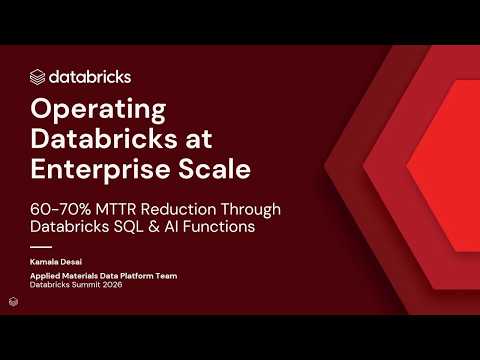
Talk by Kamala Desai, Deputy Director - IT Advanced Analytics, Applied Materials
Applied Materials built five AI agents entirely on Databricks, using Databricks SQL, AI functions and Unity Catalog, to optimize queries and jobs, reconstruct data lineage and speed up incident analysis, producing more than $1 million in annual savings and a 60-70% reduction in incident resolution time. This video shows how the global semiconductor manufacturer runs more than 250 data sources and 4,800 dashboards after a zero-downtime Hadoop to Databricks migration, including one BI dashboard panel going from 52 minutes and $8.90 to one minute and $0.04.
The global semiconductor manufacturer runs over 250 data sources and 4,800 dashboards after migrating from Hadoop to Databricks with zero downtime and 100% SLA compliance. This video shows one BI dashboard panel going from 52 minutes and $8.90 to one minute and $0.04, a PySpark job optimizer that runs beside production jobs to compare schema and data before promotion, a lineage agent that cuts root-cause analysis from 4 to 6 hours to about 25 minutes, and a converter that turns self-service workloads into certified artifacts in hours instead of days.
Chapters
00:00Introduction: AI agents that fix pipelines01:24Hadoop to Databricks migration and platform scale02:15Cost control and reliability challenges at enterprise scale03:31Using AI to manage Databricks operations04:50PySpark and SQL optimizer for BI dashboards05:40PySpark job optimizer validated in parallel with production06:04Self-service workload and root-cause analysis agent07:43Converting self-service workloads to certified artifacts08:09Results: cost savings and incident resolution time09:28Takeaway: use Databricks primitives as an optimizer
FAQs
How did Applied Materials migrate from Hadoop to Databricks?
They completed a zero-downtime migration handling 250+ data sources, 4,800 dashboards and 20,000+ users with 100% SLA compliance by building AI agents to handle query optimization, job validation and incident analysis.
How much can query optimization save?
This video shows one BI dashboard panel that went from 52 minutes and $8.90 per run to one minute and $0.04 per run—a 98% cost reduction and 98% speedup using a PySpark optimizer.
How fast can AI analyze incidents?
A lineage agent cuts root-cause analysis time from 4-6 hours to about 25 minutes by automatically reconstructing data lineage, reducing mean-time-to-resolution and keeping production systems stable.
What's the business impact of AI operations?
Applied Materials achieved more than $1 million in annual savings, 60-70% reduction in incident resolution time, and converted self-service workloads to certified artifacts in hours instead of days.
Full transcript
00:00 Introduction: AI agents that fix pipelines
Hello everyone. Good afternoon. I'm Kamala Desai, a senior manager at Applied Materials, leading the data platform direction. Thank you for joining me. Today I'll share how we use Databricks at an enterprise scale, and how we've applied Databricks SQL and AI features to reduce costs, optimize efficiency, and manageability. So, before we begin, let me ask a question. Who among you has woken up in the middle of the night due to failures in data pipelines or SLA violations due to long-running tasks?
Most of us, right? Yes. And how many times have you spent all your afternoons debugging problems that ultimately boiled down to incorrect joins or filters that only became apparent after three levels of analysis, right? We solved this problem by building our own platform. Instead of us doing the “ firefighting,” the platform is now doing it for us , and it’s this story I want to share with you today. OK? Before we begin, let me provide some context on the scale we are working with.
OK? Yes. In July 2025, we reached an important milestone by successfully completing the migration of our data platform from Hadoop to enterprise-grade Databricks. OK? This was one of the easiest migrations that went through without any problems in the system. Truth? After this migration, we have nearly 28,000 jobs processing data in our system, over 250 sources for data, and 4,800 dashboards based on these datasets and used by over 20,000 users.
01:24 Hadoop to Databricks migration and platform scale
We also have 1,750 business analysts and 370 data specialists who depend on this system. OK. With this scale, imagine how we ensure cost control, system reliability, and the uninterrupted operation of critical business applications. What are the main challenges we faced? After the migration was complete, we faced costs of $4. 25 million per year. These are compute costs in Databricks, production tasks consuming excessive resources, and 24/7 data pipelines in the production environment.
02:15 Cost control and reliability challenges at enterprise scale
Okay, there are times when it takes developers and analysts almost 4-6 hours to fix issues. We have hundreds of unfinished tasks that we don't even see. The main challenge here is how to perform manual tuning, fire suppression, and reactive troubleshooting. So, that's why we decided to show you what we did to overcome this. Okay, sorry. So, moving on to the solution: what exactly did we implement? Instead of always considering the general questions we ask.
03:31 Using AI to manage Databricks operations
We asked ourselves another question, okay? Everyone is using artificial intelligence for analytics. What if we used AI to manage analytics? Therefore, we built our AI agents on the Databricks platform, which made our work much easier. OK. Here is the solution we implemented. OK. We have five AI agents built on the same platform. All of these agents were built on Databricks. No external tools. There are no additional AI agents or other tools connected to the system.
Everything that is available works within Databricks. This does not require any other orchestration tools. Give me a minute. I'll just drink some water. So, all five of these agents are running on the Databricks platform. The only thing we use is Databricks SQL and AI functions . OK. Let me go into detail about all five of these agents and what we did. Yes. The first agent is the PySpark SQL optimizer, which is used for our BI workloads.
04:50 PySpark and SQL optimizer for BI dashboards
Let me give you an example of a dashboard that has been optimized. A panel that worked for almost 52 minutes, for which we spent $8. 9. It turned into a panel that works for one minute. Which only cost $0. 04. Truth? This is not just a typographical error. This is what he actually does. There are many BI workloads that have been automatically configured and ready to be deployed. Next is the PySpark task optimizer. So, this runs in parallel with our production jobs, comparing data between the original job and the job we're running in parallel, checking the schema, ensuring the data matches, then qualifying it and pushing it into production.
05:40 PySpark job optimizer validated in parallel with production
We have thousands of tasks to complete , and imagine if we had to do it all manually, test it, and move it to production. And this is exactly the agent that makes our work easier. Is n't that right? Next is the self-service optimizer. We have hundreds of self-service workloads running in the system that we don't even have access to. The tool takes them on and optimizes them, thanks to which we achieved an improvement of 30–40%, after which they are fully integrated into the system.
06:04 Self-service workload and root-cause analysis agent
Isn't that right? Next comes the troubleshooter . This is where our production support team or developers spend a lot of time. Just to analyze data issues. Imagine that even an average problem takes 4 to 6 hours , while there are problems that usually take whole days. Isn't that right? It's not because people are inefficient. In fact, they are excellent specialists. The problem is only in the increasing complexity and the number of levels that are constantly increasing in the system, which is why people have to analyze many scripts for one final analysis of the problem.
That's why we created this agent that analyzes all scripts. It reconstructs the linearity from bronze layer to silver and gold by analyzing all scripts, getting full context, and gives you the actual SQL query that shows which tables or items need to be joined to get the final result, where exactly the problem occurs. Is n't that right? This reduced our developers' work time from 4–6 hours to an average of 25 minutes.
So, next comes the certified converter. Where we have self-service workloads that are converted into certified artifacts. Previously, this took us several days. With the advent of agents, we were able to complete this in a few hours and then successfully move them into production. Of course? All of this uses nothing outside of Databricks. Everything is built on Databricks, using all the capabilities available on this platform.
07:43 Converting self-service workloads to certified artifacts
Of course? Yes. So, did it really work for us? Look at these numbers , they will show whether these things have yielded results. Of course? First, thanks to these agents, we were able to achieve over $1 million in annual savings across all of our workloads, with an overall cost reduction averaging 20–30%. In addition, the average incident resolution time in production support has been reduced by 60–70%. Thanks to this, we were able to free up the time of most of our engineers for direct product development.
08:09 Results: cost savings and incident resolution time
This has accelerated the work of our support engineers by 8 times, and tickets in Jira are resolved 7 times faster, understand? During this migration, we did not notice any issues, there was zero downtime, and SLA compliance is 100%. Here we have provided some figures that demonstrate the level of reduction in task failures. Once we achieved this, long-running tasks were optimized. This is a continuous process in the system that constantly optimizes tasks and transfers them to the production environment .
Right? The key takeaway I want you to take from this session is: we have all the tools we need in Databricks, right? So don't use Databricks just as a data platform. Please use it as a standalone optimizer, as an optimizer agent. It will automatically optimize workflows for you. Without any manual intervention on your part. We did this work for ourselves, so please make sure you use all the primitives available in Databricks.
09:28 Takeaway: use Databricks primitives as an optimizer
You just need to connect them, use them, and optimize your workloads. Right? And make sure you follow the guidelines set at your enterprise level. Thank you. I have
Learn more about the Databricks Data and AI platform.
The information provided herein is for general informational purposes only and may not reflect the most current product capabilities or configurations.