A New Kind of Database Architecture with Nikita Shamgunov, Co-founder and CEO of Neon
Summary
- Neon Acquisition Impact: Databricks acquired Neon, a serverless Postgres company, to power serverless database capabilities on Databricks Data and AI platform.
- Separation of Storage & Compute: Neon's innovation separates storage from compute, enabling true serverless databases that scale to zero and use cloud object storage.
- AI Agent Databases: The data shows 80% of databases created on Neon are by AI agents, not humans—a signal that AI workloads drive new database architecture needs.
A New Kind of Database Architecture with Nikita Shamgunov, Co-founder and CEO of Neon
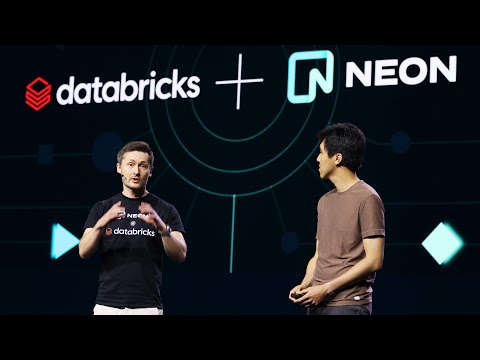
Co-founder and CEO of Neon, Nikita Shamgunov shares how production AI needs a new kind of database architecture. This was the driver behind the company’s developer-first serverless Postgres database and the vision that Databricks + Neon will be taking forward, following the recent acquisition.
Presenters:
- Nikita Shamgunov, Co-founder and CEO, Neon
- Reynold Xin, Co-Founder and Chief Architect, Databricks
See a summary of the product announcements from Data + AI Summit:
Watch hundreds of on-demand sessions on topics from AI agents to data governance:
Chapters
0:00Introduction to Neon0:39Separating Storage and Compute2:22AI Agents and Databases4:04Future of OLTP and Analytics
FAQs
Why did Databricks acquire Neon?
According to this video, Neon's separation of storage and compute architecture enables the serverless innovations powering Databricks' Lakebase product—particularly for AI-driven workloads.
How does separating storage from compute help developers?
This video explains that separation allows databases to scale to zero when unused, support instant schema and data branching for development, and enables developers to think of databases as URLs rather than managing infrastructure.
How does separating storage and compute improve database performance?
Separating storage from compute allows each layer to scale independently, enabling databases to handle high transaction throughput without expensive infrastructure over-provisioning for occasional analytics queries. Compute resources can be elastically scaled up for transactions or analytics without moving data, reducing latency and cost compared to traditional architectures where storage and compute are tightly coupled. This architecture enables applications to achieve both sub-10ms transaction latency and efficient large-scale analytical queries on the same data.
What database systems separate storage from compute for high-throughput transactions?
Neon demonstrates a modern approach to separating Postgres-compatible storage from compute, enabling applications to scale transaction throughput while maintaining familiar SQL interfaces and strong consistency guarantees. By decoupling these layers, the system can provision dedicated compute resources for OLTP workloads while allowing analytics queries to run on isolated compute resources at scale. This architecture is particularly valuable for applications requiring both real-time operational processing and concurrent analytical access.
What database architecture handles transactions and analytics on the same data effectively?
Neon's storage-compute separation enables a unified architecture that handles both high-throughput OLTP and analytical queries on the same business data without architectural compromises. The separation allows transaction processing to optimize for low-latency, high-concurrency workloads while analytics can run on isolated compute resources at scale. This approach solves the classic database scaling challenge where monolithic architectures cannot optimize simultaneously for transactional and analytical workloads.
Full transcript
0:00 Introduction to Neon
We can't not talk about Lakebase without talking about Neon acquisition because that's what power the innovations behind Lakebase. So with that I will actually like to invite the CEO of Neon Nikita onto stage um to talk to us. together with stats and hecki about four years ago and at the time and neon became sort of the leading serless postgress company but that time there's a lot of other postgress companies and all the hyperscaler have postgress what problem are we trying to solve so we actually focused on uh developer experience of all the things the biggest neon innovation is uh separation of storage and compute which does allow us to store data in an open format inside of the cheapest medium uh cloud object stores and you know lakehouse.
0:39 Separating Storage and Compute
Now what does it have to do with developer experience? Well actually a lot. So the one thing that it does allow you to do is to make a serverless system and without separation of storage and compute you it's actually kind of impossible to make a system serverless especially a system that is kind of a traditional database like Postgress. So now you can think about a database as just being a URL, right? And this URL is something you application interfaces with and then according to the application it will increase the size or decrease the size or scale all the way to zero if you stop uh driving that system which is very convenient.
You don't have to think about sizing and you only pay for what you use. The other thing that we we quickly realized when we kind of put a magnifying glass over the developer experience is that developers like to integrate their systems in their developer workflow. And that's where the idea of branching came in. And again, it's only possible to deliver on branching when you branch both schema and data if you separate storage and compute.
So now um to do it instantly at least. Yeah. And to do it instantly as well, right? We use copy and write for this. Um, now to copy and write is not a new idea, but packaging in in in a way that developers can self-s serve consume was a big innovation from Neon. Makes sense. Um, and one other thing that was actually very surprising to me at least is um we noticed um throughout the process, hey, 80% of the databases created on neon. com um were created by AI agents, not humans.
2:22 AI Agents and Databases
So AI agents actually create four times more databases. And here's a chart and it started at 30%. what's going on there? Can you tell us more about it? Yeah, that's right. Um, so, so last year, um, we had 30%, now we're 80%. I actually want to make, um, a kind of a bold prediction. In a couple of years, I think 99% of all the databases on the platform will be created um, by AI by AI agents. I I think we're at the dawn of the AI software revolution, and every engineer is becoming an AI engineer.
What what this means is if it's a human uh then the human is levered by this modern tools such as cursor a windsurf or Microsoft copilot and um but also we now starting to have uh fully autonomous AI software agents agents that generate software um you know specifically um partners of data bricks uh replets and lovable that are that are here part of the our launch partners here um they they just generate apps from a prompt and since every application requires uh needs a database um neon is a perfect solution for that because again database is just a URL database has branching and um AI kind of makes mistakes.
So creating those isolated environments uh in a safe and secure way is a big deal for those AI systems which are really hard to do with traditional databases impossible. Um, last question. Um, what are you most excited about now that Neon's part of Data Works? How do you see the texts coming together even though they kind of were coming together already? Right. Um, well, I'm excited to build the best OOLTP system in the world that is fully integrated uh with the uh data and AI platform.
4:04 Future of OLTP and Analytics
So I I think the um analytical and OOLTP systems um they have been separate uh for a very very long time and there are all these use cases that are pure analytical pure transactionals but then there's also anything everything in between. So I'm excited to not not only build the most um you know scalable and efficient OOLTTP system in the world but also deliver all the use cases for all of you that span the whole range between analytics and OOLTP all based on open source all based on open source.
All right. Thank you, Anikita. And Ali, we're gonna pass back to you.
Learn more about the Databricks Data and AI platform.
The information provided herein is for general informational purposes only and may not reflect the most current product capabilities or configurations.