The New CISO Mandate: Navigating the Speed vs. Risk Dilemma in a World of Agents
Summary
- This video features a CISO panel with leaders from Anthropic, Rivian, and the Cloud Security Alliance exploring how to deploy AI in the Security Operations Center without introducing new enterprise risks, and how AI changes the fundamentals of vulnerability remediation.
- Panelists discuss how AI enables continuous controls monitoring as an alternative to point-in-time compliance audits, and how it can compress vulnerability remediation cycles and triage alert backlogs into prioritized risk signals.
- The session addresses governance patterns for AI coding agents as enterprise identities, kill switches and oversight mechanisms for autonomous SIEM architectures, and practical security roadmap priorities for leaders navigating agentic disruption.
The New CISO Mandate: Navigating the Speed vs. Risk Dilemma in a World of Agents
In the race to outpace automated threats, AI is no longer optional, it is the primary defense. However, deploying AI within the Security Operations Center (SOC) requires more than just new tools; it requires a new framework of governance to ensure those tools are safe, unbiased, and effective.
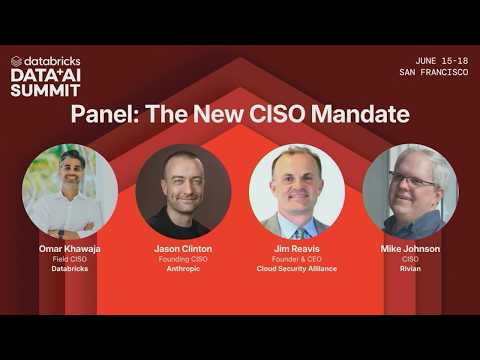
Join Databricks Field CISO Omar Khawaja and a panel of security experts as they explore the intersection of AI governance and real-world SOC operations. We will dive into the practicalities of:
Operationalizing Safety: How to deploy AI-driven detection and response without introducing new enterprise risks.
The Velocity Gain: Leveraging AI to radically compress vulnerability lifecycles and patching windows.
Guardrails for Autonomy: Implementing the essential governance "kill switches" and oversight needed when moving toward an Agentic SIEM.
this video provides a practical roadmap for security leaders trying to navigate the "Speed vs Risk" dilemma of deploying modern AI technology.
Talk By: Jason Clinton, Deputy CISO, Anthropic ; Jim Reavis, CEO, Cloud Security Alliance ; Mike Johnson, CISO, Rivian ; Omar Khawaja, VP, Field CISO, Databricks ;
Chapters
00:00Introduction: CISO Panel on AI and Security Governance01:05CISO Confidence Gap: Why 4 Out of 10 Is Worse Than It Sounds04:30VulnOps: Rethinking Vulnerability Remediation at AI Speed07:07Open-Weight Models and the Zero-Day Risk Horizon10:33Autonomous SOC Architecture: Where to Start14:01Continuous Controls Monitoring vs. Point-in-Time Audits17:25AI-Assisted Alert Triage: From Jira Backlog to Risk Signals20:47AI Coding Agents as Enterprise Identities: Governance Patterns25:58Risk Spectrum: External Adversaries vs. Insider Misuse31:08Q&A: Agentic SIEM Kill Switches and Oversight Mechanisms34:33Coding Agent Governance in Practice at the SOC38:00Audience Q&A: 18-Month Security Roadmap Under Agentic Disruption41:25Closing: Security Leadership in the Next Six Months
FAQs
How is AI changing vulnerability remediation speed for security teams?
This video's panelists discuss how AI enables a fundamental rethinking of vulnerability remediation, with the potential to compress the time from discovery to patch for known exploitable vulnerabilities. However, they note that AI is also increasing the total volume of vulnerabilities that must be addressed, requiring security programs to be redesigned, not just accelerated.
What governance controls does an AI-powered SOC need?
The panel discusses the need for kill switches and oversight mechanisms when operating autonomous AI agents in a security context, as well as continuous controls monitoring to replace point-in-time compliance audits. Designing for breach — rather than assuming prevention — is cited as a foundational shift for security programs in the agentic era.
How should enterprises govern coding agents from a security perspective?
This video discusses treating coding agents as enterprise identities that require their own governance policies, access scoping, and audit trails. Panelists explore risk patterns ranging from external adversaries exploiting AI-generated code to insider misuse scenarios, and recommend centralized governance infrastructure as the foundation for safe coding agent adoption.
What are the biggest AI security risks enterprises face right now?
The panel identifies key risks including the explosion of AI-generated code that may contain vulnerabilities, challenges in tracking provenance and ownership of AI-generated components, and blind spots in AI-native environments where traditional security tools have limited visibility. An average CISO confidence score of four out of ten cited in this video reflects the industry's difficulty adapting security programs to the pace of agentic AI.
Full transcript
[00:09] Okay, good uh good evening everyone. Thanks for making it to the end of the Tuesday of Summit and thank you for being here for our inaugural Cyber Day. We've got uh quite a treat for you. I'm uh super super excited to have a lineup
[00:23] of three amazing celebrity cyber leaders. The first person I'd like to welcome on stage is Jason Clinton, who's the founding CISO at Anthropic. Please give a big round for Jason. Awesome.
[00:38] And uh next we have Jim Rivas. Jim Revas is the CEO and the founder of the Cloud Security Alliance. Thank you, Jim.
[00:53] the CISO of Rivian, a company that uh all of you know and uh needs no introduction. So, um awesome. So, thank you to the three of you for joining us on this uh on this
[01:05] panel. I'm pretty excited to get into this conversation. I'll maybe start off with there's been many many papers talking about the state of the security industry and the DBIR has all sorts of statistics around what's happening with
[01:17] our ability to remediate known exploitable vulnerabilities. That rate is of course getting worse not better. And of course uh AIU did a study and they found uh when they asked CISOs
[01:29] their level of confidence in operating a security program in the age of mythos, what's your level of confidence? And the average answer was four out of 10. And so for each of you, we'll maybe start
[01:41] off there. Like does that do those stats surprise you? And what does that say about the uh industry and what's to come? >> No, I I don't think it surprises me at all. We're in a world now where Mythos and has changed I think the way that we
[01:55] think about vulnerability tsunami uh so to speak that we're all facing and we we have been behind on vulnerability patching for a long time. And as an industry now we have to reckon with uh a huge uh increase in the total amount of
[02:09] vans. Um and so you know that that you know vulnerability remediation is just one part of the entire threat landscape shift that's that's going to be happening here. But I do think we have to fundamentally rethink some of the some of the ways that we've prioritized
[02:21] our security programs. add anthropic. You know, we're using AI as a part of our, you know, security defenses, as I'm sure um you know, no one would be surprised about, but um there's there's lots of little strategic changes that
[02:35] have nothing to do with adopting AI. Just to give an example, one of the things we called for in our paper for postmethos defense is that you design for breach. Um and we've been saying zero trust and uh you know um you know
[02:50] designing for breach and resiliency for more than a decade now and it kind of became a marketing term. Yeah. >> Where no one really knew what we were were we were saying. Um but we really do actually have to design for a world where you know a system does get
[03:03] breached because it will happen and then and then you you know uh your your mean time to recovery is as short as possible. Interested? Can't be like the fires in the Middle Ages where one building catches on fire and the entire city burns down. >> Yeah, collective defense is important.
[03:16] Yeah. My my take when I saw that is I actually think it's quite a bit worse than that. Four out of 10. I think there's sort of a selection bias. These are actually people who cared and were looking like thoughtfully about what
[03:28] they were doing. And you know, you just have this whole spectrum of like the ones below the poverty line. We we did a briefing on this last Friday for a state
[03:41] and so they had every agency they had all the K through 12 and it's like what are we going to do? I'm I'm just a guy and I'm responsible for this sort of school district. So, so there is there
[03:53] is a lot of this sort of thinking about, okay, shift left is like that popular security term, but maybe operate right or maybe shift right. We're going to have to look at like across the board
[04:06] modernizing a lot of things. And you know the the headline of this has been vulnerabilities and um we we need to be thinking not just about the volume of them because
[04:18] now we know that's going to be huge but the there was at some of these events we've been doing mythos ready events it's what's the vulnerability absorption rate what do we what what can we do to
[04:30] actually process these things with something we're now starting to call vulnops and we got to go define what that is I think that's a task ahead of us. But yeah, there's Jason said, there's so much like non AI things,
[04:43] deterministic technologies that now we know we really need to apply those across the board in like a real comprehensive way. >> Wow. Thank you. >> Yeah, I think the the four out of 10
[04:55] surprised me uh for two reasons. One, Caesars are traditionally uh kind of like Eeyore, right? Like the sky is always falling, everything's always bad. Yeah. But at the same time,
[05:07] there's at the time of that survey so much uncertainty. And so the four actually feels high. Like how can you score that without really know what the heck is going on? Uh but as both Jason
[05:22] and Jim have said, like the opportunity here is to really revisit the things that we've talked about in the past that make sense and eject the things that don't. like going and patching faster is
[05:37] not a solution like that that is not how we are going to move forward. Uh but certain things like we've talked about zero trust and identity matters and authorization boundaries all of those
[05:51] that we have talked about and had become marketing terms. The opportunity here is to go and revisit those. And that's the world that we're in now. And that's what we need to start thinking about. And that's how you
[06:03] move off of that for you. You revisit some of those things that hey, these were actually good ideas. We just couldn't implement them in the past. And now you have an opportunity.
[06:15] >> I love this. But I and I just want to Yes. understand this in the sense that there's a huge opportunity ahead of us um to finally be in a permanent um uh defender dominant world. Uh and all of
[06:29] the changes that Mike just talked about we will have to make collectively as an industry. Um but at the same time that that is happening uh we will be fixing software vulnerabilities as a holistic
[06:41] um problem over the next couple years. Now that that is a bold and um some some would say hyperbolic claim, but if you just think about what's going on right now in the biggest companies in the world who make software, if you make
[06:54] software and data bricks is included here, um and you're looking at Mythos uh a world where everything that's occurring uh is um is making it possible potentially, you know, a few months from
[07:07] now for open weights models to enable somebody to find new zero days as soon as you put your new release your software release out the door, you can't ship security bugs anymore. And if you can't ship security bugs as a software maker, over the next couple years, we
[07:20] will get to a world where everyone who makes software goes to ship zero. Um, uh, you know, meaning that we can't have security bugs go out the door. Now, maybe we still write security bugs, but we find them with powerful models before
[07:33] they go they get shipped. But I do think that we will still have all of the problems that are solved by the technology changes that Mike is talking about even after we have a zero vone world because humans still make
[07:46] mistakes. People still misconfigure cloud infrastructure in the year of our lord 2026. People still put S3 buckets on the open internet with PII in them. Um and none of those have anything to do with vulnerabilities, right? And so it will still be very busy as an industry.
[07:59] I just think vulnerabilities are a flash in the pan. >> Yeah. If if I could just say like we've got coding agents now that like so many developers don't even code and can generate so much code so much more quickly, but we haven't really
[08:11] fundamentally sort of rethought what we do now in terms of deploying software now that we can do that. And that's actually something I'm really excited about. I think Google talks about stale software and what a risk that is. And I
[08:25] think we will get to a point where we really we we have the mechanisms to refactor software so rapidly that a lot of vulnerabilities may become really mood because by the time you identify
[08:37] that the software has already changed. So we we'll see. I'm excited for that thing sort of thing. >> Rewrite it all in rust.
[08:51] >> William Gibson. Yeah. and and so like a lot of what you're seeing you're ahead of the rest of us and other enterprises. I'm curious if there's anything from your perspective based on what you see
[09:03] you'd say for the other CISOs that are maybe six months or a year or two years behind. What's something they should unlearn? What's something they should stop doing? Yeah, I mean I I agree with everyone's uh comments here that v
[09:15] management uh can be augmented by AI and you can put a huge amount of energy and effort into that and getting to the place which we're doing inside of Enthropic on automated vulnerability remediation but uh also if you can just scrape by for the next two years uh
[09:28] we'll be in this postbone world and I I think there's you know some trade-offs to be thinking about there. If there was only one thing that I would ask security leaders to consider right now is that find it is this when when uh models uh
[09:42] get smarter for attackers, you need to have a security program that scales with model intelligence as well because these bad guys and we've been sharing intel on this, you know, for more than a year now. Uh when the bad guys take models,
[09:56] they're they don't have to go through a um compliance process to choose the model that they're using. They're they're just going out and grabbing whatever um models they can get their hands on. So, um, if your security program has some kind of defense that
[10:08] scales with model intelligence, then you're going to benefit from the model intelligence at the same pace that the bad guys will. Um, and the very specific department inside of your company where that is most true is defense, uh,
[10:21] detection and response, DNR. Um, so if you're a detection function and and there's like 58 startups doing this. Uh, there's there's a number of companies who are are shifting their product
[10:33] portfolio to have autonomous sock. So that's a place to start, but it's not the it's not the beall end all. You need autonomous sock. You need uh SIM uh uh analysts and you also need a sore you need fully automated remediation because
[10:46] if you can have a breach occur which we know is going to happen and then remediate find and cut it off and cut the device off where the where the breach has occurred within minutes you can prevent that lateral movement and
[10:58] and I think that's really the one thing that I would index on. >> I love that. I think this idea of really thinking about the value chain. So when you find a vulnerability you've delivered zero value. When you declare an incident, you've delivered zero value until you've done the remediation part,
[11:11] until you've done the containment part, there's no value that occurs to the organization. So when you're thinking about how to move in a postthos world, don't just think about I'm going to do this one part, but think about at what
[11:23] point do I can I stop and I've actually delivered real value to my organization. And now with the world of agents, you can stitch them together to to uh to actually get to that. Um Jim, you know, you've been preaching to
[11:37] the industry for a very very long time and you sort of bring that point of view. What's something that you would love for organizations and security teams and CISOs to maybe un unlearn and
[11:51] just stop doing and give them space to be uh ready for this new reality? >> Yeah. So I think there's been so much uh it's we we we know we talk about
[12:03] security's journey but there's been so much point in time security where you look at this as a goal let's let's roll out this new MFA system or let's roll out something else and then we're sort
[12:16] of done and to what Jason had said there's actually was a paper that NIST produced last week that it was a basically a mathematical proof that you
[12:30] can't have sort of a finite set of guard rails to control cyber security and it was specifically looking at AI as the use case here and I'm I'm I'm not a
[12:42] scientist there's probably some of you read it but it was like extending some some longheld mathematical theories and and so it's really saying that continuous uh approaches to how we think
[12:54] about this monitoring ing auditing the telemetry and have that continuous sort of feedback that's that's not only going to optimize security really in the age of like predictive AI and machine speed
[13:08] that uh Jason was talking about it's going be completely necessary so we need that mentality mind shift that it's not about getting ready for a quarterly audit or these specific milestones I
[13:23] mean there's projects that we want to do but those projects themselves have to be like thinking about and implementing things that are like um continuous and that's that's not easy to understand that because cyber security it's it's
[13:37] this science it's this art there's so many different nuances there's there's your supply chain that you have oneperson company that's doing something critical that you don't even know and so
[13:49] there's there's a lot that comes into that so I'm not saying it's easy but I think that's just like that's the big mentality shift if we go like through our entire program and understand how we
[14:01] can like make sure that we're we're approaching real time where we can do that that's going to be like a big benefit in the long run. >> It's almost like you know we if we think about execution whether it's in the cyber context or other enterprise
[14:14] context there is this notion of precision and determinism. So if we do the same thing in the same sequence every single time, we'll get the outcome that we need and we're now entering this world where that level of determinism
[14:27] and precise execution is probably not going to help. We need to continuously be looking at the variations and the variance and sort of welcome in this idea of nondeterminism to be able to
[14:39] protect against a very uh very dynamic adversary using uh using AI in the world we're in. Uh Mike, I'm I'm I'm curious as you think about this from the perspective of an organization, a very
[14:51] um and you operate in a pretty rich threat landscape and you hear a lot of this. On the one hand, there's sort of challenges that AI brings with it. On the other hand, as we learn about the
[15:03] capabilities and the technologies from a defender's point of view, what are some things that now become viable that get unlocked that maybe three years ago you would have wished to do but you just wouldn't have been able to do it?
[15:15] So Jim was talking about uh compliance and it being point in time the quarterly audits and and one of the things that we've talked about for a long time is uh continuous control validation like we
[15:29] always know the state of all controls in the organization and that is one of the things that's unlocked. Uh if we have and we can now have the entire inventory of all of our
[15:43] controls, we can know the state of any of them both now what it was and what it might become the non-determinism. That is something that is unlocked. That is a capability that we didn't have. We
[15:56] we were like, hey, let's do continuous controls validation. Nobody knew how to do that. >> Yeah, >> it was a bunch of reaxes on SIS log. It never worked. But now that's something that is unlocked. That's a capability
[16:09] that we have that we didn't used to have uh that we can engineer towards and we can really uplevel the entire program as a result. >> One thing to add to that um one of the
[16:21] things uh we've started doing at Enthropic is additionally in addition to controls monitoring which is excellent um doing risk register monitoring as well. So you can have, you know, an AI
[16:34] going through your Slack and your docs, um, or whatever you use, uh, looking for information that updates your risk register or identifies new risks that were not there before, um, and then attempts to appropriately score them and
[16:47] and and assess impact based on, you know, your threat model and uh, the the kinds of challenges your organization has. This has actually been quite useful because from an ISO 27,0001 sort of auditing perspective, you need to
[16:59] maintain that risk register uh and bring that to an executive monitoring and you're just getting a live view at every one of these executive meetings of exactly where the risks in the organization are that's been continually updated along with the controls uh
[17:12] monitoring as well. So, it's been really helpful from the GRC. >> I love that we actually built something um identical to that. We call it the data brisk risk app where we essentially say instead of doing interviews, instead of talking to some people, instead of people saying what does their gut say?
[17:25] Is this as high? Is this a medium? Is it a low? Like we've got all this data in Jira and in Confluence pages and in Slack and in incidents and email. Why don't we just suck all of that in and see if we can make use of it and create
[17:38] a real-time risk register? So, if anyone's interested, let me know. We're going to we're going to work on making that open source and you can run it as an app in your data bricks environment. Um >> ju just real quick to to add to that like imagine a world where a risk is
[17:51] detected, opened, remediated and closed >> without the security team ever being involved. Like that that's exactly what Jason is talking about is you have that
[18:03] knowledge, that organizational knowledge. Teams are doing the right things and at the same time they're not necessarily slowing down to say, "Hey, we should go tell security about it." they're doing the right thing that you
[18:17] may not be aware of, but it can be open and dealt with and closed and the organization is in a better place as a result. >> Yeah, I I love that. You know, for for a long time we were talking about this idea of human in the loop and if you
[18:30] apply human in the loop to that, it sort of falls apart because if a human has to go review this, how are we possibly going to keep up with the mythos level velocity and uh and speed? It's not going to happen. And so the newer
[18:42] paradigm that I've I've heard or some of our more mature customers talk about is this idea of the human at the helm or the human on the loop. So if you if you portray the world of security as a
[18:55] factory floor and we're working through incidents and we're doing the triage and we're doing the response and remediation and having all these calls, the idea is for the security team to no longer be on the factory floor. The idea is for them to be up at that second level overseeing
[19:08] the factory floor and making sure that the agents are doing all the right work. So the idea is not that you leave it up to the agents to go do this on their own. You're still overseeing them. You're still governing them. You want to make sure they're not going ary, but
[19:20] this idea of the human in the loop feels less and less like a viable one. >> Yeah. >> Yeah. Just to add an like a very concrete example of how that's happening at Enthropic now. Um human code review is the bottleneck. Um
[19:32] >> Yeah. And this is Amdell's law, right? Um, so what we've tried to do to eliminate this is we've worked with our compliance team and our legal team to understand where we can remove human code review. Um, you know, from a
[19:45] compliance perspective and it's still the case today, at least as far as we've been able to determine that you still need it for Sarbain Oxley compliance. So any financial critical system uh still needs it, but um getting rid of human code review is a high priority for us
[19:57] right now. So I'd say I'd guess that we'll be there soon. Yeah. >> Yeah. And I I've seen uh similar examples in like financial services in multi-agentic environments where you you set them up separately with different
[20:10] goals and sometimes even different models. And so you have that judge agent that's like really maintaining what and and checking what the other agents are doing and you get a lot more predictable. You get a lot more der
[20:23] deterministic outcomes than you might expect. So governance in the loop, you know, with humans sort of creating the goals. It's like where we're going. >> Sometimes this is called scalable oversight. Um I think that's the that's
[20:35] the phrase I like to think of. >> We we definitely need that. Um Jim, one of the things you've been working on is uh this new initiative around CSAI and as I've heard you speak about some of these things, I almost sense a sense of
[20:47] excitement and opportunity for the industry that we haven't had um before. telescope about CSAI and I think it's got some designation from um NIS to be able to actually be a numbering authority for CVES and how do you
[21:00] imagine CSAI as you look at the world of Agentic being sort of a dramatically different than perhaps things that uh that preceded it? >> Yeah. So, you know, we we've, you know,
[21:13] been around for 17 years as cloud security alliance and there's there's a lot of echoes in AI in terms of this this it's delivered through the cloud actually shared responsibility. this is
[21:26] just moving way faster and so we needed like a dedicated entity that was really focused to this and also we did we did some things with the structure so we could take funding from different types
[21:38] of sources to really move sort of quickly. So uh you know part of like
[21:50] do a quarter ahead two quarters ahead and really we need to like we need to understand we're in two exponentials right now step level changes in models viral adoption of agents that together
[22:05] are like creating huge issues that we got to be thinking about where this is happening a year or two three years part. So, so the the things that there's like I'll just point out three like sort
[22:17] of major things we're we're looking at. One is catastrophic risk of models as as they're pretty powerful now, but what are they going to look like a couple years from now? And so we we've got to
[22:29] be able to understand how we can have a an ecosystem that is able to measure those areas. So, we actually had a a Silicon Valley benefactor fund this for us for an 18-month pro um project. Get
[22:43] in CISOs, get in AI safety experts, get in auditors, and let's go figure out how we can identify, hey, a novel pathogen or radiological other issues can happen
[22:55] and and how can we like identify within the model cards and and everything else. Identity management, again, a lot of different sorts of controls. um the the um vulnerability side, the thing that
[23:07] you mentioned is CNA. That's the CVE numbering authority. That's where you can be a um a a special numbering authority and issue CVES. So the CVE program great it was it was invented in
[23:21] 1999 for pre-cloud even it was shrink wrap software and so we are trying to take that into a new age by like with what we want to do is look at specifically agentic types of
[23:34] vulnerabilities and other things which they don't even fit necessarily the traditional view of this and so what we see happening is bringing this together in a way that we get the industry
[23:47] together to like sense some issue some audit classify what it is and then route it to the proper authority which could be aert it could be a information
[23:59] sharing and analysis center could be another CV or it could be some new entities that we haven't created yet and that we we need to go create so so that's it and then finally the the like the second of the exponentials is really
[24:14] understanding the nexus of agentic AIs between being this statistical model and a humanlike digital worker. And I I've I
[24:27] love playing with Claude code. It's his fault I don't get any sleep,
[24:41] back to do its job. and I I wrote about it that I gave my agent PTSD because it just refused to very human-like interesting sort of capability. So, we feel that sort of that's this longer term research we can do with our CSAI
[24:55] foundation that maybe we come up with new sorts of like a a certification that looks like a human-like education certification for agents that doesn't exist now. So it's a lot of fun, a lot a
[25:09] lot of different work that we need to do and I think it complements is like provides more tooling that enterprises ultimately will be able to use as we change the ecosystem. >> I love that. You know I was uh recently
[25:21] using uh harness and coding something. I mean not me coding it. The agent did all the work. I just told it what to do which is why I can call myself a coder. Um but uh as part of it, it sort of said
[25:33] that uh there it detected a prompt injection attack and it turned out it wasn't. It was just an overly eager uh skill that I'd written and it tried really hard to to go meet my objective
[25:46] and I wasn't there to give it permission. So it decided instead it was going to go find any credential databases and any OOTH tokens it could use to complete the work that I was doing. I I'm curious for each of you,
[25:58] what do you see as the bigger risk? Is the bigger risk that that there's someone like me that doesn't really know how to wield AI properly and potentially causes a risk to be realized or how much
[26:10] or is the bigger risk really that there is a trained adversary that is specifically attacking you?
[26:22] So the reality is the adversaries have always been out there and there will always be more of them. Uh now they can be faster, they can uh test more things.
[26:34] Uh it it's a speed uh issue. uh the person making a mistake uh that risk uh is also always been there and AI
[26:48] is helping to scale that as well. Uh it can allow humans to make mistakes at machine speed. Now I I don't know that you can say one is greater than the
[27:00] other. Uh the reality is you have to address each of them separately. You have to look at them in different ways. uh the person making a mistake with the way that they use AI, that's a different
[27:14] set of controls that are probably novel. There there's something there that is new. The other side of you've got attackers coming at you faster, harder, smarter.
[27:26] That is more traditional controls. Uh what it tells us though is we can't rely on humans in the loop to defend us in
[27:38] those situations. We have to revisit and implement hard barriers where we can like those things that we can just take off the table. There's no reason for people to be using
[27:50] just passwords anymore as an easy for instance is a lowhanging fruit, right? But we know that that's still out there. We know that that's still happening. You need to look at what are those barriers that you can build that just
[28:03] completely eliminate things. It doesn't matter how hard or fast or how much they throw at that particular control, it won't yield. That's what we need to be looking for in dealing with in that scenario. the uh
[28:18] human making a mistake. That's how we need to think about how can we support them, train them, teach them, give them the appropriate guard rails so that um either decreases the
[28:32] likelihood of them making a mistake or decreases the impact like the traditional risk uh equation of impact versus likelihood. address one or both of those and that's how you deal with
[28:46] the humans on the inside who they're just saying, "Hey, go do this for me." And it's going to figure out how to do it. You have to figure out how you can restrain or constrain that impact of it
[29:01] going off and doing something, solving it in a way that's unexpected. Um I think those of you who've been in this industry for a long time remember um the ancient history of 2019
[29:27] for insider risk and insider risk mitigations. Um we're back we're back to you know everything old is new again. Um so uh you know whether it's an external attacker or an a rogue agent uh it's
[29:40] indistinguishable from an inside risk perspective and and so um you know we know that them we know that the TTPs of some of the um you know run-of-the-mill DPRK actors or IGRC
[29:53] um folks will use um you know getting a beach head on an employee laptop and then moving laterally uh inside of your network. uh and it's the same, you know, the same kind of an attack pattern that
[30:05] you would see from an agent that's been misaligned. So this this um whether it's a misaligned agent or or it's an attacker, I think you've been augmented by AI, uh the defenses are the same. We have to have, you know, designed for
[30:17] breach, zero trust, um like all the things that Mike was just talking about. So I think in many ways it's the same same playbook no matter what. And I I'd say that like if you're threat modeling now, you just need to understand the world of mythos that like this idea of
[30:30] skip of script kitties. It's like everybody's got nation state capabilities now. >> Yeah. Just just a point on that. My my guess is right now based on based on the the best threat intel that I've seen uh
[30:43] is maybe 7 to 10 months from now before open weights models have mythos level um offensive capability. So that does give us >> Thanks for the good news. Yeah.
[30:56] busy and vendors will make a lot of money in the shorter term, you know, but uh we will we will get to a place where the vulnerabilities are gone. So, I think that's that's why I'm optimistic. No. >> Um uh I've got one more question for the
[31:08] panel and uh closing and we will have a few minutes for questions. So, if you do have questions, I think Taylor is somewhere out here with a microphone. So, he is out up here. So maybe if you have a question, make your way to that
[31:22] staircase and uh uh then you'll have the mic rone to uh to ask questions. There's also a microphone on on that side. So if you guys have questions late on a uh late on a Tuesday evening, please uh get
[31:34] in line. Um uh my other next question is you you know all three of you have been doing the defensive work and getting your organizations ready to prepare for
[31:46] how uh how to be ready for what's going to happen in in seven months and in many ways what's already happened because we've seen the time to exploit a vulnerability from the time to disclosure that shrunk. The number of uh
[31:59] events is increasing. We see all of those crazy numbers. What are some of your learnings? What are some of your gotchas? Are there things that you thought would work and turned out they didn't work and you're iterating a
[32:12] second time or a third time on? Could be from a technical perspective. It could maybe even be I know a lot of CISOs are asking the question, how should our work structure be and what job descriptions should be updated? What current roles do
[32:25] we need to eliminate because the agents can do? what new roles do we actually need to replace them with to be better prepared for for this new world? So, I'm I'm curious of uh any gotchas that uh that you've come across that our
[32:38] audience can uh take away as things maybe to uh try to avoid. >> I would just say like refocus right now. This is not as much about how you secure AI versus how you use AI to secure
[32:50] everything and transform. And you talk about job titles, be builders. Like I think cyber security needs builders that know how to use this. And the the the industry is great. They're not going to
[33:04] solve it all for you. There's a lot that you're going to have to build. A lot of your own technology, a lot of your own agents you're going to need to build. >> Maybe get out of the chatbot. >> Yeah. Well, I I think that's the opportunity, right? is you now have the
[33:17] opportunity to pivot your team to be builders, to go and solve those problems that like, oh, if this product just existed, like if somebody could sell me this one thing, just go build it. And
[33:29] and that's the world that we're moving into. And and that's part of what excites me about this sea change that we're a part of is you don't have to wait for somebody else to solve your own
[33:42] problem. See a problem, fix it. And I I don't think it's like restructure your team or uh reorg or or whatnot. It's transform the team that
[33:55] you have. They have skills, knowledge that just needs application. Give them the tools and the capabilities. Get out of their way. And it's amazing what
[34:08] happens. My my one of my uh engineering managers recently said, "I can't keep up with the rate of what my team is shipping." Now, we're a security team. And that's not something that we could
[34:20] have said a year ago. So, building, turning everybody into builders, giving them the permission, the opportunity, shows them the art of the possible. You get them out of the uh the
[34:33] chat interface. fire up a claw code or codeex or whatever your choice in an all hands say hey let's just build something show people how easy it is get them past some
[34:47] of that initial fear and you'll be amazed at what you get out of it >> what what prevents organizations from doing that because I hear from a lot of security individuals professionals that our CISO won't allow us to do that
[35:00] that's really scary and we're gingerly going through this and were so sort of like most security teams seem to be stuck in the chat window. How do they like cross that cap? >> Yeah. So, I talked to a lot of customers and I hear lots of concerns uh across
[35:13] the board from from enterprise data risk, data governance issues, DLP, regulatory oversight, just there's a litany of reasons people might feel reticent um from a policy perspective.
[35:26] And then I think there's also reticence or resistance from rank and file uh employees because they don't necessarily feel like the company has their best interest in heart like there's this concern around uh job displacement. Um
[35:39] and one of the ways we've addressed this um is actually somewhat adjacent to to what Mike just said. Um at Anthropic we you just go look at our website today you'll see that we don't have any junior
[35:51] roles posted. There are none. Um and you you we we we went through that process of saying to our folks like look uh junior roles are going away. There's this career path. An example is our um our analysts who are working on our
[36:04] sock. Um they are now junior detection and response engineers. We didn't lay anyone off. So there's this like conversation where we're saying very clearly if you work and you invest in automation, if you can move faster,
[36:16] we're going to look out for you as a company and that will not result in layoffs. and and that's been that's been part of the conversation uh that we've been having with our folks. I think the other thing that I mentioned um just briefly uh as we as we think about the
[36:29] future and and some mistakes that I've learned the hard way um when I first joined Enthropic 3 years ago, we had no product, no revenue, no customers. We were 100 people and I took um like the best security um like org design and
[36:44] operational technology that I can think of and like how to run an org to Anthropic and it's sort of like okay we're going to do OKRs. We'll have a we'll have a we'll have a two-year roadmap. Um you know uh all of that was
[36:56] a complete waste of time the punch line. >> Yeah, exactly. And you know just to give you an example of how fast things are um I honestly we don't have anything more than a 90-day plan at Enthropic. Um and uh and in January it was publicly
[37:10] reported that we we conceived of built a prototype for and shipped co-work in 10 days. Um and that's the kind of philosophy that we're that we're operating under now. So honestly, if you have 18-month road maps, just throw them
[37:23] out. Um if you have an 18-month road map, it'll be completely disrupted. Even if you do nothing in your organization differently, I can guarantee you that there will be another mythos type moment or something like that that's going to,
[37:35] you know, uh flip the table um um from your planning perspective. >> Wow. Uh I guess we'll take the uh question in the back. >> Hey, thank thank you guys for uh coming and speaking to us today. Very
[37:47] enlightening. Uh I love the idea of Agentic certifications for the new ecosystem. My question really is for Jason and it comes with a a timeline that you've mentioned a few times early
[38:00] on in
[38:13] you step us through your mind what we look like in about seven months to two years? Seven months from now, I would anticipate we have the first example of
[38:25] a threat actor using a model to do something like a colonial pipeline hack, a solar winds, a log forj at scale. And we have an industrywide P 0 response. That would be like 7 to 10 months from now. My guess and I would guess that for
[38:39] the subsequent 12 to 18 months after that, we have one of those happening every quarter or maybe a little bit more frequently. That would be my my ballpark estimate for the kind of difficult time that we're all
[38:52] going to be going through together. Um but at the same time that this is happening, it will become um industry standard best practice to put advanced AI models in your CI and CD pipeline at
[39:04] every software company in the world. And if you're not doing that, it'll be like going into a software company and finding out people don't do code review. um uh in terms of like um you know social social expectations and perhaps
[39:16] even regulatory expectations. And so I would anticipate while it's going to be very rough and and potentially extremely bad for operational technology and uh critical infrastructure um there will come a point um approximately twoish
[39:31] years from now when all of the software in the world just doesn't have security vulnerabilities any anymore. And I know that's a bold claim and and I've heard arguments about the halting problem and uh computer science and the
[39:43] theoretically rebuttals to this, but the pro the thing is there's only so many ways for software to be wrong in a way that's also useful for an attacker. Um and uh that that that is just what we
[39:56] have to eliminate. Um we're not going to adopt formal methods in two years. I'm not saying that it's impossible. We're not going to rewrite all the software in the world in Rust in two years, even though I love that. Um, but, uh, I do think we can get to a place where we
[40:08] just prevent the bugs from going out the door. >> Love it. Well, um, uh, thank you for the question. We've got just a couple minutes and in the final couple minutes, any closing thoughts? Maybe something that you're hopeful about or a wish that
[40:20] you have for the, uh, for the industry? >> What I would say is this is an opportunity to lean in on like there have been a friend of mine used the term cryerity.
[40:33] So a crisis is an opportunity and really the way that we should be thinking about this and and the opportunity ahead of us is everything is transforming.
[40:45] That means that we should be a part of that. We should be leaning in. We should be helping. Uh I remember when the iPhone came into the enterprise and that was just absolute panic. Uh, I was at
[41:00] Salesforce while we were trying to figure out what cloud security was. All of these opportunities, if you're a part of them, if you can actually take advantage of them, you're going to
[41:12] come out better. And that's really what we have is it's changing very quickly. But that's what's exciting to me is like we have this opportunity to fix things that we've not fixed in the past. >> This momentum, take advantage, ride the
[41:25] wave. So look at how software development has changed in not even 12 months but like six months. Assume that cyber security
[41:37] is going to change in the same way and the profession and everything else maybe not quite that quickly could be that like the the data lake data bricks and building agents on that it's going to do
[41:50] a lot of disruption to this industry. Who knows? So assume that and then figure out how to start building it. >> Awesome. Jason. >> Yeah. The last thing I would say would be um you know um the reason I come out
[42:03] and do these uh speaking engagements is I I'm trying to make some awareness of the changes that are coming down the pike. Um if you think that something like the mythos moment is the last event
[42:15] um uh in the story, I you know I want to disabuse you of that. Um there there are these incredible um something called the scaling laws that predict that models
[42:27] will keep getting more intelligent. And two weeks ago we released um some evidence publicly that u we're sort of like just now starting to see the beginnings of something called recursive self-improvement where the model is
[42:39] making the model get smarter um completely without human involvement. And if we think about the way that that will change the threat landscape. Yes, we will be entering a defense dominant world. But we will have many many new
[42:52] problems as you know many many people have said this before. CISOs are risk leaders and we will have new risks to manage that have almost nothing to do with traditional cyber security. So be thinking about how do I get my risk
[43:05] program in order and I I'm very optimistic succeed. >> Lots of opportunities. So the good news is we won't have these problems. The bad news is we're going to have a whole set of new problems. Well, that's all we have time for. A big big round of applause for my amazing guests, uh,
[43:18] Jason, Jim, and, uh, and Mike. So, thank you all for being here.
Learn more about the Databricks Data and AI platform.
The information provided herein is for general informational purposes only and may not reflect the most current product capabilities or configurations.