Multimodal AI & Next Gen Databases | Data Brew | Episode 42
Summary
- Multimodal complexity: Managing images, videos, vectors, and subtitles alongside traditional data requires specialized systems beyond traditional database capabilities.
- LanceDB solution: LanceDB is a database optimized for multimodal AI, enabling efficient querying and processing of diverse data types at scale.
- Future of AI: The shift toward holistic AI systems that integrate multiple data modalities will drive enterprise applications and competitive advantage.
Multimodal AI & Next Gen Databases | Data Brew | Episode 42
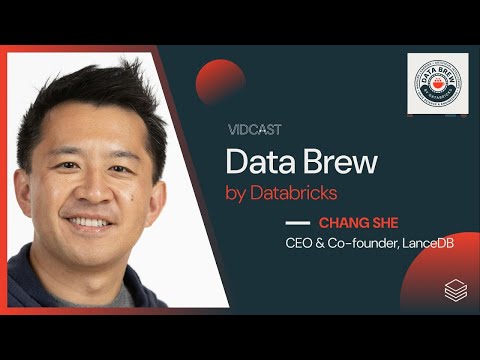
In this episode, Chang She, CEO and Co-founder of LanceDB, discusses the challenges of handling multimodal data and how LanceDB provides a cutting-edge solution. He shares his journey from contributing to Pandas to building a database optimized for images, video, vectors, and subtitles.
Highlights include:
- The limitations of traditional storage systems like Parquet for multimodal AI.
- How LanceDB enables efficient querying and processing of diverse data types.
- The growing importance of multimodal AI in enterprise applications.
- Future trends in AI, including a shift from single models to holistic AI systems.
- Predictions and "spicy takes" on AI advancements in 2025.
Connect with Chang She
Chapters
0:00Introduction to Data Brew0:40Chong's background and Lance2:24The challenges of size7:19Multimodal use cases9:10Why LanceDB was created14:06The meaning behind the name15:30The future of pre-training18:42Ensuring data quality21:42Productionizing multimodal26:30Searching across modalities29:06Advancements in open models32:11LanceDB's technical benefits35:06Spicy takes and future trends
FAQs
What is multimodal AI?
Multimodal AI combines multiple data types (images, videos, text, vectors) to build more powerful AI systems. This video explores how databases like LanceDB enable multimodal applications.
Why do traditional databases struggle with multimodal data?
Traditional databases like Parquet optimize for tabular data and handle images and vectors inefficiently. This video explains the limitations and solutions.
Lance vs Parquet for storing embeddings and multimodal data
Parquet is optimized for columnar analytical queries but becomes inefficient for vector operations required in AI applications. This video explains that Lance columnar format is purpose-built for AI workloads: it efficiently stores embeddings, multimodal data (images, text, audio), and supports fast approximate nearest-neighbor search. Lance maintains columnar advantages for analytics while adding vector search acceleration, making it significantly faster for AI retrieval tasks than Parquet. For production AI applications, Lance reduces both storage costs and query latency.
Parquet vs Lance for machine learning
While Parquet excels at analytical queries over structured tabular data, Lance is optimized for machine learning workloads. This video highlights that machine learning often requires storing vectors (embeddings), multimodal data, and running similarity searches—all operations where Lance outperforms Parquet significantly. Lance columnar format enables efficient storage of high-dimensional embeddings and fast approximate nearest-neighbor search, making it the better choice for ML feature stores, vector databases, and retrieval-augmented generation pipelines. The choice depends on your primary use case: analytics (Parquet) or ML (Lance).
Best open-source tools for a data engineering career in 2026?
This video surveys the open-source data ecosystem in 2026 and highlights foundational projects that data engineers should understand: Apache Spark for distributed processing, Delta Lake for reliable data storage with ACID guarantees, LanceDB for AI-optimized storage, and emerging tools like Spark Declarative Pipelines. The video emphasizes that data engineering is evolving beyond ETL toward enabling AI and analytics pipelines. Engineers who understand both traditional data infrastructure (Spark, Delta, Iceberg) and modern AI data requirements (embeddings, multimodal data, vector operations) will be in high demand.
Full transcript
0:00 Introduction to Data Brew
Welcome to Data Brew by Data Bricks with and. The series allows us to explore various topics in the data and AI community. And whether we're talking about data engineering or data science, we're going to interview your subject matter experts to dive deeper into these topics while we're enjoying our morning brew. I'm a principal developer advocate here at Data Bricks and one half of Data Brew. And hello, I'm, director of the machine learning practice at data bicks and the other half of datab.
And today I'm thrilled to introduce Chong Sha, CEO and co-founder of Lance DB, a database for multimodal AI. Welcome, Chong. Thank you. Super excited to be here. So Chong is also one of the first co-authors of the pandas library, which was my initial foray into data science. And so Chong, really curious to hear from you. How did you go from working on pandas to working on lance db? Yeah, absolutely. Um so I I started out my career in in quant finance but um I've been making tools for data science and machine learning for about two decades at this point.
0:40 Chong's background and Lance
Uh pandas was my first fora um I I then but most recently I was at 2BTV where I um ran into two big problems. One was uh I designed the entire platform for ML research surveying and experimentation. Um, I was super happy with how that turned out. We we were able to increase the rate of ML iteration at 2B by more than 100x. Now, the second problem that I couldn't solve at 2B, at least to my own satisfaction, was how painful it was to work with image, video, vectors, and subtitle assets that we had.
Right? So um from pandas to spark to all of the tools that we had for working with tabular data that wasn't that part of the equation wasn't so bad but when the data became bigger it it was extremely painful and the teams that we had working on multimmodal projects always took you know five to 10 times as as long um than pure purely tabular uh data projects right so that was basically the original motivation behind starting LANCB.
That completely makes sense having a core business problem to solve then creating a company and an open source project out of it. But just to help with our listeners here, maybe you could share some uh share with everyone what is multimodal AI? Is it just turning images into vectors? Is it uh much more than that? Um yeah, absolutely. So I think in terms of um the overall problem with multimodal is um managing managing that data query and querying that data um extracting insights from you know whether it's videos or audio or um uh or images and it's and the generation of those things it's way more than just uh simple vectors.
2:24 The challenges of size
So I think u there's basically one kind of first principle that we started from and that we realized was the driving force behind a lot of the changes that we needed to make. And so I brought my special cup uh to to show you what that is. Um and that first principle is size matters. For those of you who can't see the cup, it's got a measuring tape around the room. Yep. Um, and I think when I say size matters, there's a it means a couple of things, right?
So, first, if you think about a table that's storing multimodal data, the each cell becomes much bigger. Um, for example, a column of OpenAI embeddings is uh 3,000 times bigger, precisely 3,72 times bigger than a floatingoint column. Um, the table sizes are much bigger, right? So nowadays multimodal startups easily accumulate tens of terabytes to pabytes scale data at a much earlier stage of their evolution. Um and that also means the rate of ingestion is bigger as well.
Uh so routinely we hear enterprises coming to us that are like oops we're just starting out with our AI practice. we tallied up our data and we already have two pabytes of data in Microsoft SharePoint or you know we're evaluating a use case for um AI for like searching through our video footage and realize we have to search across a billion images for this use case. So um it's it's much is much much bigger than what we're used to from uh from the outset, right?
Um and I think that the problems that it presents are um are manyold. So access is a problem when you uh mix like large and small data together. Uh you know you have me memory issues, you have bandwidth issues with like you know if you're accessing tons of images for example it's easy to run into concurrency limits on uh blob store. Um the management of that of those kind of data sets really suck. Uh so you know for companies uh it's it's not uncommon to see okay we're we're managing all these image assets along with the metadata and like sensor data and all that.
So we have to use BigQuery as one system to do some of the querying and manage some of the data and then keep that in sync with web data set for the raw assets and god forbid we have to run some experimentation um that means we have to download you know like 100 terabytes of um tar tar files tar balls unzip them all generate the new feature zip them all back up and then transfer them all back up to um S3 And it takes days to generate one feature and it cost a ton of um money in in both store extra storage costs and extra data transfer costs as well.
Uh and then the last set of problems is just querying right when when data is large um and the workloads are different from you know previous like BI and data pro um and data engineering workloads like search and retrieval is a problem. Um analytics is is a problem. Um and then you know plugging all that data into training is is also a third set of problems. So um from this one I think principle uh we we were able to see how like both the data the data sets the new data sets for AI and the new workloads for AI causes problems for enterprises um all stemming from this one fact.
So I'm I'm just curious. I mean this is really cool and I've got like a ton of questions uh just related on the how size matters as you've noted there but one thing I'm curious about is from your perspective like of working in the multimodal AI space what's the most common scenarios like are there really lots of enterprises working with lots of images or lots of video or is it more like trying to make sense of PDFs and charts I'm just curious like let's start from the basics in terms of the more common use cases that you're typically seeing.
I I think there's two um kind of driving high level use cases there. there. It's basically um infra or platform teams that are creating a platform for their researchers and application developers to be able to quickly do um iterations on some model whether it's image video or audio um or to quickly build um AI applications and these tend to be you know uh rag applications agent applications um today, right? And so the um the most um in terms of the applications that we see, it's a lot of we have a lot of I guess Dart data or multimodal data that we we don't quite know what's in there.
7:19 Multimodal use cases
Um and we want to make that available across the company um across multiple divi divisions. Um and for the modeling companies, right, you can imagine these are companies that are generating um cutting edge videos or or images and they their priority is keeping the rate of um iteration on their models uh as as quickly as possible. Got it. So then, okay, then let me go backwards because me as a like data guy as opposed to the AI person that you know certainly is much better than me on this stuff.
But I'm just curious then like can I just you know save all this as a parquet file and be done for the day like can I just like you know after all I've I've shoved in really really large embeddings and parket files before and of course everybody here is going to be laughing at me going that's a really stupid idea. So please clarify Chang why is that a stupid idea? uh it's not at all a stupid idea and in fact we in the in the beginning of the company um you know we didn't set out to create lance commer format at the beginning of the company we um wanted to solve the problem of working with multimmodal data and we started with parquet is you know it's it's it was 2022 and you don't just you don't just um start with hey I'm going to replace parquet uh but we uh ran into a bunch of problems um across you know that those um storage management and cringing areas.
9:10 Why LanceDB was created
So one is with parquet you have row groups and that means when you mix you know large data types um and small data types you're you have to choose between um bad performance or running out of memory uh or you have to choose between uh scan performance versus uh you know search search performance. Um and then when you're talking about um these workloads for ML, a lot of it is, you know, random access uh uh dependent. And so there are there have been efforts at indexing um that indexing for parquet in the past, but the problem is parquet itself doesn't support uh fast random access.
So you could have an index that quickly tells you which rows in the parquet fate file you need to you need to access but then accessing those is incredibly slow and that which basically means the indexing effort and the performance gains are moot and when you're dealing with AI data uh because they're so much bigger the problems with parquet uh that parquet has with random access is a hundfold worse. than if you just had tabular data.
Got it. So, and so what you're implying is that I can't just go ahead and put like a NAND device or an SSD underneath the parket and it'll just magically solve my random access problems, right? That just won't work, right? Right. It won't work. I mean, no, no, but okay. But in all seriousness, uh there's definitely going to be some who are like in the data warehousing space who'll say that, but wait, you know, we have data warehouses that actually are welld designigned for random random IO access.
The they are they they use a different binary format than parquet. So because of that, I could just chuck it inside there. And again, I'm pretty sure most people who have built these type of systems are are going to laugh at what I just said, but from your perspective, like, you know, why isn't a traditional warehouse, even one that is designed for random access, um, well, well suited for this type of a problem? Yeah.
So I I think there is um specialmade warehouses that has optimizations for and proprietary formats for random access um I think are a bad foot for AI for a number of reasons. One is that the random access they focus on are on small data types um and so they don't work well on large binary blobs. Number two is the workloads that you need to do on AI data across the enterprise is pretty diverse. So to have something that is in a proprietary format that only connects to one compute engine um is also not a great fit for uh the diversity of things that you need to do with AI data today.
That sounds like a lot of challenges and a lot of trade-offs uh you have to take in designing systems like Lens DB. Yeah. Yeah. Um fortunately I think this is the reason why we uh invested heavily in the in you know in the first you know year and a half or two in the open source for lance colmer format is um we said we're not going to solve this problem by um uh by putting systems on top of the existing storage layer. uh we have to invent something new right because I think we've uh with all the efforts that the whole market has gone has put into this I it felt like we were at some sort of purto frontier um in terms of dealing with AI data and if you're if you're focused on building on top of the existing infrastructure you're basically just tra making trade-offs along that suboptimal frontier um and lance format is is our effort to say Okay, we can actually push the frontier.
So, um you can you can basically um have your cake and eat it too, right? So, you know, lance format is uh you can think of it as like I don't know like the of data formats. And actually, why is it called Lance? Like why why Lance DB? Um I I think it was called Lance because um we we were in the kind of arrow um the arrow ecosystem. All right, arrows the in memory data format and um we were thinking of something that that uh kind of occupied similar mental space but we chose jousting lance because AI data is just much heavier.
14:06 The meaning behind the name
So, it doesn't go it doesn't uh it doesn't fly like an arrow, but it's able to penetrate very heavy and large objects. That is fantastic. And so, so now everything at LANCB in 2025 will be um our our arthurian legend themed. Um so our community contributors are called Lancelots now. Okay, I'm in now. Yes, just for that alone, I'm in. So I know we talked a lot about some of the challenges with storing this data, but I'm very curious in terms of the modeling side of how to work with multimodal data.
So there's been a lot of conversation is pre-training over have we ingested all human generated text. People aren't talking so much about have we ingested all the video, the audio data out there, the images. Just curious to get your take as to whether or not you think pre-training is over. Yeah, absolutely. Um I I the answer is yes and no. like for the um audience who've been paying attention to like the conversation at Nurups um late last year I I almost caught myself saying this year and um you know you saw Ilia essentially pronouncing pre-training is over and I think if you dive a little deeper into what he said what he means is that human generated text is over uh because at this point we we've indexed and trained on the internet And so further training data for text LLM models will depend on synthetic um text data which isn't nearly as high quality and it it is basically generated by the models that you're training this uh training on.
15:30 The future of pre-training
Right? So um the I I think this means a couple of things. One is that because for text models because we're we we're not we're no longer going to be in a regime where every quarter a new um open AI model comes out or a new anthropic model comes out and it just pushes the boundary by like an order of magnitude on a significant area of workloads. Uh it and so enterprises will now have enterprises who have been waiting to say uh we'll just upgrade to the next model version.
They will now think about okay how do we customize the model to our data our the way that you know our customers write the way that our employees write um in the specific content that we have. So I think we'll see much more like post- training fine-tuning um kind of efforts from like big big tech companies than like the you know the traditional enterprises um in 2025 and beyond. The other thing is u multimodal. I think you know if you look at the um talks recent talks from like or um or Jensen um there's a huge focus on on multimodal right and so um and the interesting thing about multimodal is that most of that data if you're capturing it from the real world it's it doesn't depend on um humans writing uh text right even if it's the same object if you take uh if you use a different format factor um to capture data.
If you take it from a different angle, you're generating real data that has meaning for the model um without without making it dependent on like being generated by humans. So I I think we're uh we're at least like you know two or three years away from um being able to say like okay all the meaningful real world uh uh uh multimodal data has been captured by the latest models and how do you ensure quality when ingesting this data for example like so much of YouTube is covered with like cat videos uh how do we ensure that these multimodal models don't just understand what cats and not learn anything else.
Right. Right. Right. Um yeah, I mean I think this is something that um autonomous vehicles companies have been fighting for a long time. Um and in that you know after a certain point it becomes like a a whack-a-ole game of um longtail issues, right? And so if you just randomly sample from the data that you're getting uh like after a certain point you're 90 you know 90% of the data that you randomly sample are going to be uh things that you've encountered or the model has encountered before and so it won't add to the model quality uh and this is where I think for multimodal training um the ability to quickly do search retrieval and analytics becomes super important right so I think it's the same thing for multi model um uh like gen generative models as well is that you know if you find let's say you find an edge case well how do I find a thousand images or a thousand videos kind of like kind of like this edge case that then I can add to my model labeling practice.
18:42 Ensuring data quality
Um when I do analytics I want to get a bunch of data in or when I train a new version model like where is the model weak and where is the model strong. So the analytical needs um workloads that will support the evaluation workflows for the research team is super important as well. I'm curious then I mean thinking through right right now we've tal even though we've been talking about multimodal we're talking like okay a thousand pictures or thousand videos and then we've also talked about like you know the volume of text data from your perspective multimodel is it going to or already has started where there's actually an intermingling of the relationship of images directly with associated text with associated uh video like you know for sake of argument you're a telecom company you're um doing video of a uh of where the the cell tower is going to be.
You're taking images of the where the cell tower location is, the maps that goes with it, and then literally all the forment policies or land policy uses that are associated with that. You can tell I was talking to a telecom company recently. So I'm just curious like is there from your perspective is there are we going to get to a point from a multimodal perspective where we're actually going to see the associations of all of these different things when you're doing analysis all at the same time uh and training and building models that can understand that or is that like that is there an implication of that or is this still very much in the vein of the domain expert that actually pieces those things together?
Oh that's a good question. Um I I do think the ultimate goal um which is not unrealistic is to have one model that understands you know five 10 different modalities and can project everything into the same latent space um effectively. Now um in in production I think in in practice today uh I I don't see people um doing that yet or the models aren't quite good enough yet. um where I I see people um putting into a production is models that understand two modalities like text and images and then text audio and then text to video or something like that.
21:42 Productionizing multimodal
And so when you're when you're like that telecom company or other or you know if you're generating if you're a company that's working on like video generation models from a prompt right uh practically speaking you're storing data and you have multiple uh embedding columns let's say right for these different modalities you you have um uh you have multiple paths to record that data and a lot times people still use text as the common den denominator.
So um you know reducing like PDFs and images into text first and then doing all text embeddings. Um that's a I guess like a a simpler um a simpler path uh to a to a more traditional like production proven path that I see a lot of uh enterprises doing today. Got it. So, so you do see it eventually happening. Do do you feel that like this would turn into almost like like the let's bring graphs back again like you know we actually kicked off the first of this particular season about uh uh um about basically the importance of bringing graphs back into the picture.
I'm just curious do do you see that also coming into play per se or is it still very much into because I guess what I'm trying to ask is can we really have this idea of one model that has all of these components together or more like a and of course I'm going to being from data bricks a compound AI systems that actually merges all these two these these like multiple models together that can somehow relate to each other through a graph or something like that.
I'm just curious from where do you see that especially because you are building these systems like where do you see this going here what the applications are at least so I think the big problems I see today are actually um at the like the practical problems with production that I see today is like um more well like I I guess like it's less sexy it's about like okay h I have a bunch of PDFs how do I parse the text how do I parse the information out Right.
And so, uh, this is why, you know, like I'm I'm a I'm a big fan of Llama Index and like Llama Parts, for example, does a great job of Oh, heck yeah. Exactly. Right. And well, we got to invite, by the way, but that's a side note. Yeah. Yeah. Yeah. And so this is where I think models like late interaction models like, for example, um has great promise. I think we're like that model it still takes a lot of effort to get it working well. uh but we're I think we're like in terms of late interaction or approaches to visually and directly extract information from images we're very close.
Um so uh I I think that's the big problem folks building multimodal applications today are are trying to solve. Um and then number two is then the next thing is like compound systems versus you know compound systems being connected by an external DAG if you will versus like a model or or system that basically capsulates a graph internally right uh I think that's the that's the question um I'm not I'm not sure I think like my um I think my uh uh experience tells me that the it's going to be compound systems for a while and that we're going to have specialized models that do one thing well and then people that need more than one modality or more than two modalities can pick and choose the ones that they need and then uh putting and then they need some way to connect those information systems together.
Yeah, totally agreed. And speaking of the non-s sexy enterprise use cases, virtually every customer we're working with is ingesting PDFs. And for most of these MVP solutions, they're just discarding the charts, the images, and the PDFs. And so I'm curious for you, how does it actually work when you're searching over different modalities? When you're searching over both text and image data, are they stored in separate vector indices?
Are they stored in separate embedding spaces? Just curious, how does this practically work uh when using Lens DV? Yeah. Um and so I I think with LANC DB it's very flexible um and scalable on how you want to do that. So um we've seen folks uh basically extract like tables for example and generating markdown from tables and then putting that um putting that in the same table as the rest of the document as as text. Um, we've seen folks who will parse out the tables and figures um, and embed them in separate in separate tables, but then usually use like the captions and the and the references from the document itself to link those references together.
26:30 Searching across modalities
And so when they do a search, they're searching across multiple sources and then using those like join uh, those that metadata as like join columns at the end. And so this is where I think the flexibility of LANCB is is is interesting. Um so that you know you can you can run SQL, you can do joins, you can you can do all sorts of um uh non vector search kind of workloads uh with LANC DB that you don't you don't really do with other uh vector databases.
That's super powerful. And so that naturally leads me to wondering what gap is there in the open models versus proprietary models when working with multimodal data versus the text data. It seems like tech side, the LA models, the other open models out there, the Quen models, etc. have really caught up with proprietary models. What does that gap look like for multimodal models? Um, that's a good question. I mean I think in terms of like uh if anything I think the extracting information right from multimodal data um I think a lot a lot of folks I've seen have been working with like the coal qin coal poly type of um open source models right in terms of like generation uh I think your proprietary models are uh still like you know way better.
You know, if you have a uh company built around that particular modality, I at least right now, you're going to have a big advantage. But in terms of extracting information, I I see I see a lot of like, you know, uh you know, clip and coin and coal um with success in varying degrees of success in production. Interesting. So can you just because this is new to me actually can you tell me a little bit more about the those two models the co- poly and co-human and in terms of like what they're how you have used them right now with the customers that and the enterprise use cases that you have.
29:06 Advancements in open models
Yeah. So, um I I think co copoly is basically like if you have um instead of having to do like OCR and just a text like a text description and or uh you can use co-oly and what c-oly does is essentially it chops the image into patches and generates um vectors like uh on on the patches right so this is the name comes from covert where you generate created token embeddings instead of sentence or chunk embeddings, right?
And so you can think of the image patches as as um as tokens in this sense. And so um in terms of um uh in terms of the use cases, what this allows us to do in a lot of or our users do in a lot of instances is skip that like complicated like OCR process, right? Like this might be like, okay, I have some baseball cards and I want to I want to know um like who the player is, what team he plays on, and like what's the what's his uh position and all that.
And with the traditional approach, it's like, okay, I got to do localization, then I got to do text recognition, and then I got to think about the layout. And there's a lot of complicated processing that goes on on there. And like you know like it's 2024 and like if you ask people like what OCR library do you use in Python you're going to get like 15 different answers and there's no there's no gold standard and I think um folks that we're working with are just were just like searching for like a simpler answer.
Um and um I think they also start out by okay can we use something like clip or siglib or you know something similar um that first foray into into multimodal and inevitably it's like yeah worked great in that first demo but you know clip something like clip is really made for like classification problems and not like detection and recognition. So they quickly run into limits for that. Uh and and then when came out and CoQen um they uh there was a lot more excitement.
I think the quality uh in general of uh of that of those types of workloads were were much much better. That is really cool. I I really wished I had been talking to you uh dang it now it's been a while but uh this is like like I guess a decade ago because we were I happened to be working in a place where we were actually doing good oldfashioned OCR of uh receipts so we had to actually get the signatures out. It's like yeah that your your solution sounds a heck of a lot easier and better for crying out loud. uh but outside the fact that I have less like this personal regret from the past um how what the what is the implications of then using models like this when it comes to like why it's better to work with something like lance versus or and versus like you know again at the risk of repeating myself versus something like parquet like what is there something inherent about lads db that allows it's better suited for this type of use case right so um I I think from a storage perspective, right?
32:11 LanceDB's technical benefits
Um you if you if if you're storing all of that data in parquet, you are not going to be able to do um fast search and retrieval types of workloads or you know forget paret if you're I don't know if you're storing your data in like vice indices or something like that, right? So that search and retrieval workflow um becomes becomes much less scalable. So th those indices because the data format itself uh doesn't support random access.
So you can't keep all that data in object store and just access it when needed. You have to store it in memory. You have to store it on SSDs. Um and then you you manage all that yourself, right? And so with LANC CV because of the the format and the compute that layer that we build on top and the caching uh you're able to get basically the scalability and the cost efficiency of S3 but u you get performance as if the data was uh in memory.
Um and then um there are things like running uh if you have videos for example uh we have lance APIs that allows you to uh target a video on S3 as if it was like a Python file pointer. So if you're seeking within a video, you only have to read the bite range for those frames that you need rather than have to load the whole video. So when when that when you take that to scale that that's a huge difference in terms of the amount of data access the cost and all that.
Um and then uh and then the platform that building on top of like okay uh I I need to generate an expensive feature on this data set. Um how can I do but only on a subset of rows how can I do that efficiently? Um, and it requires kind of a combination of like the open source lens format and then the data platform that we're building on top. That is super powerful. You've got you've got me convinced uh of the power of multimodal models.
And I know I'm about to ask you for your spiciest take and most exciting trend for 2025. At least for me, multimodal seems to be an exciting thing that it we're now able to start tackling more use cases uh with just the more powerful models coming out, the more infrastructure support for multimodal. So, I'm super excited about that. But I would love to hear your spicy takes uh for 2025. Totally. Yeah. I mean, I I think I totally agree with you on on the like I I'm super excited and I think in 2025 is when um we're going to see lots of multimodal being put into production in um in in enterprises outside of like I'm creating a foundation model for that particular modality.
35:06 Spicy takes and future trends
Um, I think my spiciest take, I don't know if it's my spiciest take, but like I guess my spicy take is I think the word agents will fall fall out of favor in 2025. Um, not because I think agent companies are going away, but I think like just the term will fall out of favor. So it's like, you know, 20 2023 was like everyone was like vector databases rag and 2024 was like, okay, everyone's putting rag into production and everything is a rag.
And so like ah rag is rag is so yesterday it's all about agents in 2024 I think 2025 is when everyone's putting agents into a production and that concept that word gets so overloaded then now it's like okay if I have a vector database or no if I have an llm call and I add an if statement to it that's an agent and then if I add a vector database call to that that is agent rag right so the term gets overloaded and becomes like not not super meaningful anymore.
I'm using case statements. What are you talking about? I'm not. All right, I needed the spicier take then. If agent the keyword is falling out of fashion, do you have a proposed alternative for agent? Oh. Um I I've heard I've heard the term like cognitive systems. Um or uh put being being thrown out there. And uh yeah, I I I'm not sure if I like I don't know. That's it's too much of a mouthful, I think, to um to become like the new the new hot thing.
Mhm. Yeah. But maybe I'll stick with age. It's over cognitive. Yeah. Yeah. Yeah. Yeah. Exactly. , what are your uh hot takes for 2025? Oh, my hot takes is 2025. I I actually agree with that basically um agents like if you look at what people are talking before going to production. Yeah. Like the that absolutely this is the year of the agents. But to your exactly the point, it will be overloaded just like we overloaded rag, right?
And so I I do think I don't honestly don't think what I'm saying is a hot take per se, but I do think basically yeah, people are going to start recognizing it's the systems that we build around this, not just necessarily the models themselves. And then of course now I get to say again compound AI systems, right? I mean it again not a much of a hot take per se, but I do truly feel that people are recognizing that this is actually more important than just the singular model itself.
Yeah. Yep. Yep. Yeah. I I think like to expand on that um a maha take it's like I think uh 2020 like 2024 was when we realized like agents um as a as a layer like the application layer and agents is secure in that position like no one's worrying about the application layer or agents going away because openai makes a new release announcement right so there's like uh I think at this point everyone's like Hey, there's there's tons of real value here uh for agents company.
And that's that's kind of the driving force between for overloading that term is that now everyone else is is jumping in to say, "Oh, we're also agent for you know, whatever." How about you,? Like what what's your take? Like, you know, so we've got the two of us on the spicy take. You got anything that's going to knock it out of the park, per se, or like sort of like whoa, you know, not knock it out of the park. Uh it it's hard to follow both of you.
I will say I definitely agree that more of the focus is going to be on the systems rather than on the models. Uh at least I'm just seeing a trend of companies being less committed to a single model. For example, like if today Azure OpenI is the best, tomorrow they'll flip to anthropic if that has a better model. They'll flip to the llama models for specific use cases. So seeing less loyalty to a specific model and more focus on improving the overall system and observability.
So, actually seeing a bit of a decrease in fine-tuning uh as the go-to, that might be my hot take of instead trying to optimize the N10 system through tools all DSPI for prompt engineering. Um, and really trying to focus on the quality. Um, yeah, I think quality is going to be the main focus. I am definitely concerned around the cyber security risks um of any of these systems. I think we've noticed a lot of quality issues when using them, but I think there's about to be some like massive security risks.
That might be my spicy tape for 2025. Oh, yeah. Um, very true, actually. Yeah. Yeah. I I definitely agree with that. I I think um well, I don't I don't know if we'll keep this in the in the post, but did you hear about the um the thing in Hong Kong last year? No. No. No. Which one? So there were there were uh there was this set of scammers that I think somehow got in touch with the Hong Kong an employee at a Hong Kong subsidiary of a British financial company.
They and through social engineering all that they they all jumped on um they pretended to be from headquarters. They jumped on a Zoom call with the employee with uh deep fakes. like there were like six people in the call and everyone except for that employee being scammed were deep fakes and wow they convinced that employee to transfer like I don't know it was like $250,000 or something out of the company to the scammer account.
Um, and then they kept following up with Deep Fakes over email and like texts for months. And it wasn't until that employee had a real a meeting with um the folks from the uh the headquarters in the UK that he realized he was even being um scammed. That's rather brilliant. I'm not sure we could keep it in there, but that's that is terrifying as hell. Yeah. So, like I think Yeah. I so I I absolutely agree with you. I I think it's only a matter of when that next like big security incident is going to happen.
Yeah, there's a pretty major Wall Street Journal article about Amazon seeing nearly a billion cyber uh threats of just I think it's maybe a 9x increase year-over-year of just attack vector is going to increase. Yay. Awesome. Well, thank you so much for joining us today, Chong. a really lightning session on multimodal and the future of AI in 2025. It was really fun. Thank you so much for having me on.
Learn more about the Databricks Data and AI platform.
The information provided herein is for general informational purposes only and may not reflect the most current product capabilities or configurations.