Lakehouse//RT, the real-time Lakehouse powered by Reyden — Reynold Xin, Co–founder & Chief Architect
Summary
- Real-Time Lakehouse (Lakehouse//RT): Delivers millisecond performance on governed Delta Lake and Iceberg data without setting up separate serving systems.
- Reyden Compute Engine: New compute engine designed for agentic enterprises, enabling sub-second query performance previously impossible in traditional lakehouses.
- Unified Data Platform: No more copying data to separate serving stacks—Lakehouse//RT unifies analytics, warehousing, and real-time serving in one place.
Lakehouse//RT, the real-time Lakehouse powered by Reyden — Reynold Xin, Co–founder & Chief Architect
Introducing Lakehouse//RT: The real-time Lakehouse powered by Reyden
Lakehouse//RT delivers real-time analytics directly on governed Delta Lake and Apache Iceberg™ data. Underpinned by Reyden, a new compute engine designed for agentic enterprises, Lakehouse//RT lets companies achieve millisecond performance without setting up separate serving systems.
Learn more about Lakehouse//RT: https://www.databricks.com/company/newsroom/press-releases/databricks-launches-lakehousert-bring-real-time-analytics-directly
05:31 — Introducing Reyden with live demo
Chapters
0:00The limitations of legacy data warehouses2:07Challenges to a building a single database engine5:31Introducing Reyden with live demo8:21Reyden's performance compared to competing systems11:24How Enverus and Meta use Reyden to accelerate query times13:00Introducing Lakehouse//RT
FAQs
What is Lakehouse//RT?
Lakehouse//RT delivers real-time analytics directly on governed Delta Lake and Apache Iceberg data with millisecond performance, eliminating the need for separate serving systems.
What is Reyden?
Reyden is a new compute engine from Databricks designed for agentic enterprises, enabling millisecond query performance and real-time analytics at scale.
How can broadcasters build real-time analytics platforms?
This video shows how Lakehouse RT on the Databricks Data and AI platform enables broadcasters to modernize legacy systems into real-time analytics infrastructure. Sub-second latency enables responsive decision-making. The unified lakehouse approach combines batch and real-time benefits.
How difficult is migrating real-time from ClickHouse or Druid?
This video addresses real-time workload migration complexity on the Databricks Data and AI platform comparing alternatives like ClickHouse and Druid. Lakehouse RT provides comparable performance with superior flexibility and governance. The migration path depends on existing architecture and team expertise.
Is Lakehouse RT an alternative to ClickHouse or Druid?
This video demonstrates that Lakehouse RT on the Databricks Data and AI platform provides comparable real-time capabilities with broader applicability than specialized tools. The unified lakehouse eliminates trade-offs between real-time and batch analytics. Organizations gain flexibility without sacrificing performance.
Full transcript
0:00 The limitations of legacy data warehouses
All right. Thank you. Um I'm super excited coming on stage today to talk to you about this new uh effort. And honestly, it's probably the largest single largest innovation we've done since our introduction of Lakehouse. And as already mentioned, um with the Lakehouse, we were able to actually unify data science, data engineering, as well as data warehousing. And uh our data warehousing business have taken off exponentially since its introduction 5 years ago.
It was recognized by the Gartner and both as a leader in data warehousing. I think over 60% of the Fortune 500 uses the Lakehouse for warehousing. And I joke about we actually scan exabytes of workload depending on which time zone you are before you have breakfast. The uh and over the course of last few years, we worked fairly hard to improve performance. At every single Data and AI Summit, I think me or somebody else would come up on stage and introduce to you some massive performance performance improvements we've done.
But the reality is kind of the warehouses or the Lakehouses hit a wall at about a second. And what do I mean by hitting a wall? It doesn't mean you can never get a response from the Lakehouse or warehouse in less than a second for a query. It just means if you have a very stringent workload that you want to have very tight SLAs in the range of milliseconds or hundreds of milliseconds, it it would be very very difficult to accomplish that because you might actually get latency spikes.
And as a result, I think for many organizations that actually require um workloads that have very stringent SLA s, they started setting setting up a separate serving stack. They would copy their data instead of the data warehouse or the Lakehouse and copy a portion of it that's required for serving into a separate stack. And this caused a lot of problems. It's actually data pipeline to maintain for every data set. Um these serving stacks tend to perform super well on very simple queries, but doesn't actually work well for more general workloads.
It's a governance nightmare. You now have to worry about, "Hey, did I forget to actually secure my data set in this specific platform, but I actually did in my underlying warehouse?" So, if the whole theme here is unification, what if you never had to move your data? What if you never had to copy it? And we asked ourselves that question a couple years ago. And now, it turned out it's actually fairly fundamental. It's very, very difficult to tackle this problem.
2:07 Challenges to a building a single database engine
Um as a matter of fact, who's a Turing Award winner, and some of you might know him as the original creator of Postgres, wrote a whole academic paper about it called one size fits all. An idea whose time has come and gone. And in this paper, um Stonebraker actually argued it's very, very difficult to engineer a single database engine that's capable of running a wide variety of workloads. And ultimately, it's because the increase in complexity makes it very, very difficult to actually engineer the system.
And the fundamental reason for that is, if you look at how database engineering were done in the last four decades, or even five decades, um every database engineering team started working approximately this way, um Databricks included. We'd go targets of, "Hey, here's the new workload we might want to actually uh study and then understand and then actually build a system for it." Um and the way to do it is to uh study all the latest and the coolest academic papers about the specific type of workloads.
And some of the papers actually go back 40, 50 years. Some of the papers were published in the last few years. You try to study them, understand, "Hey, in my or my uh sort of apply in real life." And you spend a lot of time implementing it, and at some point you try to roll it out to uh test how well it works with real-world workloads. And inevitably, this happens. So, the new technique you implement, or new It could be a new algorithm, could be a new data structure, it works remarkably well for a subset of the queries, and it works terribly for a subset of the queries.
So, the database ends up, "Hey, we're doing better here and actually regressing. And many of the algorithm and data structures actually work really, really well for very, very low latency to guarantee maybe a millisecond response time. Tend to actually backfire when you have larger data sets and vice versa. So, this is one of the biggest problems. Um so, we 2 years ago decided, hey, can can we break the status quo? How can we challenge it and do the best we can?
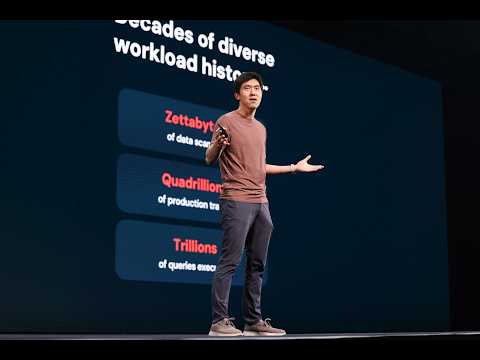
And now we actually went back to the drawing board so with amazing engineering team, um we actually flipped the way how database engineering were done. Instead of starting with ideas and techniques, went back to the workloads. Um so, luckily on Databricks we have collected over zetabytes of data where we scanned traces from all of this data, um which is in the range of quadrillion actually traces. I have to learn how to pronounce that word.
Um and all coming from trillions of queries that were executed. And based on all of this um traces, we're able to actually build a machine learning model um that give you very high fidelity estimation of what might happen in practice given a specific new technique. And based on this machine learning model, we can do two things. The first is we can select the right algorithm to dispatch very quickly at runtime. But it's not a LM cuz LMs we have too high latency.
We can actually pick the right algorithm to dispatch at runtime. But even more importantly, we can decide and predict what algorithms to even implement before it hits production. Because there are millions of algorithms and data structures out there. It would be virtually impossible to actually find them all. Knowing what to implement is one of the biggest advantage one can get. Right. So, the resulting engine of that is Raiden, which you all know is a reference to Mortal Kombat.
The um so, Raiden um and the resulting engine is actually pretty remarkable. And you might have actually used some of the other serving stacks out there. Um you have so and if you have, you run into many of the issues you're talking about. For example, a solid can't run queries longer than 5 seconds. Almost all of them require you to copy the data into a very specific format. It's very engine specific. They can't run complex joins and all of that.
5:31 Introducing Reyden with live demo
But Raiden can actually do it all, right? And the way Raiden will show up is going to come in the form of a new SQL warehouse. And um, this is kind of abstract. So, let me give you maybe a quick demo for you to help understand what Raiden actually does. All right, can I get the demo on stage? Okay. So, here I have a very simple setup here. Honestly, it's a very simple query. I have the New York taxi data set query. You don't really need to understand what it does.
But then for those of you that actually know what the data set is, it's fairly small. And this runs I First of all, I ran this query in Lakehouse today. All right? It finished It's not terrible. It finished in about a second. All right? And on the right-hand side, I have the Raiden setup, which we call Raiden RT. And let's try to run this. Okay. I don't know if you can see this number. Uh >> Let's try to run it one more time.
Yep. Did we hardcode it 1. 007? Oh, no, we didn't. Uh Okay. But that's just one query. All right? What's the fun of running just one query? Um, here I want to show you a demo of what will happen in practice when you start hammering the system. And we've built a simulator simulating real dashboard application workloads hitting against the Raiden engine. And I'm going to show you start with just one active session here.
So, let's imagine this is an actual dashboard running. We're just going to load this dashboard. It loads fairly quickly, all right? It's probably what we expect. But what happens if you scale up to 10, 100, or why don't we try 1,000? So, now we're going to simulate 1,000 active agents hitting the same engine at the same time. Each of the agent, by the way, is generating more than one query. The dashboard actually takes about eight queries for it to load.
And they will all hit exactly the same moment. Let's see what happens. Done. All right. So, we executed >> milliseconds. This is incredible. None of existing systems can do this. That's a very simple demo. Okay. But when I told you, "Hey, none of the existing systems can do that." Let's put it into the perspective of existing systems. So, here I want to show you a benchmark measuring latency versus throughput. Throughput here means queries per second.
8:21 Reyden's performance compared to competing systems
Right? So, we have the Y axis, which is the P90, 90% tail latency, and the X axis, the number of queries executing. And we're running a very simple query, TPCH query six, which is a canonical query of scanning a little bit of data, running some aggregation. And let's see what happens when we test the different systems out there. So, for a competitive vendor, using their latest warehouse, we're able to actually push the warehouse.
It started fairly low latency, but as you start pushing up about 160 queries per second, latency started climbing up and hitting a wall. So, the same vendor actually announced a fairly innovative offering last year called interactive warehouse. It's so interactive, they can't actually read the same data with the general warehouse. The only way to actually have it work is to copy the data into a separate warehouse. And interactive warehouse does do much better than their latest generation general warehouse.
You're able to push like 300 queries per second before the latency starts spiking up. And we also tested through a open source uh query engine that's known for being able to run very simple queries very very fast with the yellow color. Um and it's actually running much better on this specific workload compared with the uh um Gen2 and the interactive warehouse. It's able to push all the way to a close to actually I think 15,000 queries per second.
That's pretty good, right? But then it just started crashing right after. It doesn't actually time out, it just crashes. So, how can Raydon do? Right? How does Raydon do? On the same workload, Raydon could actually run all the way to 12,000 queries per second while keeping the tail latency still below a second. >> There's one other benchmark I want to show you, um which is what if we run all of TPC-H, which is a standard data warehousing benchmark.
Um as you can see on the screen, when data set is small, actually all systems run reasonably well. I mean, it's like a few seconds running 22 queries. I mean, some are a little bit faster than others, but they all run pretty well. But as you scale up, for example, 100 GB, you started seeing the yellow systems uh run time started spiking. And this is actually I'm trying to point out the very specific part of my uh talk about earlier, which is a specialized serving engine doesn't actually work very well on the more complex joints, which will show up in the full TPC-H queries.
And of course, uh when we scaled up to actually bigger amount of data, both systems actually started crashing. The interactive warehouse started crash uh can't even finish because it cannot run any queries longer than 5 seconds. And the yellow system couldn't actually complete because it started running out of memory. And Raydon was actually able to complete all queries at all scale factor. You might have benchmark fatigue at this point, so many benchmarks.
Um the who cares about synthetic benchmarks? Um so, one of the thing that we're really excited about in the process of developing Photon is the design partners we've been working with. Saw, which I've shown their logo on the screen here. Want to share with you some two results from all these design partners. The first one is Ambers. Ambers is a global leading data and AI platform for the energy sector and they tested Photon with 11 of their most representative production queries.
11:24 How Enverus and Meta use Reyden to accelerate query times
And what they found compared with the existing serving stack is that with Photon the same extremely low latency queries remain sub 100 milliseconds, whereas the longer running queries can now actually dramatically shrink their run time and across the board on average they're actually getting a 16 times speed up. So, from Ambers was super excited to see that they're able to now execute queries in tens of milliseconds, but also shrink the run time of the longest running queries by almost 100x.
And Meta also tested Photon and they found very similar things. They were able to have their typical queries come back in tens of milliseconds and the most important thing is you don't need a separate system on the side just for your serving. So, what Photon does it can give us the best low latency possible at extremely high concurrency. It can actually run real world workloads really really well and it can also handle the complex CDL EDW workloads super well.
And today very excited to announce the first product offering powered by the Photon engine. It's called the Lakehouse RT. A Lakehouse RT is a new warehouse that's showing up starting with read only workloads. It will support millisecond performance and massive concurrency, but the most important thing is directly on the lake governed by Unity Catalog on the same Delta or Iceberg data. >> >> So, what can you do differently with Lakehouse RT where RT stands for real time?
13:00 Introducing Lakehouse//RT
Um, challenge your conventional wisdom. If you have a separate serving stack, test it out, and you might be able to collapse the two platforms into one. And that would give you millisecond performance, massive concurrency directly against your data lake in open formats. And beta starting today, try to talk to your account team to get early access. Um, and there's also two talks at this conference starting soon today on Raiden and Lake House RT that you can learn more about.
And that's it.
Learn more about the Databricks Data and AI platform.
The information provided herein is for general informational purposes only and may not reflect the most current product capabilities or configurations.