Introducing CustomerLake – the agentic CDP built in Databricks
Summary
- Agentic CDP Platform: CustomerLake combines core Customer Data Platform capabilities—Customer 360, identity resolution, audience building, and activation—into one agentic platform built on Databricks.
- AI Agent-Driven Campaigns: Marketing teams deploy AI agents to eliminate manual campaign work and focus on customer relationships, dramatically accelerating campaign velocity and personalization.
- Unified Data Governance: Shared, governed data foundation enables marketers to activate 1:1 experiences with full control and compliance through Unity Catalog and Databricks Data and AI platform.
Introducing CustomerLake – the agentic CDP built in Databricks
Introducing CustomerLake: The agentic CDP
CustomerLake brings core CDP capablities together to help marketing and data teams turn customer data into always-on, 1:1 experiences. With CustomerLake, Customer 360, identity resolution, audience building, campaign automation, activation, and personalization are all available in one platform. And with a shared, governed data foundation, marketers can deploy AI agents that help eliminate manual campaign and keep their focus on customers. Learn more about CustomerLake: https://www.databricks.com/blog/introducing-customerlake-agentic-cdp
21:07 — CustomerLake partners
Presenters:
Tasso Argyros, VP Engineering, Databricks
Chapters
0:00The impact of AI on the customer experience2:28Why legacy marketing campaigns fall short3:51The shift to Infitity Campaigns6:41What's a CDP?7:35The need for an Agentic CDP8:55Introducing CustomerLake15:53Demo: CustomerLake21:07CustomerLake partners
FAQs
What is CustomerLake?
CustomerLake is an agentic Customer Data Platform (CDP) built on Databricks that combines core CDP capabilities—Customer 360, identity resolution, audience building, campaign automation, activation, and personalization—in one unified platform.
How does CustomerLake change marketing campaign workflows?
Traditional campaigns involve lengthy waterfall processes with strategy, data engineering, operations, creative, and activation stages. CustomerLake uses AI agents to automate manual work, compress timelines, and enable real-time campaign optimization.
Why is agent-driven CDP important for modern commerce?
Modern commerce happens through AI agents making purchasing decisions in seconds or minutes across multiple channels simultaneously. CustomerLake enables marketing teams to respond with AI agents that coordinate across channels and make decisions in real-time.
How does CustomerLake maintain data governance?
All of CustomerLake's capabilities operate on a shared, governed data foundation in Databricks Data and AI platform with Unity Catalog. This ensures consistent governance, security, and compliance across all customer data and campaign operations.
Full transcript
0:00 The impact of AI on the customer experience
Good morning. How's everyone doing? Okay. Um it's a real uh pleasure to be here with you today. This is actually very, very special for me. I'll tell you why. Um I spent the last 20 years building two companies. I spent 10 years building a database company. But then I really wanted to do something that would bring the power of data to the business. So I spent another decade building a marketing technology company. One that would combine data but also combine a UI for the business.
That was my passion. And it's really special to be here because in some ways I'm back at my roots, but what I'm about to show you is something that truly brings the power of data and agents to the business. But before we talk about this, I want to talk to you about customer experience. Why do we talk about it? The best companies differentiate on customer experience. 80% say that they compete primarily on on the basis of the experiences they create for their customers.
And we live in a very interesting time because AI is dramatically changing how people buy and as a result how those experiences need to be designed. Why is that happening? First of all, humans do not buy on their own anymore. How many of you do you consult with an LLM before you buy anything? Be honest. Okay, I think this is like 80%. Uh very soon is not just going to be advice from a chatbot. It's going to be delegating agents to do all the research, all the price discovery, all the buying, figure out shipping.
Everything will happen through agents. This means that buying decisions are now happening in seconds or minutes, not days or weeks which was a buyer journey until now. And finally, because commerce is going headless and agents are really good with APIs, agents can be on multiple channels buying, researching all at the same time. So, this creates new challenges, right? To how things were done before. Because the way things were done before is very simple.
Someone in a company, usually marketing, would start with a universe of customers, create segments, we call them audiences, that would have millions of people, and then activate those audiences through campaigns. And the way these campaigns would be designed to begin with was through this big waterfall model, right? So, marketing would do the strategy, data engineering would put the customer 360 data together, marketing ops would create the audiences, creative would do content, marketers would activate, measure, right?
2:28 Why legacy marketing campaigns fall short
And monitor the campaign as they were running. This waterfall worked, but it had some issues, right? First of all, it takes a really long time and is very rigid. It's hard to change dynamically. Um so, for all these limitations, though, these waterfall campaigns worked fine up to now. But, do they work for the era of agentic buying? And the answer is no, right? Of course not. When agents buy on multiple channels at the same time, in seconds, you can't spend weeks designing a single campaign.
But, what if what if we could personalize every interaction for every customer in real time all the time for their customers and their agents. That would be a game-changer. But to do that we need to think differently. We need to invent a new type of campaign, one that doesn't rely on this waterfall model and one that can personalize audiences of one instead of audiences of millions. What if we could do this with agents, right?
3:51 The shift to Infitity Campaigns
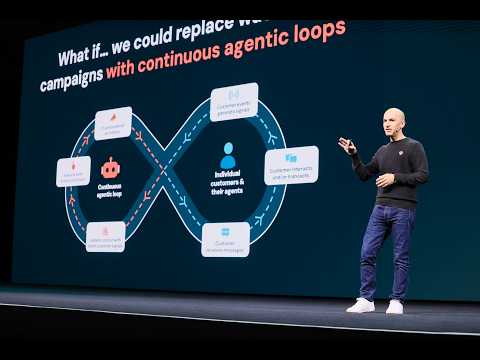
So agents create the new challenge on the buyer side, what are also the solutions? What if we could have an agent for every customer? And then what this agent would do is to process the latest signals from every single customer, determine what's the next best action, and create a highly personalized content just for that individual customer. And from there on, that would go back to the customer, customer would process, transact, and then create more signals that would then feed back to the agent in this infinity-like loop.
We think this is the future and this is such a new approach to how marketing can do campaigns that it deserved a new name. We called it infinity campaigns. And we call it infinity not because the symbol looks like an infinity symbol, but uh importantly, these are campaigns that are evergreen. They don't need to have a start and an end. Because we have agents, the agents continuously adapt, so the same campaign can adapt to new customer behaviors, new business goals, and it can keep running.
Also, infinity campaigns can provide content that's highly personalized, right? It can pick from a multitude infinitely large number of variations of content for what each individual customer needs that particular moment. And finally, if you employ agents, they can respond very, very fast. Right? You You You don't have any limits in how fast these agents can respond. Now, it's important to note that human remains in control.
The marketer is the chief strategist, the chief orchestrator, and the chief approver of what the agents are doing. But now they have an army of agents that can do all the one-to-one personalization work that humans were just too slow to do before. Okay. So, hopefully, I'm convincing you that this new concept of infinity campaign is very cool. But the question is, can we make it work? How do we make this happen? And the way this would have happened in the past was through CDPs.
And let me talk a little bit about what CDPs are. For those of you that don't know, CDP stands for customer data platform. And it's essentially a business application that sits between the data and all the marketing tools, the customer tools that actually send the communications to the customers. So, what do CDPs do? First, they can turn raw data into customer 360, organized data ready for business use. Then, they have a business UI where marketers can come in and build audiences and journeys.
6:41 What's a CDP?
And finally, they send data to marketing tools that serve content to the end customer, like email tools or advertising platforms. And that process is called reverse ETL because the data goes from the CDP into the content or the advertising platform. The challenge here that CDPs were middleware, so they were detached from the data. And it's not just about data anymore. Now, in order to make agents work, you need data, but you also need context, and you need data and context to be where the agents live.
7:35 The need for an Agentic CDP
So, we think you need a new generation of CDPs to make Infinity campaigns work, and we call this new generation the agentic CDP. The agentic CDP is not just some general concept. There's three very specific things that a CDP needs to do in order to be agentic. First, it has to be embedded in the lakehouse because that's where the data, the context of the agents increasingly live. Second, it has to be built with LLMs at the core of its architecture.
This is not just about having some co-pilot to help you do some operations better. As we discussed before, the agent is the core of how this new type of CDP works. And finally, it has to power Infinity campaigns. It needs to have the capability to have evergreen, real-time, continuously adapting campaigns that personalize every individual customer with individual agents. So, agentic CDP is a new category within there's going to be several new players there.
However, we are one of the very first to launch an agentic CDP, and we call this Customer Lake. Thank you. Thank you. Customer Lake is an agentic CDP built specifically for the Databricks platform. It's embedded, meaning data never has to leave the lakehouse, and all the governance for data and agents that you've done with Unity Catalog will be transferred immediately into Customer Lake. It's democratized. It's built for the business users, so it has a business first UI, and it is autonomous.
8:55 Introducing CustomerLake
It can power one-to-one personalization agents to provide the perfect customer experience a billion times a day. Customer Lake comes with two modules. The first is profile agents, which automates the process of going from raw data to customer 360. The second is campaign agents. That's a business first product that allows marketers to power in 50 campaigns with agents. Let's double click and talk about it a little bit more.
There's a lot of capabilities that we're introducing here and in the remaining of this talk, we're going to talk a little bit more about these two products. Uh and also show you how it works. Okay, let's start with profile agents. Profile agents are agents that automate the process of creating customer 360 data that is business ready. So, with the prompt that defines a use case, profile agents get to work. They ingest, transform, enrich data, resolve customer identities, and evaluate profiles to generate this intelligent loop that keeps improving quality.
The first step is to prepare customer data for use. With Lake Flow Connect, we can ingest third-party data from applications or obviously use Lakehouse data that's already there. Our agents will semantically tag data and also improve quality such as fix emails, addresses, or phone numbers. And we can also bring third-party data in, which we call data hydration, through the Databricks Marketplace. The second step is one of the key core features of profile agents, which is identity resolution.
What is identity resolution? Identity resolution for first-party data, meaning data you already own, this is data you have collected from your own customers, is a process of identifying the same customer across different data sets that do not share the same customer key. So, you have information about the customers. You may have names, emails, addresses. They don't quite match, but probabilistically, you can tell it's the same customer.
This is very important because if you don't do this, you may end up thinking the same customer is different people, and that leads to massive problems for marketing and customer experience. So, we introduce here a new approach to identity resolution that we call the agentic identity resolution. We have agents that come up with rules on how to resolve these identities. If these rules are inconclusive, LLMs take over and try to make a determination, and if needed, it falls back to human feedback.
And as more and more identities are being identified and resolved, the agents learn. And they enable this agentic loop that make the rules better, the LLM learning better, and the whole process continuously improves. Historically, this has happened through static SQL rules or machine learning. Both approaches have significant limitations, and we think the agentic identity resolution wins on all fronts over these traditional approaches.
And when it comes to third-party data, meaning data that comes from third-party partners, we are introducing today a way to resolve identities through those partners without your data ever leaving the lakehouse. So, this is a privacy-first approach to third-party identity resolution that we enable through the Databricks clean rooms. And the last step in profile agents, after having ingested, transformed, quality checked the data, and identify the identities, is to output the right data products for the right use cases.
So, that involves schema mapping, survivorship, and also data validation so that the agents can self-improve the quality of the final output as needed. So, that's profile agents helping you go from raw data to business-ready customer 360 faster than ever before. So, let's talk about our second product here, campaign agents. Campaign agents are agents that automate campaign work. So, given a prompt, the agents can create the right campaign uh brief from business context and business goals, the marketers review it and approve it, and then we deploy agents to do personalization.
What's cool also is that campaign agents also do traditional CDP functionality like audiencing. But, of course, we do it in a way that's Genie-powered. So, everything can happen through prompts, but we also have a business UI that marketing and marketing operations can very quickly review the work of the agents, approve it, and you with one click you can take audiences and turn them into campaigns. Infinity campaigns is the heart of what campaign agents do.
The beauty of Infinity campaigns, because it's built around the LLMs, is that you can start personalizing immediately. You don't have to spend months building ML models. You also don't need to use ML-based decisioning, that takes a really long time to start to work. It provides exceptional campaign performance out of the box, and of course, batteries are included. We have guardrails, you can do simulation runs and measurement.
Everything is built in. And for the first time, we're We're a feature that so many of you have been asking. Reverse ETL, we can now have native managed connectors to multiple products in the advertising, marketing, and customer experience ecosystem that with one click you can make it work. We're launching with approximately 20 connectors to a rich ecosystem of partners. We have dozen more connectors coming by the end of the year and many more beyond that.
Okay. So, it's time to see Customer Lake in action. So, I want to invite to give a demo of Customer Lake. Welcome, >> Thanks. Oncore demo, I'm flattered. Um so, uh in this demo, um we're going to give a quick overview of campaign agents. Um the assumption here is that you've already used profile agents to ingest, uh model, and resolve your customer data. And what I'm going to walk through is using campaign agents um to build audiences using Genie and then Infinity Campaigns to decision on a one-to-one basis.
15:53 Demo: CustomerLake
Okay? So, let's jump into it. Now, I'm a marketing manager for Brooks Sport. And here I can see my campaigns dashboard. This is my overview of my active campaigns, some key audiences that I'm tracking, um my most active reverse ETL syncs, um kind of my kind of uh overview dashboard. Let's jump over here, though, into the audiences. Here's a list of audiences that I've created. I can see the size of these audiences, the percent change over time.
Um what we're going to do is we're just going to create a new audience. And as I do this, I could create this audience using uh rules and filters, but we're going to use Genie. And I'm going to copy and paste a prompt in here. Um include our most valuable Team USA fans who have spent more than $500 on merch this season, um and exclude anyone who already bought the USA fan kit, okay? So, let's see what Genie comes up with.
Genie's going to go and actually generate this audience, so it's going to look at the attributes and the audiences that I already have created. And there we go, Genie generated this audience. So, now I have an audience of 800,000 customers. I can see the qualification criteria here. If I wanted to, I could go in here and tweak this, right? So, this is um uh editable. I'm going to trust Genie and go ahead and accept this.
I come back out here, and now I have uh some quick insights that Genie generated. Um we'll come back to that in a second. I actually want to show this. Um you can view the SQL that is backing this audience. So, this is starting to look probably more familiar uh to many of you in the audience. Uh if you've ever supported marketing by pulling lists and writing custom campaigns, um you can get really complex SQL um to power some of these campaigns, and we got this from one prompt with Genie.
Um let's go ahead and save this, um and I'll get brought out to the main insights dashboard here. Um and I can see kind of insights on this audience. These are automatically generated by Genie. So, dynamically, every audience is getting its own unique dashboard. Um and then I can immediately use this in a new campaign or even just a new sync. Um so, the point is all these audiences are actionable. This is not just insights.
You can immediately run this in a campaign. Now, for the sake of time, I'm going to go over here, um and I'm going to find a live Infinity campaign. Um in this example, it's my in-venue fan experience. Um so, let's quickly look into this running campaign here, um and see how it's configured. All right. So, I can see the audiences to include, the goals, um conversion metrics, any sort of guardrails that I wanted to apply.
So, this is kind of the constraints that you're putting on the agent. I can see the messages that I made available as part of this Infinity campaign. So, here I have a match day guide and a match day offer and we'll come back to those in a second. Um and the really interesting part is looking at this agent's tab. So, this is where the agent is actually looking on a one-to-one basis um at each individual customer. So, you can see a list of sample profiles here.
Um here we have. Um this agent decided to defer, so not send anything to right now. Let's take a look at why. We can actually see the reasoning um behind this decision from the agent. What was evaluated? What was the timing that was considered? Um what sort of data signals were considered as part of this decision? Um any sort of guardrails that were applied, like I said, frequency caps, etc. Um if we uh go into somebody who got the offer here, we see this person got the match day offer and same thing.
Um Genie decided to send this personalized offer. And this is a preview of what they actually got. So, this is a 15% um offer off a seat upgrade. Um let's find somebody who actually got just the match day guide. So, here we go. Um if we preview this, we can see this customer got just a summary of the match day kickoff, parking information, etc. So, campaign agents is personalizing every single one of these message for each individual customer in this campaign continuously.
I can go out and see a overview of the insights on this campaign. I can look at performance by individual messages, opens, clicks, conversions, etc. Um to get kind of an aggregate view of how this campaign is doing. And with that, I'm back at the home page. That's a quick run through of Customer Lake Campaign Agents, the world's first agentic CDP. Thank you. Back to you, Tassa. >> Okay. Thank you. So, the uh the era of true one-to-one personalization is here.
21:07 CustomerLake partners
It's very, very, very, very exciting. So, in developing uh Customer Lake, we were very fortunate and honored to work with some of the top uh innovators globally. Um some of which uh were kind enough to let us uh put their logos up on the screen. These are world-class data and marketing teams that are pushing the boundaries of customer experience with data, agents, and marketing strategy. Thank you to all our early Customer Lake partners.
And similarly, um we have been uh building Customer Lake surrounded by an elite ecosystem of partners um that jointly serve our customers in terms of data, content, advertising, activation, and services. Thank you to all of our partners that are joining us today for this launch. So, with that, I'm excited to say that Customer Lake is in private preview today. Um if you're interested, please talk to your account team.
Thank you. Uh please talk to your account team if you want to learn more. We also have a brand new CDP track in the breakouts. And we also have a marketing forum today at 1:00 p. m. You can find both Search for Customer Lake in your uh Data and AI Summit app, and you will see both the marketing forum and the breakout session. That's the place to learn more. Some of the breakouts is from the team, the engineers, the product folks that actually built Customer Lake, and we also have some of our early uh customers talking about their first experiences with Customer Lake as well.
Make sure to check it out. So, with that, uh thank you for your time. It's a very special moment for me to be able to bring together the worlds of business, customer experience, and data all in one place uh to build something that provides the perfect customer experience a billion times a day. Thank you.
Learn more about the Databricks Data and AI platform.
The information provided herein is for general informational purposes only and may not reflect the most current product capabilities or configurations.