Why Genie Adoption Stalls and How Minimum Viable Data Governance Fixes It
Summary
- Trust and governance: Genie deployment loses adoption when AI returns plausible but incorrect answers without governance.
- Minimum Viable Governance: requires ownership, definitions, guardrails and documentation for adoption.
- Semantic layers: naming stewards and semantic definitions close the gap between deployment and adoption.
Why Genie Adoption Stalls and How Minimum Viable Data Governance Fixes It
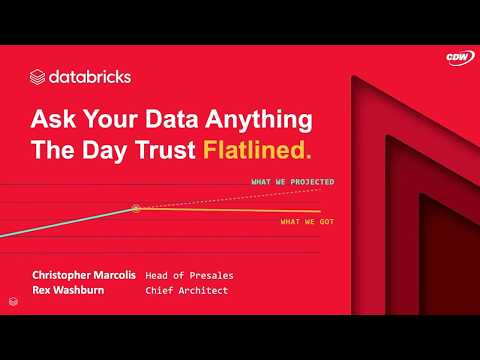
Talk by Christopher Marcolis, Head of Presales, Data, CDW
AI assistants such as Databricks Genie lose user trust the first time they return a plausible but unexpected answer to a question like projected revenue, and the fix is governance rather than a better model. This video explains the gap between deploying Genie and getting it adopted, and the four conditions that close it, called Minimum Viable Data Governance: Ownership, Definitions, Guardrails and Documentation. Practical steps include naming data stewards per domain, adding column descriptions so Genie speaks the language of the business, and scoping Genie spaces to their audience.
CDW's Christopher Marcolis shows why skipping steps to satisfy leadership, with no semantic layer or defined business terms, undermines adoption even after a seven-figure platform investment. Practical fixes include naming data stewards who own each domain, adding column descriptions so Genie speaks your vocabulary, showing users where data comes from, and scoping each Genie space to its audience instead of selecting all data. The talk also covers change management, Unity Catalog's built-in access controls, and portable semantic models through the Open Semantic Interchange (OSI).
Sponsored by CDW.
Chapters
00:00Introduction: Genie deployed but nobody uses it03:33The day trust died: why Genie answers get rejected03:57Undefined business terms: semantic layer and ontology05:22The data management gap and change management07:25What is Minimum Viable Data Governance (MVDG)08:25Guardrails: scope Genie spaces to the audience09:14Definitions: column descriptions and data trust signals11:02Portable semantic models with Open Semantic Interchange11:26Closing the last mile with professional services
FAQs
Why does Genie adoption stall?
User trust breaks the first time Genie returns a plausible but incorrect answer to a business question. Without governance—defined terms, named stewards and scoped data—even a seven-figure platform investment fails to drive adoption.
What is Minimum Viable Data Governance?
It's four practices: naming data stewards per domain (Ownership), adding column descriptions so Genie speaks your vocabulary (Definitions), scoping Genie spaces to their audience (Guardrails), and showing where data comes from (Documentation).
How do column descriptions help AI adoption?
Column descriptions let Genie speak the language of your business instead of using raw technical names, which increases confidence in results and drives adoption among business users.
Can Unity Catalog help with governance?
Yes—Unity Catalog's built-in access controls enforce governance at scale, and the Open Semantic Interchange (OSI) standard lets you create portable semantic models that work across tools.
Full transcript
00:00 Introduction: Genie deployed but nobody uses it
Um, my name is Christopher Marcoles. I lead the pre-sales department at CDW in the areas of data, analytics, and AI. What does this mean? Do you know who pre-sales specialists are? It's like salespeople: they promise you something and then bring in people like us to make sure it's true. Yes? We discuss technologies, build solutions, argue with you. Um, if you and I aren't arguing, then we're all doing something wrong.
Because we try to create solutions that are reliable and will lead you to success. I have been working in analytics and data science for 32 years. This is a Korean skin care program. I've been creating dashboards since I was 15 years old. I started with Cognos 7, 8, 10, and whatever it's called now, you know, Tableau, Qlik, Tibco, etc. And throughout this journey, I learned how to do Data Science, how to do FP&A, that is, financial planning and analytics.
And now I work in this industry, serving clients and helping them build solutions. Here , for example, is one of them right here. In fact, even a few of you. Who here knows CDW? A few people, okay. We are more than just laptops, cables, and routers, right? We are also a consulting company. We are a consulting company with a turnover of 4 billion dollars. We are actually fifth on the list. Most customers don't know this.
They sometimes forget about it. But we truly strive to help our customers. We serve every customer in this room. Each of you most likely buys something from CDW . We have over 300,000 customers in this country . So today I wanted to talk to you about a scenario that we can all face, because we're all implementing AI, right? Our leadership says we must. That's why we do it. Check the box as soon as possible. So I had to play the role of one of those people.
Faster, stronger, right now , shareholders, press releases—all of it. Meanwhile, my colleague Rex Washburn, whom I've known for 27 years, distracts me with other things. He was to play the role of an architect. Someone who would say: "It should have been done differently," right? It is through this conversation that we will go through today. So what we're seeing, and whatever you call it, Christopher, you're not necessarily just talking about Databricks.
This is not true. I'm talking about implementing AI and analytics in the workplace. Snowflake, Databricks, Fabric, Mongo—it doesn't matter. Choose at your own discretion. Today we chose Databricks. Um, I notice that a lot of clients just skip the stages. We are looking for shortcuts because management ordered us to do so. So someone like me comes along and says, " Hey, there's something here." Let's do a Genie demo, okay?
"Who has already implemented Genie?" OK. Is your boss here with you? Well, you don't count. We're going to talk about some complicated things, so to speak, aren't we? So, we showed the demo, management was happy, we put out a press release, I completed the task, published a post on LinkedIn as a manager. The IT department even gets involved. They're proud of it because they did something avant-garde, something new , AI, right?
And they can say they did it well. Even the CFO says, "Wow, what's the ROI on this investment, huh?" Because I just signed a seven-figure deal. This is great. But here's the problem. When we deploy these things, put in the effort, and announce our results to the world , implementation doesn't move forward, right ? I am thinking about implementing Copilot as I am very familiar with it. I launched it, but no one is using it.
03:33 The day trust died: why Genie answers get rejected
Why do n't they use it, huh? This is the main topic of our conversation. This is the day trust died. And, as an example, you go to Genie, your chatbot, and you say, "Show me the projected revenue for this quarter." He will not leave you without an answer. He will provide an answer, but the question is, is it the right one? And this is where we run into problems when trying to implement. Is "projected revenue" my term?
03:57 Undefined business terms: semantic layer and ontology
Is this word defined in a semantic layer or ontology? Probably not, and that's what many customers miss. When I set up spaces and just say, " Select all, open all the data, because it has to be high-quality, right?" Christopher will know when he asks the question to the robot whether it is the correct answer. So the biggest problem right now is that executives, janitors, everyone in the middle of the organization are going to the robots and saying, "Show me the projected revenue for this quarter."
And then they run to the board meeting and share something, and it's not that it's the wrong answer, it's that it's a different answer than the one they expected in the question. So we really need to think about how we can go back and, you know, undo and redo some of the things that we need to figure out. So, in particular, we need to define our semantic level. We need to make sure that business terms are clear. Projected revenue is a metric, not, uh, what is it?
An adverb before, you know, the noun " income". We need to make sure that we are bringing expert knowledge from within the organization to these levels that are closest to the data. The user can easily see the origin of the data, where it comes from. This is where they are stored. We need to be able to contact the data owner. And I think, you know, that's the biggest gap that I see in a lot of organizations— data management.
05:22 The data management gap and change management
Who here has a data management board? That's not enough hands. And that's really sad, right ? I need to know, for example, at work, when my boss calls me and says, "Christopher, I need these numbers for the big boss." Thank you. Please. Oh, look at this. Wow. That's the problem, by the way, right ? I spent seven figures on Databricks and I get this result, and eventually the CFO comes in and says he's calculating the payback on this.
Like , you just spent so much money, right? Christopher? This is not a Databricks problem, because everything is built into the platform. Maybe it's a change management problem, organizational change management. So take change management with you to work. We need to change people's behavior because we are stubborn and arrogant, and we sometimes need to be told to behave differently, and we need to do it for different types of people.
Some people are kinesthetic, some are auditory, and some are visual. We need to make sure everyone understands that we need to live differently because we are transitioning to governing differently. We're doing a super-fast version of this, right? Because, you know, why not? So, this is the situation we find ourselves in, the situation I find myself in when I talk to clients. The manager says, “No one told me I had to do data management before I launched it .”
I thought it was a second-year thing." You smart people in this room, the technologists, this has always been a first- year problem, Christopher. You just skip steps to appease the boss, tick a box, you know, get a bonus, or buy a new yacht. The problem is that we don't take into account all the technical challenges and debts that we have to solve. I could say, "That sounds like something you could tell me, thank you, Rex, who's not here."
He really told me. He warned me. So as technologists, we now have a huge burden of responsibility: to explain to people like me and convey to them in a language they can understand that we shouldn't skip steps and should build solutions, some of which I might show you today. So, here at CDW, Rich Washburn in particular developed a concept we call Minimum Viable Data Governance. MVDG, MVDG. We love saying these words, do n't we?
07:25 What is Minimum Viable Data Governance (MVDG)
This is based on the product methodology of the bare minimum : do at least this and you won't get fired or go to jail. Whatever it was that worked for you , right? We must appoint stewards, data stewards. So in my company, when my boss calls me and says, "Christopher, I need some numbers to tell my boss's boss how we're doing ." What am I doing? I'm calling Suzy. Suzy has the same spreadsheet, right? Because she's like an assistant to a bunch of bosses, and she brings all the data together.
Wouldn't she be the perfect data steward? The one that understands all the financial data? Shouldn't I find someone who does marketing data, like Joanna, and an operations person , and make them stewards, so that when we find errors in the data because the genie is lying to me, I can go to the person—the one person responsible—and say, "Hey, let's fix this," right? And while we're here, let's define business terms differently.
Let 's make sure we have column- level lineage tracking available to end users. And most importantly, most importantly— define your Genie space by knowing your audience. So if you build a solution, a chatbot, and make it accessible through Teams using an API to your sales force, I do n't think they need warehouse logistics data. Maybe I shouldn't check this box when I define my spaces. Because they will get strange wrong answers.
08:25 Guardrails: scope Genie spaces to the audience
Do you know what sellers do with strange incorrect answers? They pronounce them aloud and spread them in all directions. So we should be worried about that . Hmm, what does a fix look like in the configuration in the 10 minutes I have left. Let's skip this, okay? So, I have the Unity Catalog. If I identify the business owners, the data owners, then I have someone to turn to when the data looks strange. Are you all having this problem right now?
I have it at work. Trust Trusting your data is an art. This is uh This is a challenge. I need column descriptions so that Genie understands my dictionary. When I do this, Genie communicates with me in a way I understand. It responds to my natural language differently, because the days of dragging and dropping visual objects in a GUI are over, right? They are fading into the past. When I provide end- user trust signals about the origin of the data, people can verify everything for themselves.
09:14 Definitions: column descriptions and data trust signals
This is important. I don't like to lie unless I intend to deceive people, right ? Um, the Genie principle: don't cover what shouldn't be covered. Stop answering the wrong question. And really, you know, it's like a hallucination. If I ask him, "What was the revenue last quarter?" and there are seven different data sources where I have the column "income" available, whether it's defined in the semantic layer or not, I can get one of seven correct answers, maybe.
So, five things I want you to think about, and they're universal. Yes, this applies to Databricks, since we're here, but also to any other AI tool that I implement. Just because you implemented it doesn't mean the job is done. This is not an "end game" mode for you. You need to stop and take a break. You have to think about people. Can I change their behavior differently? Can I engage them in a conversation around this selected data to introduce Suzy, Tom, and Joanna, the new data curators in my organization, because we're finally taking this seriously.
Um, I can't skip steps, because if I skip them, what happens? Release, prison, you know, think about regulated industries. I can't just give access to sensitive data to the wrong people without consequences. This is already built into the tool. Unity Catalog is already there. Just today, or yesterday, they announced, uh, what's this? Genie ontology. Ontology levels, have we tried this yet? So, if you come to my booth over there, it's because there 's a reason for you.
There are prizes and all sorts of amazing things. They embed business knowledge directly into data so we can “talk” to it. So that we, you know, use OSI. If you guys haven't read about OSI yet, right? This is an organizational semantic exchange, right? Basically, it is an open industry standard. Almost everyone accepted it. They say : “These semantic models are portable. When I identify revenue here, I can direct other tools at it, and it works and transfers.
11:02 Portable semantic models with Open Semantic Interchange
This is unified. "This is useful." Um, when we get to this last part, like the "last mile" of services, most often when we meet a customer, you know, we have 300,000 of them. And we see that they are struggling because they didn't know what they didn't know. And they didn't think they didn't know about these pre-sales specialists. My team is free. We do n't cost anything. Yes, you buy $50 million a year worth of networking equipment, servers, Chromebooks, or whatever from CDW, but there's a benefit that many customers don't take advantage of, and sometimes it's just a little nudge.
11:26 Closing the last mile with professional services
Right under the ass. Hmm, and then the path becomes clear. We know what you should be doing at Databricks. We know the levels of tools and solutions you need to take on. So why not? And what it really leads to—I hate to promote it. This is a professional services problem disguised as a platform problem. I couldn't figure out how to do it. I had no one to call. My boss won't let me work with you because you're free and don't have a contract with me .
This is very easy to fix. Hmm, sometimes you need a group. Um, I encourage you to scan my QR code on the left. I think you can scan Rex's code even if he's not here. I publish a lot of articles about tokenization, about the many challenges we face in organizations, some ideas on how to act differently as a leader in an organization in today's rapidly changing space. Um, I think we're done here. You got this weird, abbreviated, half-cut PowerPoint presentation.
Are there any questions? The whole point of this conversation was to say, "Don't go from step one to step six." You must go through step two, three, four, five. There are some very, very smart people at the CDW booth who can walk you through these scenarios, talk you through all the different tricks and levers you can use to get where you need to go. And I should also point out that all those pieces of paper with keys that you're holding in your hands, I don't know how many there are, Joanna.
How many grand prizes are there in total? Needless to say, you have to put this key in the lock. If you're lucky, you'll win an incredibly expensive prize. This is not a seven-figure sum. And even if you don't win, you still won't be left at a loss. Everyone will receive a great bag of gifts and souvenirs to take home. So, anything else, Joanna? The stand is located right next to the fourth hall. Come visit us. I guess I didn't hear that, did I?
Right next door, right there, near the fourth hall. Search for CDW, Computer Discount Warehouse. Just don't tell them I said that. And if you have no questions, thank you for participating. Sorry that Oh, you have, sir. Thank you.
Learn more about the Databricks Data and AI platform.
The information provided herein is for general informational purposes only and may not reflect the most current product capabilities or configurations.