Enterprise Data and AI Transformation in Telecommunications
Summary
- Telecom leaders from AT&T, EchoStar, Jio Platforms, Lumen, DirecTV, and AirTies share how the Databricks Data and AI platform enables connected intelligence across fragmented operational systems serving tens of millions to hundreds of millions of customers.
- AT&T achieved a 5x ROI on its data and AI investments, while other operators report reducing customer churn by 40% and scaling AI deployment to 100,000 users while maintaining enterprise governance.
- The forum identifies context, control, and choice as the three principles that differentiate telecom organizations generating real business outcomes from those still managing isolated pilots.
Enterprise Data and AI Transformation in Telecommunications
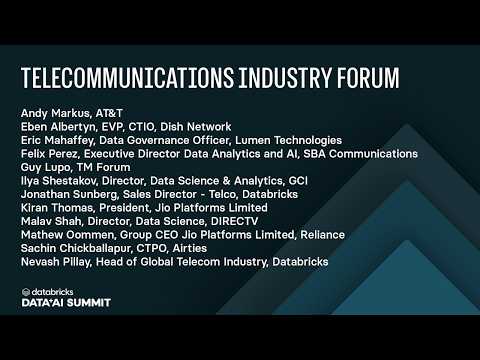
Enterprise telecommunications leaders manage exponential data growth across fragmented systems. With 50 million to 500 million customers generating real-time data across network, billing, sales, and customer service teams, operators face severe data silos. At the Data and AI Summit, leading telecoms shared how Databricks enables connected intelligence through unified data platforms and Genie spaces, turning massive data volumes into actionable insights for customer experience, network optimization, and revenue growth.
Hear from industry leaders including Andy Marcus (AT&T Chief Data and AI Officer), Eben Albertyn (EchoStar EVP), and representatives from Jio, Lumen, DirecTV, and AirTies. Discover how enterprises scale AI across 100,000 users while maintaining governance, deploy conversational analytics with Genie spaces for operational decisions, reduce customer churn by 40%, and achieve 5x ROI on data and AI investments. Learn the principles of context, control, and choice that guide successful enterprise transformation.
Chapters
00:00Telecommunications Industry Forum Opening02:20Data Silos and Business Context06:41Making Better Decisions Faster with Data09:07Future Operating Model: Genie and Personalization14:56Getting Started with Data and AI Transformation21:41AT&T: Enterprise AI Scale, Innovation, and 5x ROI34:28EchoStar: Governance-First Transformation Strategy48:34Jio Platforms: Managing Data at Unprecedented Scale58:47AirTies: Connected Home and Network Optimization01:06:17Trustworthy AI Standards and Industry Collaboration01:09:13Breaking Down Data Silos with Genie Spaces01:16:53Governance and Domain-Specific Architectures01:25:19Operational Impact and Future Roadmaps
FAQs
How is AT&T using Databricks for enterprise AI at scale?
AT&T's Chief Data and AI Officer shares in this video that the company has achieved a 5x ROI on its data and AI investments by deploying AI across 100,000 users while maintaining enterprise governance. The discussion covers how AT&T scaled beyond pilots to deliver measurable business outcomes across a large, complex organization.
What does the telecom industry forum cover in this video?
This video is a forum featuring senior leaders from AT&T, EchoStar, Jio Platforms, Lumen, DirecTV, and AirTies discussing how they use Databricks to manage data at scale, deploy conversational analytics with Genie spaces, reduce customer churn, and drive revenue growth. The session is hosted by Navash, who leads global telecom industry at Databricks.
How do Genie spaces help telecom operators make better decisions?
Genie spaces provide conversational analytics that allow operational teams to query large datasets using natural language, enabling faster decision-making without requiring SQL expertise. This video shows telecom leaders describing how Genie spaces break down data silos between network, billing, sales, and customer service teams to enable unified operational decision-making.
What principles guide successful enterprise AI transformation in telecom according to this video?
This video identifies context, control, and choice as the three principles that differentiate enterprise AI leaders from organizations still managing pilots. Context means grounding AI in real operational data; control means maintaining governance over data and models; and choice means avoiding lock-in by retaining flexibility in tooling and architecture.
Full transcript
[00:11] We can do better than that. I was out at a few parties last night. Where are the guys from Lumen? They were so loud last night, right? You can surely do better than that, Eric. Shall we try again? Good afternoon, everyone. Good afternoon. Oh my gosh. What a big difference. Feels like there's some AI magic in the second
[00:28] phase. But thank you for joining us today. On behalf of the entire Databricks team, we are thrilled to welcome you to our customers, to our partners, and to industry leaders. Thank you for being here with us today.
[00:46] And thank you sincerely for the trust that you place in us every single day. So, in our team here today, we have Andy Flint, who is my partner in crime across telecom, pretty much around the world.
[01:01] Jonathan Sandberg and Eddie. And all three of us are here to serve you. And anything you need, of course, today and beyond today regarding telecom, we are right here to ensure that we help you on your transformation journey.
[01:16] Now, today we have um a very exciting agenda. Probably one of the most exciting agendas I have seen across, can I say, the entire data and AI summit. Because we have some of the most remarkable speakers here today.
[01:33] We have got speakers and industry leaders across AT&T, EchoStar, AirTies, Reliance Jio, TM Forum, Lumen, GCI,
[01:49] SBA Communications, and DirecTV. And everybody is here at the forum today. And what makes this What makes this so exciting is that these leaders are no longer talking
[02:05] about POCs. They are actually talking about the outcomes they are really delivering every day and transforming their telecoms. How lucky are we? A huge sincere thank you to all of you.
[02:20] Now, for those of you that I've not met before, um my name is Navash. I lead the global telecom industry here at Databricks. And I have spent 20 years in telecom myself. Now, you can tell by my accent. I mean,
[02:36] you can guess if you like. Um but most of those 20 years were spent in Australia, where I had the privilege of serving customers at Telstra. I led the um enterprise parts of the enterprise business, SMB, network operations, alliances, the partner
[02:53] business. And in all that time and up to today, I know that telecom is like no other industry in the world. Telecom is actually the connective tissue of modern life.
[03:10] I mean, let's face it. A family member calls home. Emergency services respond because of the network of a telecom. We have businesses that actually function and serve their customers because of a telecom. And as we know now, we have students who join and learn
[03:28] online. And all that happens because of a telecom. And as you know, 99.9% of the time, the network works perfectly. And when that happens, nobody ever notices. I mean, think about the last time you called your telecom to say thank you for
[03:45] the great service you provide in the connectivity that you delivered to me endlessly every single day. But yet, when one thing goes wrong, .1% of the time, everybody notices. Not only is it on the
[04:00] daily news, in everyone's newsfeed, you know, you have social media going crazy, and you have customers who are looking to churn, and that is the tension and complexity of this business that we are all in. And I know many of you live that every
[04:17] day because on the one hand, we have rising customer expectations. You know, if you're a consumer in a telecom, you want to ensure that your expectations are met at the first point. You want to ensure that it's personal and it's
[04:32] immediate. Now, if you have 10,000 customers, that's probably, you know, easier to do, but when I look around in this room, the majority of our telecoms have 50 million subscribers.
[04:48] We have many in this room who have more than 100 million consumers. And we have one in this room that has 500 or more than 500 million subscribers. And that is complex to ensure that every single person feels
[05:05] special all the time. But the great news is we are tackling this tension one-on-one with some of the leading telecoms, and you're going to hear more about how that is happening every single day. Now, as we know, if you're a leader in
[05:20] telecom, not only are you facing that pressure, but you're also facing operational pressure. And last night at dinner, there was an interesting conversation. The telecom has to invest in more network capacity every single year. But guess what? Everyone's watching more Netflix, and the telco's not necessarily
[05:36] getting the revenue of that. People are using WhatsApp more so for international calls, and the telco's not getting the revenue from that directly. Yet, the investments to maintain a network and to add more capacity, cuz all of us in this room are probably using more capacity on our network every
[05:52] single day. Video calls, movies, streaming music concerts, watching, you know, the F1, the World Cup soccer. All that requires a telecom to invest more and more, but they don't necessarily see the revenue.
[06:08] And over and above all of that, we know that data volumes are totally exploding. And in addition to that, if you're a leader, you're dealing with rising expectations, operational pressure, and you also have the growth the growth mandate.
[06:25] You know, you've got to find new ways to derive new revenue streams. And I know in my 20 years in telecom, the one thing that I kept thinking through every single day, "How do I make better decisions faster?" Because what that means in telecom is
[06:41] that you can actually stop a customer from churning out before they do, if you have access to the right data at exactly the right point. You can get to a network issue ahead of it actually impacting millions and
[06:57] millions of customers. You can derive and provide the right price for a very large enterprise deal before the customer considers a competitor. And all of these things are so heavily dependent on the data.
[07:15] And you know, when we look at the telecom landscape, let's face it. It's an industry that actually has all the data. But the challenge this industry faces, and I'm hearing this from you and my own personal experience, is that there are
[07:31] numerous versions of the same data. And in actual fact, the network team sees one version of the customer data. The billing team sees another version of the same customer data. The sales team has something quite
[07:46] different but relates to exactly the same customer and the field team has their own version. And to everyone here today, today is about us as a community closing the gap between data and insight.
[08:01] Closing that gap between signal and the action. The action is critical for us to transform this industry. You know, ensuring that leaders like myself when I worked in telecom or our teams at the face of the customer in the
[08:18] contact centers or in our stores have exactly the right data at the right time. To ensure with that context can give the customer the response all 500 million or 100 million or 50 million of them the
[08:35] right information at the right time. And as we learn every single day to do that with the data we've got to ensure that the data is governed well and totally trusted. Now, talking about the data being trusted
[08:52] many of our customers that you're going to hear from today have already hit that milestone. And some of our customers are now thinking about what does this future look like? You know, we don't want to do more of the same or transform necessarily what
[09:07] we are doing today. How do we look at a new operating model for the telecom of the future? And at Databricks, our team has put together what we believe with a lot of your input what the telecom of the future looks like. And I'm just going to share one slide with you today,
[09:25] but we have a very similar view for the B2B space, the network space, the field space, you know, data monetization. But just to give you a flavor of what this could potentially look like. You know, we've heard a lot about Genie.
[09:40] Some of our customers are now looking at what if we had a Genie for every one of our customers? Because, you know, if we've got all their data and we've got the Genie ontology that's connecting me to the fact that I have two children, a husband, I have two homes, you know, I'm
[09:57] I'm in New York, um you know what my plan is, you know what my um calling um rhythm is, you know what I use my Wi-Fi for. If you have that ontology, how do you use all of that to serve me better?
[10:13] And this is just an insight, right? But imagine if I had an average AT&T Genie and I can personalize it, call it my own, or an average um Eco star Genie, or an average Geo Genie.
[10:28] And my Genie realizes that I've traveled to India over the last month and my bill is a bit higher. And my Genie, ahead of me getting my bill, says, "Hey Navash, you're going to get a bill in the next 2 days. It's going to be a little bit higher for this reason. If you have any questions, just let me
[10:43] know." Or my Genie detects that someone tried to pretend to be me and swap my SIM over. And it says, "By the way, we had these two calls. We know that it's not you. We believe it's not you. So, we've blocked that change, but if you need any help, let us know."
[10:59] Or if um you know, I'm moving house and my Genie says, "Hey, by the way, we recognize that you've moved house. You know, we noticed that you may need a fiber plan and we've just rolled out some fiber in your suburb. We can give you an amazing bundle." Or
[11:15] um you know, if it realizes that in my family I can have a better offer and it pushes it out to me. How does that make me feel? Well, I mean, it would make me feel like my telecom is not treating me like I'm part of
[11:30] 50 million or 100 million. You know who I am. You know what I need. You care for me. And you are always watching out for me. And if I have any question for you, I know where to go in a
[11:45] hyper-personalized way. And this is how we see part of the future because by doing that, you can lower churn significantly. You can get to first point resolution because today a customer calls three times
[12:01] in order to get a single issue resolved. You know, there's higher trust and and, you know, personal growth. But for the average telecom, and many of you receive 300,000 calls from your consumers every single day, think about the impact
[12:17] if that reduced by 50% while increasing your NPS. The impact is transformational. So, as I shared, you know, there are versions for B2B and network operations, um and data monetization on what we see
[12:35] the telecom of the future looking like powered by Databricks and the plethora of of new products that you have seen over the last 48 hours. And we would be thrilled to share some of that with you. And by the way, this is just an example
[12:50] of of what would happen in the background if I had my own genie. And in this example, my genie in the background is simply recognizing that I've moved house. And it's, you know, just messaging me to say, "In your new suburb, we have this great fiber opportunity for you. We've
[13:05] recognized you've moved house. You also have three other people living with you. And they all have their own individual telecom bill. What if we were to package it all up for you and present it back to you in a in a more financially viable way?
[13:21] And in a way that's going to better suit your needs." And I have the opportunity here to say yes, no. It's giving me a view on what the price might be. It's giving me a view on if I say yes, well, great. Would you like for us to come in and do uh install in your house of a new
[13:36] Wi-Fi solution? Or do you want to do it yourself? And if I say, yes, I'd like for you to come over and install it, it's saying to me, well, hey, okay, here are the times that a technician's available. It's removing all the friction.
[13:51] So, I can have this new personalized service that's giving my telecom a much better view on success, on additional revenue streams while it's meeting my own personal needs. So, that is just a snapshot. And of
[14:06] course, if you want to go through any of these demos in more detail, we have them all at the telecom demo booth um in the um expo area. So, team, as I shared, you know, the future for this incredible industry is moving from isolated analytics to
[14:23] connected intelligence, from dashboards to decision loops, as you've all seen, and from one of automation to, you know, governed autonomy. And we've also heard a lot in the last 48 hours about what's
[14:39] necessary for us to bring this to life. You know, I had three customers yesterday say to me, well, how do I start? Where do I start? What does starting actually look like? And you know, this comes down
[14:56] to the principles. Having the context, you know, accurate data. I can't tell you, you know, through my travels meeting with telecom leaders, many of them say, well, we tried it, but the data's just not right, so nobody trusts it anymore.
[15:12] And we can't afford to do this as an industry anymore. So, accurate, trusted data, having that right context gives you the the to achieve some of the things I've just shared. Having the right levels of control and governance, you know, ensuring that the right person
[15:28] has access to the right data at exactly the right time, being able to evaluate and judge that every single day is now what is possible for every customer who is here. And also having a little bit more choice, not just in terms of, you know,
[15:45] open cloud, open format, but also in models. And let me just close by sharing a few things with you. Now, when we talk about context, this is just an example of Genie that many telecom C-level executives love. Because what it gives them is
[16:01] every day a view, how is your business performing from a revenue perspective, from an EBITDA perspective, from a product perspective. It gives you the snapshot. But with Genie today and having the right context, you could also have a
[16:18] view on my daily connections and disconnections. What is my churn in and churn out? And not just, you know, uh great um graphs that are shared with you, but we have Genie research that will then say
[16:35] to you, we have noticed that your decline in business wireline has been much greater than you anticipated. And to bridge the gap, you need more X number of fiber bundles to be sold in the month to bring you to a point where you still
[16:51] achieve your KPIs. So, you can talk to it. You can have research agent giving you the insight on what you should be doing next. You can have a view on each business function within your business. You can have a view on the mean time to restore
[17:08] network outages. Wouldn't it be great if you're a Telco leader to know that every day, what is my mean time against my target? What are the SLAs that I'm up for because of the outages that my business has faced? How do I overcome these and prevent these from happening again? Why
[17:24] is my churn in the San Francisco area higher today than it is in New York? Because it could be because of competitors out there. And these are the insights that are now available to you with the right context, and this is available to you today. Um and again, if
[17:39] you want to know more about it, Layla Young has prepared an amazing demo. It's in our demo area. You know, building on that, in control, when you have all your data in the right place, digital twins of your business. There are many telecoms, and in this example over here, Scott
[17:55] Eade is working with a customer right now. They want to know, if I increase the plan, the price of my $30 plan, what is likely to be the impact in my business? Across churn, because if your price goes up, some customers may leave. What is
[18:11] the impact on my revenue? What is the impact on my network capacity? With your data being in one place, you now have the ability to do these sensitivity analysis, so that you make the decisions from the front. You understand if you're exiting
[18:27] a product, what impact it's likely to have in your business before you go ahead with that change. So you can mitigate any of the risks. And this takes into consideration not only what you are doing, but what your competitors are doing. Because in changing any price or
[18:43] knowing about a product is that you want to know what your competitors are doing also, because if they have something that you are exiting, you could have a bit more churn. So having a digital twin now, again, it's all the same gold data that you have in Unity Catalog that's giving you the ability to do this. This
[19:00] is available right now. And the last area that I would just touch on briefly relates to model as a choice. You know, we spoke about choice earlier. There are so many telecoms, and in fact, we're doing a catalyst that we will be
[19:15] sharing next week at the TM Forum event, model as a service. Because as we heard even from Ali, the models are changing quite rapidly. And quite often our customers say to us, "But which model should I be using?" And so, together with customers like AT&T, Telstra, Globe, Singtel, we have
[19:33] two catalysts that we are presenting next week. And in this catalyst that I'm about to share with you, um next, what this is doing is simply saying, "If you have a use case in natural language into the details of the use case and
[19:49] your KPIs, it will look at all the models available to you in your jurisdiction. It will look at the frontier models, and it will look at the open-source small language models, some of which AT&T have actually already completed and made
[20:05] available to other customers also as part of the industry standards. So, you can now choose, if my KPI is price versus speed, stack rank them, and you can get the right model for the right use case, and
[20:20] not only will it give you the two models, it will show you what the output would be like for that specific use case. So, these are some of the things that are available to all of you now, giving you the right context with the
[20:35] right controls in place, and also with choice. And when these things happen, of course, we get to see the great results, some of which you're going to hear about in a moment. We have seen customers reduce churn by 40%, grow B2B revenue by 20%,
[20:53] reduce fraud by more than 80% and monetize their data with clean rooms that has given them a whole new revenue stream, and in some cases equivalent to the size of their SMB business. So, I thank you for giving me the
[21:09] opportunity. Andy, Jonathan, Eddie, and I are so grateful for this opportunity to share some of what we are doing each day, for the privilege of working with all of you each day, and as I said, we are here to serve you and to bring to life
[21:25] all of what we have just shared. Now, I am your support man for today, just so you know. The main band is just about to come on stage, and we're going to have some incredible leaders that you are going to hear from.
[21:41] Um so, we are going to start with a leader that probably needs no introduction. I have seen him myself on the global stage. Andy Marcus, please join me. Now, for
[21:59] Thank you, Andy. Please have a seat. Now, Andy is senior vice president and chief data and AI officer at AT&T. Andy leads AT&T's enterprise-wide data and AI strategy. Now, AT&T has 133,000
[22:15] employees, and you are leading this enterprise-wide for one of the largest telecoms and making a huge impact. Andy, thank you so much. It's great being here. Amazing.
[22:34] I think it is. Okay, here we go. Um it's hard to follow Navash. I mean, what an amazing intro, right? It's crazy amazing stuff. Look, um if we can put that slide up and we can talk about this. I mean, go ahead. You know, we have We've asked our audience, you know, what would you like to hear from an amazing leader like
[22:50] Andy? And you know, some of what they have shared is like, "What is your journey right now?" Like, you know, how did you get started? What's happening today? What have you achieved? So, let me get um this slide up that you kind of shared with us, and let's please take us through, you know, what's happening in
[23:05] the business and how you're approaching this. So, to me this um this kind of really capsulize what we're doing with AI. And like AT&T, like most of you guys, we're not new to AI, right? AI's, you know, kind of ingrained into how we
[23:21] operate the network and the business already. But in the new age of AI, we had to really adapt. I think we've all had to really adapt, right? On how we embrace embrace this. Because it touches everything, right? It's not the old era of AI where it's bespoke, it's behind the scenes, that no one in the business
[23:37] ever sees, right? It's touching everything, and that's what I think what I want to convey with this slide. There's three things that you see here. The first is scale, right? Scale matters so much when you're trying to reimagine an enterprise as an AI-first enterprise.
[23:55] The second is innovation, right? Because sometimes you're ahead of the curve. You got to get over the hump. You got to invent things. And the third is driving value. And so, scale here is making sure we have our Ask AT&T platform that
[24:10] everyone across AT&T has access to incredible AI tools. So, 100,000 people enabled across the company. But the power of the system, the Ask AT&T system, is really the back end, right? That we're plugging it in to the
[24:25] systems and the screens that our employees work in every every single day. And by doing that, like it's really helping them have a better experience. Over 3 billion production API calls, right? We have now 45 billion tokens
[24:40] that we're averaging per day. That's growing, right? I'll talk about that in a second. I had an interview this morning with the New York Times around how to manage tokens at the scale of enterprise. Um it's something we're doing, right? We have some really great concepts on how to do an AI gateway with smart routing,
[24:56] you know, with really intelligent, you know, uh information and and and decisioning on where to place the call. Um this is something that's so critical. And Navash talked about data. We all know this. The The frontier models, as great as
[25:11] they are, aren't that great out of the box at Toku, right? They're not that great helping us run our business without our data, right? Our data is what makes the difference. So, we have at AT&T 122 domains, you know, specific either rag
[25:28] or fine-tuning pipelines that are cultivated by a data steward. And that's used to make the models great because they're not without that. And at this scale, right, we also have to do it smartly. On top of that AI gateway, on top of that router, we now
[25:44] are building small language models across the the company to replace frontier models. And when we do that, we save over 90% of the cost. So, that really matters. Innovation. Um the reason innovation is so important is sometimes we're there before the industry is. And we have to,
[26:00] you know, solve that problem. Two things here. One, 50% of our use cases, and we have over a thousand use cases in production, involve complex data analytics. So, how to take human language, turn it to computer language to do really complex data analytics accurately. Accurately is the most
[26:17] important thing I said there, which be in the new age of AI is not created equal. We have to deliver results that our, you know, customers can trust, just like you showed to Jenny. Um we competed on this external benchmarks to say how good are we. 10
[26:32] times we've been number one in the world over, you know, US companies, over Chinese companies, all pushing the bar. But it's not the benchmarks that tell the story. It's that when we take this back in house and use it against our own data products curated through Databricks, um we get close to 100%
[26:48] accuracy. Accuracy that our users can trust, right? They know that it comes out of this process, this algorithm, they can take it to the bank. We can use it to report to the street. Um another area we looked at and and this was in Mobile World Congress was we found that the frontier models just
[27:04] aren't great at Telco. No surprise, not a knock on them. They weren't trained on Telco specifically. So, we said let's take and see if we can post-train models and make them as good or better than the frontier models on Telco. We did that, right? And the GSMA partnered with our
[27:21] good good partners there at GSMA created the open Telco model. Navash mentioned that in the in the in intro, but that's been downloaded. It's open source over 18 million times. It's available available on Hugging Hugging Face. Take a look at it if you haven't already. Um
[27:36] we're fixing to upgrade that to a 2.0 version that has over 30 billion parameters. Um and then finally on this slide is all a story of value, right? All this comes together to create the value story of AT&T that we can do this and we can say this publicly that we're
[27:52] generating a 5x return on investment and that's free that's free cash flow impacting. It's not cost avoidance. It's free cash flow impacting in year. So, contrary to the swirl last year of the MIT story that says 95% of the companies
[28:07] that are seeing $0 of of investment return on their G&I investment, you know, I think the folks in the room are different than that. Like you said, we're not doing use cases, we're doing AI at scale. Andy, that is just outstanding. 5x return.
[28:23] Um you know, 100,000 people, you know, now trained and ready to go on the journey with you. You know, we've seen some of the small language models and Mark Austin and I will be speaking next week at TM Forum for anyone's who's
[28:39] going to be in attendance, but as you say, the the price delta, the cost delta, because you want to make sure whatever you do is within your budget. It gives you the opportunity to do more. Can we build on one of these areas? You know, we're often asked, how do you take
[28:55] people on the journey? And again, AT&T being one of the largest, you know, in in North America, it's been around for a while. How do you shift the mindset of people and take them on the journey so you can achieve these great results? What's been the
[29:11] secret for you? It's a It's a great question. So, a lot of like complex things on this slide, but the recipe for that is is actually pretty simple. It's five things, but it starts at the top. It starts at the top with our CEO
[29:27] who has a very clear, and if anybody knows John, a very clear way of articulating, you know, what he wants here. He means what he says when he wants us to be an AI first company. And our entire C-suite right really adopts that mentality. So, the top-down
[29:44] mandate really resonates. And then the second thing, and this is something I see people struggle with across industry, is we have our risk organizations at the table with us from the beginning. I see so many use cases that are really great on paper
[29:59] that fail to see the light of the day because they haven't gone through the right governance. You mentioned governance in your intro. Doing that at the beginning versus the end has been a really secret sauce for us. They help us find a way to do versus oh, find a way not to do. And that's really key.
[30:15] Probably one of the biggest things that we've unlocked is really working on what matters. And we do that by centralizing, you know, our development capital in one place. We bring the entire business to it, and we look at the use cases that we believe can have value, and we do formal
[30:30] business cases tied to our our CFO organization. And when we deliver that use case, now we can impact the budget. We can increase the revenue, we can, you know, take the cost out. And that's how we can articulate the return on
[30:45] investment. Great technology, including Data Bricks, is another component. And then finally, we've had a really great bottoms-up groundswell. People coming to us with great ideas, wanting to be involved. How do we democratize this so we have more builders? So, I think that's another part of the recipe.
[31:01] That is incredible and some great learnings for everyone else cuz, you know, again, as recent as yesterday, we had probably four questions. Like, how do you engage to get everyone on this journey? And I know the results you're seeing are a result of that incredible collaboration that you have across the
[31:17] business. So, Andy, one last question for you. Of course, we'd love to have you back next year. Um we'd be very lucky to have you back in 12 months from now. When we are on stage in 12 months from now, what do you want
[31:32] things to be like at AT&T? I know you've already got this remarkable remarkable set of results that have actually occurred. How do you see things going even further in the next 12 months? A great question. Um two things. One not
[31:48] so sexy, one I think a little bit more out there, but like we have so many agents now that are moving towards production in production. Um 1,100, you know, agentic workflows um working, you know, towards production. We're spending so much time right now on the systematic
[32:04] governance aspect of agents. So, I want to come back here next year and say I've got it all solved. Um because we don't have it all solved today, we're working really hard. We have really good plans, but we've got work to do, right? And I think that's the non-sexy thing, but it's a real thing. As we move more and
[32:20] more agent workflows into the environment, how do you ensure you have the right controls in place? How can you go and push the edge of truly having an autonomous network, but not go over the edge, right? That's what we're working on. Um on the kind of more out there technical thing, I think we'll see a lot
[32:36] more true AT&T Frontier like models. I think there are there are situations where we believe our data connected to true proper training, not just post training, will make a really big difference for what we're doing.
[32:52] Everything. Like we I hope you saw a peer of mine at AT&T, Raj Savoor, was in Fierce Wireless yesterday talking about the AT&T, you know, network foundational model. That's only the beginning, right? Having a model that's based off all the open source data, but
[33:08] our network data that really drives our decision-making process, I think you'll see a large model there. Models that are really great at coding that I don't have to pay another person to use. That's a breakthrough. I think you'll see that next year. That sounds incredible. Andy, we can't
[33:25] thank you enough for sharing those insights so transparently. You're actually achieving all these great results today. Your plan for the future sounds incredible and aligned to what everyone's saying, like how do we get the security, the trust, the governance right? Thank you so much for joining us
[33:42] today. Is there any last-minute advice that you might provide to some of the operators who are here in the room today? I mean, just keep going on. I mean, it's I mean, this this is a journey. I mean, I think we're all working hard and and I I Look, I see across industry news,
[33:57] across LinkedIn, I think everyone in this industry is really setting a bar. I'm I'm very proud to be in this industry. You guys make me proud. And we are so proud of everything that you have achieved and thank you for including us on your journey. I should say
[34:12] Thank you, Andy. Thank you so much. So, you you you mentioned you started with a New York Times interview. How lucky do we feel that you're ending with the TM with the Telco Forum at Data & AI Summit today? Thank you very, very, very much. Okay,
[34:28] so team, our next speaker is equally distinguished. And I've had the privilege to spend some time with Even Albertyn. EVEN YAY!
[34:43] EVEN, WELCOME. Thank you so much for joining us. Actu- Actually, a funny a funny fact, um we realized recently that Even and I were both we both were born in South Africa. Yes. We both lived in Australia.
[34:59] Yes. And now we both work in the US. Like, how coincidentally is that? It wasn't designed that way, but gee, it hasn't happened to me before. No, that's the first time for me, too. That's the first time. Even, thank you so much for joining us, um today. Now, you are Executive Vice
[35:16] President and Chief Technology and Information Officer at EchoStar. You've had leadership spanning multiple telecoms around the whole world. Vodafone, Airtel, Airtel Africa, MTN,
[35:31] and EchoStar. And you've helped shape some of the world's most advanced telecom networks. And you are now leading this at EchoStar with an entire technology strategy, and you are redefining totally what's possible in
[35:46] wireless communications. We are so lucky to have you here and to share Thank you for inviting us. Yeah, thank you for inviting us, yeah. So, Even, let's start with, you know, your approach. Um you know, having spent a bit of time with you and the team, you started with governance. You wanted to
[36:03] have the right framework in place and the right foundation so that you could enable all of the business to prosper. Are you able to give us some insights on how you got started, why this has been such a key focus area for you, and how things are tracking?
[36:18] Yeah, sure. So, we're very serious, um about using advanced technologies in EchoStar, uh as quickly as we possibly can and to the greatest effect. Now, I guess we can debate the magnitude, but I think we can all admit
[36:34] that that AI is is an inflection point in mankind's history. Um and wanting to adopt that at the highest possible speed cuz obviously adopting it early is going to matter for us in the long term. Um we opted for a command and control
[36:51] governance model. Um we decided that we were not going to burn calories on convincing um on arguing uh we were going to burn calories on getting things done um and having and having robust debate.
[37:09] Um it's important to realize also that as we went through this process um no leader in EchoStar had the option to decide if they want to participate or how they want to
[37:25] participate. But our team was very clear about explaining why and how. Uh and that has helped us to build speed, focus, and efficacy because we're not building calories internally on
[37:41] trying to convince each other of of of how we're going to go ahead. Um so, what this has given us is it's given us in the first 5 months of this year, it's given us a deeply aligned AI strategy uh that covers all 16 business units,
[37:57] all the businesses in EchoStar um and that aligns with our corporate strategy in terms of how we want to move forward. Um it allows us to execute on what we really want to get to, which is not actually AI or even data.
[38:14] It is how do we industrialize the use of this so that we can create real value for customers and for shareholders. How do we measure this and how do we keep ourselves accountable in terms of being able to to to measure this as we move across? And it's given us aligned
[38:31] prioritization. So, because we're centrally coordinating through the AI office, we have purview across everybody's corporate strategy, but also everybody's AI and data initiatives, which allows us to allocate resources in the best possible way
[38:47] and allows us to prioritize um from a central perspective. So, again, we're not we're not really negotiating in that perspective. So, it allows us to move with pace. So, I think in summary, no. I do not think we would have moved at the speed
[39:04] that we have uh if we did not adopt this model. However, having done it this way, I do believe that a great number of leaders in EchoStar today have a way better understanding of other
[39:19] people's business than what they did in Christmas. Um I think it's given people a very sound understanding of why we're doing things and also where we're heading towards. And the stuff in the middle, we're not, you know, wasting our time to try and
[39:36] get stuck in kind of the details of those things. We're we're really pushing forward from that perspective. Um over time, this will probably change. Um but for now, we will continue to execute uh in in this way where um from an
[39:53] overall portfolio perspective and how the the the transformation program runs, uh it runs very much as a as a command and control uh program. Thank you very much for sharing it. Because, you know, again, having worked in Telco, you have lots of people.
[40:08] You also have people who have been in the business for a long time. And, you know, to go and get approval from everyone to move forward can take a lifetime. Yeah. So, not investing in the calories that are going to just require more and more yeses or nos, and having the clarity and strategy to move forward sounds
[40:25] incredible. You know, one of the things that I know you've done so successfully is you've started delivering and engaging on use cases across the entire business. Many of the telecoms that we work with spend, you know, a disproportionate amount of time on the
[40:40] network side, the customer experience side. But, in EchoStar, you've equally brought along finance, HR, supply chain. How have you been able to so effectively bring across these support functions at the same pace at which you've brought
[40:56] around some of the primary business functions? So, um you point to a very important uh aspect there, which is that the transformation really is about every single area in EchoStar. Uh it's not a technology thing. Like I said, the focus really
[41:12] isn't on data, the data transformation, uh the fun that we're having with Databricks, uh or the ML and AI stuff. It is about how do we industrialize the value that we create. And in essence, the outcome that we want
[41:28] is we want the professionals in the organizations, it's about 9 or 10,000 professionals. We want human creativity to be connected to a disproportionate method to be able to implement and experiment with that human creativity. We want to 10x what people can do.
[41:47] And that means that we want to do transformation across the entire organization. So, yes, one naturally starts with technology cuz those people don't need any help with this. They naturally go ahead and do it. And then, we generally go to the call centers because, you know, large language models
[42:03] were taught to speak English first. Um and then, maybe marketing, sales, and churn. But, um there is massive value to be had from HR, legal, finance, and several other areas in the organization. And so, there's a couple of learnings that we've had in terms of how to
[42:19] onboard them. The first one would be that we cannot have those functions come to us to be able to ask for help and ask for input on technology. That's not going to work. Um we need to go to the business and we
[42:35] need to embed ourselves in the business. And so, that's exactly what we've done. Is we create its small teams uh which embed themselves, technology teams, which embed themselves in the business, which their core purpose is to be able to understand how those uh businesses work, what their key business flows are,
[42:52] what their data transformation needs are, make sure that people are up to date about how things are progressing. So, we're trying to remove all forms of watermelon reporting, so green on the outside, dark red on the inside. Um and make sure that when we understand
[43:09] how those businesses work, we can translate that back to the technology teams to see how we transform those business processes. So, that would be the first one. Second one is a lot of the areas that we work with uh conveniently have table-based data sources.
[43:24] Uh a lot of these areas um have unstructured data. Um and 50, 60, 80, 90% accuracy in several other areas are useful. Uh you can't make mistakes with HR. Um if if somebody is off work one day because they had a
[43:44] you know, cancer surgery or something. That is not something that an agent can ever accidentally share. Tolerance there has to be 0.0%. So, in terms of how we use things like Unity Catalog and how we work with those
[44:00] teams on the unstructured data, it's become very important that we adopt the architectures which we have for the rest of the business up front to be able to deal with the realities that they have. Pivot early and make sure that we design for that all the way up front.
[44:17] And then the last one is that user-based and permission-based access really matters with these teams. Finance, legal, and HR, again, we have zero zero tolerance there. Um if an AB test uh on digital marketing,
[44:32] you know, goes 5% wrong, well, we'll get it right on the next iteration. If we have an issue with AI SDLC and code doesn't get optimally deployed to to a test environment, well, we fix the code and we deploy it successfully 10 minutes later. Um if something goes wrong with
[44:48] financials or if we have something that's a problem in legal, those have very large ramifications. So, we had to design for that all the way up front. So, although most of the business follows kind of the similar architecture, we really had to lean in to provide bespoke support
[45:05] uh and bespoke architecture to be able to to to support these teams properly and make sure that they're integrated well. That is amazing. So, understanding each business function, what's important to them, ensuring you have, as you say, zero tolerance for some, you know, you might have a small area of flexibility
[45:22] for others, but bringing everyone on the journey, not waiting for them to engage, but being far more proactive. By the way, I love the watermelon reporting. We may get our marketing team to keep that in mind for our Genie marketing. That could be, you know, watermelon to Genie could be really really good. Thank you
[45:38] for that. And even, of course, we would love to have you here again in a year. So, when you are on stage with us in 12 months from now, again, you know, you have already done so much. What do you want Where do you want EcoStar to be
[45:53] positioned from a data and AI perspective? What would it look like? So, I think uh selfishly most of myself and my team, would just like to be done with the plumbing. Um, data transformations and converting things, I think we'd like to be done
[46:10] with that. Um, as a team that settled ourselves with the responsibility to lead the transformation across the organization, um, you know, on on paper we say that we want to advise, uh, we want to guide, uh, we want to be the architects of the
[46:26] change. The reality is that we have other roles uh, in the organization, such as janitor, uh, and marriage counselor. Um, I think it would be fun if those can end as well. Um, in a year's time,
[46:41] um, I would be extremely happy if we've enabled an ecosystem where all the fancy thingamabobs are not what people are actually enamored with, but our goal of being
[46:57] able to connect the human creativity of every person in the organization with the ability to express that in a non-linear fashion, because they were spending 7 days creating some sort of a promotion,
[47:12] that's now done in 7 minutes. And the 6 and 1/2 other days they can now spend to ideate and implement things that were previously, first of all, impossible, and second of all, they can do that now at an enormous velocity. Uh, I think that would be
[47:28] that would be fantastic if we could be there in a year from now. Even, thank you so much. I know I spent the last, um, Data and AI Day at Ecoster a couple of weeks ago. Um, you know, not only can you see the evolution, but people are so
[47:45] happy. Like, your whole team, you know, in the lunch area, in the learning area, so proud of the changes. Um, you know, that in itself is a a reflection of your leadership. And, you know, at Databricks we are so humbled and privileged to be
[48:00] part of that journey. So, thank you so much for making the time to be with us, for sharing so authentically. You know, I know what you and Andy have already shared. These are tens of thousands of hours of this journey that's been curated into 7 to 10 minutes of the best
[48:17] and I can't tell you how grateful we are as well as our teams who are here today. So, thank you very, very much.
[48:34] Okay. So, team, um we have a few more incredible C-level speakers and the one that I would love to introduce next is Anish Shah, who is
[48:50] Woah! the president and COO of Jio. Anish, gosh, I feel so nervous having to ask you a few questions over here cuz I can assure you for all my time in Telco, probably even in postgraduate studies
[49:06] I've done at university, I have been learning and reading about Reliance and Jio and the impact they are making to the entire world. Anish, please join me and welcome and thank you so much um for for being here with us um
[49:22] today. Um so, team, for those of you who have not met um you know, Anish before and you would have seen this morning at the keynote um Mukesh Ambani um shared his vision and plan with Databricks and gosh, we were so thrilled to hear that.
[49:38] So, you are president and chief operating officer at Jio Platforms and Reliance and chief of IT and data platforms. You're a core member of the leadership team. You're responsible for driving the company's technology strategy, digital platforms, and
[49:53] large-scale innovation agenda. And you've had more than 25 years of experience digital transformation. You've become pivotal in the role you're playing on innovation, not just at Jio and Reliance, but I have seen you firsthand with
[50:09] our chiefs at Databricks sharing how you think we should be transforming, too, with you. And, you know, again, it is such a privilege to have you here. Thank you so much. Thank you. Thank you very, very much. Now, please, could you
[50:26] share with everyone here a bit about you know, not everyone's familiar with Reliance in this room. I would love for you to start by sharing a bit about Reliance and Jio and the scale of the organization and the impact you are making in India.
[50:43] Uh sure. Um Reliance is a very prominent conglomerate across energy uh petrochemicals, refining telecom
[50:58] media financial services. So, pretty much everything in India. Most of it. Um if I have to talk about scale, um let me start with Jio because
[51:13] uh we have got 500 and 30 million subscribers as we speak on mobility. We are the largest 4G and 5G provider. Um 30 million home subscribers
[51:28] on Jio Fiber and AirFiber. Um if I have to take in terms of volume, so that's Jio. Uh if I have to say the amount of data consumed by our customers
[51:44] on Jio network, uh that is largest globally uh, in terms of volume. Um, on the media side, uh, Jio Hotstar uh, we have got 400 million
[51:59] subscribers on watching media and sports. Um, uh, retail and e-commerce that'll be we have got 30,000 plus physical stores and online e-commerce and close to around 200 million plus
[52:15] subscribers uh, there. So, if you if I have to talk eventually it'll be close to around 800 million plus customers. And if I have to talk about complexity on data uh, which is at the customer layer
[52:31] all of them are interconnected. Uh, but that's where the complexity is. And that's where we are really working with Databricks. Wow. 30,000 stores? 30,000 physical stores, yeah. Wow. And interesting because, you know,
[52:47] managing all of those industries, as you said, telecom has probably the most data. Oh, yes. Um, I mean if I have to just talk about telecom itself in last 6 months we have moved uh close to around 25 petabyte of data
[53:04] into Databricks from all our existing infrastructure. Incredible. Um, in terms of volumes uh, which is generated on a daily basis on voice minutes and data uh, probably globally we are largest. Yes. So, how are you approaching, you
[53:21] know, your data and AI strategy across Jio and Reliance Group? I mean, this is 800 million people. I mean, the scale is enormous and truly one of the largest I have seen. How are you approaching it as a COO? And I know you're just getting on
[53:36] with a lot of things, but are you able to explain to, you know, many of our people who are here today how it started, where you are today, and how you are seeing that future. Yeah. I think when we started uh a year back not even a year back, maybe 6 to 8
[53:51] months back, uh when we started looking at how we are going to migrate, we had multiple uh different data warehouse, data sys- data platforms. Um Cloudera, SAP HANA, Oracle. I'm sure many other large enterprises would have
[54:07] the same uh framework, but I think uh probably in 6 months, and probably I believe we are the fastest to move more than 25 petabyte of data into Databricks. Uh more than 12,000 tables uh into Databricks. Uh close to around 1,500 plus jobs which
[54:23] we run onto Databricks. So, uh that was the kind of complexity which we had. And thanks to Databricks team who had really worked with us uh to do all these things, and today we are done with all other platforms, and everything is onto Databricks. Uh now, we are personally so grateful.
[54:41] Um you invited us to India. We spent time with you and your direct reports across all of Jio Telco. We went through and understood their priorities. We then mapped out the use cases Yeah. across each business function, and then before we left, we prioritized the seven
[54:58] that impact you most. You move very, very, very fast. Um what might be some of the guidance you provide to others in the room today? I know Andy said, "Hey, you've just got to get on with it." And even indicated the same thing. Um what might your
[55:14] guidance be? Uh I think uh I I mean everybody has, I'm sure they have their right plans for what they want to do and their priorities. Uh I mean, at Reliance for us, it is uh very important that
[55:29] we start now. I mean, we have done with the foundation layer. So, that's one good news. But then we have to now start looking at how do you are going to build agentic frameworks, the intelligence layer, and that's the most important. We spoke
[55:44] about uh different use case. We have already started building uh some of very prominent use case. Uh of course, across HR, finance, uh we already have supply chain. Uh specifically for Telcom, if I had to say, uh we have started building
[56:02] many use case. One of them is uh uh something very close to me is churn radar. Uh where we have built complete agentic framework. Uh there are agents which are running on it. It's not a just a dashboard. Agents running on
[56:18] it. Uh defining next best actions, uh integrating with human in the loop. So, human human is just validating everything. And that is something which we are closed looping directly into customer app. So, that is something. So,
[56:33] this very close to what you are referring as MyJio. Uh something which we are trying to do for all our customers, 530 million. So, that's something which we already started doing it. Um I think uh if your foundation is right, if you have
[56:49] the right data framework and foundation available, then in Databricks, as we have seen even in last 2 days, the kind of announcement made, you don't have to go anywhere outside. Everything is available. You can just start using it and start building it.
[57:04] Anish, thank you so much for so transparently sharing everything you have. You know, again, we are so privileged and humbled to be working with you. Now, we have something small for you, but we would love to invite Raghu to just join you for a moment on
[57:19] um stage. And um you know, we've Raghu, would you like to please um join us? Um this is a small token.
[57:36] A small token of, you know, Databricks appreciation. You know, we've heard the the Reliance and Jio story from Mukesh and Ambani earlier today in the keynote. It's so clear that you are, you know, exemplifying what it means to innovate with data and AI. We are so proud of the
[57:54] growth and everything you are achieving, and this is a small token from our CEO um to recognize the great work that you are both leading with Databricks across every industry.
[58:09] Thank you so much, Anish. Thank you. Congratulations, Raghu. Thank you very, very, very much. Thank you.
[58:29] Okay, gosh. I feel so lucky, I think um we may even top some of the the keynotes that were delivered. What do you think, Jonathan? The the speakers are just incredible. Thank you so much, and we have got another two incredible C-level speakers that you're going to hear from. Um please join me in welcoming Sachin
[58:47] from Airties. Sachin, um welcome. Now, So, team, you know, some of our customers are at the front, and you see everything that they're doing every day, and others are the supporting act to
[59:05] many of the telecoms who are here today. And Sachin is one of them. So, Sachin is Chief Technology and Product Officer at Airties. And Airties is a highly respected technology leader. Um and Sachin himself has 25 years of
[59:21] experience, where he has worked not only at Airties, but at NTT, at Rakuten, at Nokia, at Juniper Networks, at Samsung. And you are helping shape the future of AI-powered connectivity and customer experience for service
[59:38] providers like all around the world. I come across Airties in EMEA, in the US. I think Andy, you're probably one of the largest customers in in the US as well as many others. In APJ, welcome. Thank you for joining us and gosh, we'd love to hear more. I'm sure
[59:54] everybody wants to hear more. So, without me sharing my view of Airties, which I will do in a moment, please could you help everybody understand who is Airties, what are you doing in telecom, and how are you making this huge impact today? You're welcome to
[01:00:10] have a seat or stand, whatever works works better. Firstly, thank you for inviting us at Data AI Summit. It's been great. Uh hi, my name is Sachin. Great intro, thank you. You did my whole LinkedIn. Uh the only thing I got against this
[01:00:26] esteemed panel, I have the longest last name. I kid you not, right? It's not even even my full last name. picking on me because I didn't say it? I didn't want to mess it up. No, I mean, great panel. I am a no pressure, right? So, yeah, Airties, we are I was just thinking, how do I
[01:00:42] introduce Airties? It's a fun technology company that takes the job of providing and helping broadband service providers provide pristine and secure connectivity, right? We are maniacally obsessed with it.
[01:00:59] We have years of IP and expertise around that space when Wi-Fi and broadband. And how do we do it? We have a platform. It is a AI platform and it monitors millions of households and SMBs
[01:01:14] on behalf of the service provider and gives them the visibility into each household. It automates the the act of troubleshooting, optimizing, and ensures that the connectivity is pristine, right? Pristine connectivity is the foundation
[01:01:30] of every other thing that you mentioned in your impact metrics, be it churn propensity being lower, calls, tickets, and so on. And we provide this connectivity uh by by virtue of fingerprinting all the devices that are out there in the
[01:01:46] home, be it a smartphone, be it your TV, to a headless device, IoT devices, and so on. And also, we track the applications. We fingerprint applications in a very privacy-sensitive manner. And thereby, we ensure we tune all the knobs in the network, be it on the Wi-Fi
[01:02:02] or on the broadband, giving pristine connect. So, that's what Airties is, and we count many tier-1, tier-2 customers across, as you said, America, Europe, NEAPAC. We work behind the scenes. We are very rarely seen in forums like this. So, for me, it's a
[01:02:19] absolute change, and I'm chuffed to bits. Yeah. That is awesome. Um and I know you have, in our demo area, if you want to see how Airties works, how it's impacting churn, how you can pick up details on network automation, that is all available for everyone to have a look at. Um so, you
[01:02:34] have a view to millions of connected devices, you're using network intelligence, um you're reducing churn. Um are you able to share maybe one example of what you're doing? Yeah. Um as I said, the the broadband uh the
[01:02:50] ecosystem is very fragmented. There are many CPE vendors, customer premises equipment vendors, be it fiber or FWA vendors. There are multiple chipsets. So, what we do at a So, ours is a very neutral, Switzerland kind of platform
[01:03:05] that monitors and and ingests tons of data, performance metrics, uh telemetry data. And and turns these petabytes of data into actionable intelligence, right? And we we we we munch all of this
[01:03:20] together into a composite score. It's a It's an always-on platform. We score every household uh with this health score. We call it connectivity index. And that we also correlate that has a direct correlation with lower churn
[01:03:36] and also call center tickets and various other bits. We not only do that. So, we we work with the service provider tracking this experience index across individual homes and fleet of homes or SMBs. And we also track how the churn is trending according according right. And
[01:03:53] not only that, so we work with campaigns. So, a lot of the action happens automatically. But there are still you know, campaigns where in you might have to work with the service provider to smartly target mesh extenders to the right homes at the right time in the right position.
[01:04:09] Or you can even help drive revenue by virtue of uh a cyber bundle or a gaming bundle and so on. Because we have the visibility across we are able to do not only influence lower churn, lower tickets, but also, you know, help drive
[01:04:25] revenue with based on these. Amazing, Sachin. We are so grateful for you sharing that. Um I know we're running a little bit um out of time, but I have seen, you know, a lot of what you've done first hand, the impact you are making to telecoms around the world.
[01:04:41] In 12 months from now, how do you see the relationship between telecom operators and customers in the connected home? And of course, if you could wrap with, you know, just details of your team and where to find them next, that would be incredible. Yeah, so what we are seeing, right? The
[01:04:57] subscribers, the end subscribers still view the telco as the, you know, most reliable partner, right? Especially with the advent of AI, people are spooked. But when when they're in the hands of the AT&Ts and T-Mobiles of the world, they they've or even Verizon, they feel
[01:05:12] safe, right? So, they do expect personalization of all services they consume. They no longer are going to go to their apps. They are getting really smart. They do expect, you know, an agentified interface. They do expect hyper-personalized connectivity.
[01:05:29] And yeah, so it's a it's a tremendous time to be in this industry. Amazing. And my my team, we have a demo booth together with Databricks at the demo area. Please feel free to hit us up. And if I may, as a proud Indian, if you ask me what will I do when I come here next year, I want to pick up that award
[01:05:45] there. Ah. Okay. Well, we're going to hold you to 500 million subscribers, okay? Well, that's a bridge too far. Thank you so much, Sachin. We are so grateful. Okay, we have 1 minute
[01:06:01] remaining, and I'm going to invite uh my friend and colleague from TM Forum, Guy Lupo. Now, we had a joke at the start of this session that Guy could actually speak for an hour himself without me even asking a single question. So, Guy, thank you so much. You are, of
[01:06:17] course, EVP, TM Forum. Now, for those of you, I'm sure every telecom in this room is already a member of TM Forum. Um I am quite confident cuz I asked that question every time I meet with one of our telecom customers, and you are leading the data and AI mission. You
[01:06:33] have a data and AI mission board. Andy's on that board. We have Kieran from Jio on the board. We you have invited us to be on the board, so we represent this, and we all have exactly the same mission. Safe data and AI for every customer. Let's work out what you want, and also work with TM Forum to deliver
[01:06:49] that at scale. So, in 30 seconds, and we're going to hold you to this, who is TM Forum, and what is trustworthy data and AI from your perspective? Go. Go. Um well, the TM Forum you know, or those of you don't know, 800-plus members around the world with around 150,000
[01:07:07] odd uh practitioners. We work on those standards and collaboration and bring together integration patterns that you can actually use to be very pragmatic about what you're doing. And we're all about pragmatism and adoption and
[01:07:22] acceleration of that AI today. The trustworthy AI and data mission, as it's called, which I'm heading, is going to be focused for the next year in making AI trustworthy. Simply speaking, and that's our
[01:07:38] main focus. And we tell people that you can't build a race car for a couple of million dollars, train a bunch of drivers, and then the day of the race, don't trust the driver and don't trust the car. I think in the Silicon Valley they call it the Ferrari in the garage.
[01:07:54] Do not build Ferraris in the garage, please, okay? We want to help you roll the Ferraris out and make some money. Awesome. That wasn't in 30 seconds. Yes, I know. Okay, you win. You've got 30 seconds. But Guy, we are so privileged to have the opportunity to be
[01:08:09] on the board of TM Forum, to be shaping the future of the industry. We have put together an AI native blueprint together with many other telecoms. And in 20 seconds, what could our customers in the room expect from all of us together? It's
[01:08:25] a lot, so I've got tons to say. I would recommend everyone in the room to look for the catalyst that was done and founded by Databricks, AT&T, called Modaz, model as a service, which you've heard some of it today from
[01:08:41] Navash today. Already some of it gets implemented. It's going to have a phase two. Look for that. It is a very evolving and a very, very beneficial thing to adopt. It's very pragmatic. Awesome. Guy, thank you so, so much. Really grateful. Now,
[01:08:58] with that, please may I welcome Jonathan Sundberg. Jonathan is my peer. We work together at Databricks. He leads a very large team and he's going to host a panel with some amazing telecom leaders around the world. So, Jonathan, I am handing over
[01:09:13] the stick to you. Kamran. Thank you so much. Great job. Thank you. Thank you. Kamran, up. And a big round of applause for Navash and and the rest of them. Always does an amazing job.
[01:09:32] So, guy, I absolutely love the Ferrari in the garage scenario because these are four gentlemen that are absolutely racing Ferraris right now. So, it's it's a it's an absolute privilege to have you here. I represent as as Navash mentioned a good portion of our Telco practice as a
[01:09:48] as a leader of the account teams that support these great customers and I'm honored to have them here because they're doing so such amazing things. One of the really cool uh ideas of having four different companies here is these all represent different
[01:10:03] parts of the Telco ecosystem. So, we've got Eric Mahaffey from Lumen who represents Lumen as the digital networking solution for AI for a lot of companies like yourselves that are trying to deploy AI. Eric and his team
[01:10:19] lead the AI and data capabilities to be able to serve that. I've got Felix Felix Perez who represents uh towers at SBA. So, he helps deliver global tower operations for SBA
[01:10:35] and they're doing amazing things with with data and AI as the director of data and AI there. Mahav Malav Shah Malav represents the data science AI and ML operations at DirecTV and the work that they're doing from a streaming perspective in
[01:10:50] delivering media at DirecTV. And then last but not least Ilya Ilya Shestakov. Ilya p- Thank you from from the great state of Alaska. Ilya represents GCI, the largest
[01:11:07] uh uh telco operator in in Alaska. So, thank you, gentlemen. So glad to have you here. Such a great opportunity. We do have more than a minute, thank God. Um So, we've talked a lot about telco, the immense amount of data, the silos that
[01:11:23] are out there, the the complexities of governing that. These are the leaders of the practitioners. These are the people that are actually doing it and are so excited because they're so excited, right? So, these are This is the first time that I've truly seen where
[01:11:39] Databricks and AI and data is truly changing the way they operate and the business is partnering with IT like I've never seen before. So, we're going to start with talking about the data silos that Nabash had originally spoken about and some of the great things that you've been and um
[01:11:56] and Andy have talked about and and we'll start with uh with Eric. And and first of all, I would I do want to congratulate Eric. Uh Lumen was awarded the uh Communications, Media, Entertainment, and Gaming Award for best solutions and use cases. So, congratulations to
[01:12:13] Eric. So, Eric, let's start with you. So, you know, traditionally, there's there's been these data walls, right? And and different organizations, different parts of the business are either duplicating the data like we saw or they're using it in different ways and it's not necessarily governed the way you want.
[01:12:30] So, what we're going to be talking a lot about today is how they've used Genie to enable certain things and and, you know, they're really excited about what they saw this week in terms of you know, they've been doing this for the last year or so. So, a lot of what we see developed are the things that they've learned and struggled through
[01:12:45] and be able to deploy. So, we'll talk a lot about how they got through that, but also the the value that they're delivering. So, Eric, why don't you uh talk a little bit about how you broke through some of those silos at at Lumen? All right. Thank Thank you, Jonathan, and thanks for congratulations on the
[01:13:00] award. I'm proud to get to represent Lumen and the team up here that really contributed to it. One of the key areas that our teams did contribute to in helping to break down those silos, we we have our data data warehouses, databases all over the company, right? Um we have
[01:13:18] teams that are very very They're very they're very intense about protecting their data and what they have. We have teams in our business intelligence reporting, for example, they don't want to share how they come up with the logic that goes into it. So,
[01:13:34] those kinds of things kind of scare you in terms of can you trust it or not? But I mean, they come out to the reports that we end up using. So, kind of one of the things I look at in breaking down the silos, when we look at what we can do with Databricks, we start to bring all that data into one platform. We expose it within the Unity Catalog.
[01:13:51] Everyone now can we can democratize that data. We can look at what your identity is and ensure that with your identity we're protecting what data that you can get to. Um with that now people in multiple different roles, whatever their role may be, I could be an analyst, I could be a
[01:14:07] manager, I could be an executive, um they can all get to appropriate data that they need to when they when they want to ask. And our Genie spaces right now are just such a great place for us to do that. We can ask questions. We don't have to wait for things to queue up, when somebody else going to be
[01:14:23] available for reporting, do I have a charge code to get that done? So, it's it's it's something on the platform that really enables us uh with the Unity Catalog and the Genie spaces really enables us to share data across the company. Awesome. Thank you so much. So, Felix,
[01:14:39] Felix represents the tower operators. If you're not familiar with the tower operators, a great deal of their business is run through unstructured data. It's It's a lot of paper. It's a lot of uh uh documentation and such. And so, over the last I would say year, we've seen an explosion of use use cases and
[01:14:55] opportunity from the business perspective. So, tell us a little bit, Felix, of how Genie and and what we're doing with Databricks is is breaking some of those silos. Yeah, so the way that that we're using Genie in and especially with that unstructured data, because that's the majority of our data. We have a lot of
[01:15:11] very good data. Uh I'm going to air a little bit of dirty laundry. We don't have great data quality. Right? I don't think anybody in this room um is immune from that. So, um we have a lot of custom developed applications that have the data that's in those
[01:15:28] contracts, in those systems. And a lot of that over the years has either been transcribed data, because somebody read it, or has been imported in because of transactions that have happened through acquisition. That all ties to contracts. Um again, the data quality on that
[01:15:46] um it's pretty good. Um hard to report on that on good reports because obvious reasons. Um what we've been able to do with Genie is have all of these documents in our data warehouse be able to through
[01:16:02] good data governance on the back end be able to tie a lot of that data together to tell a story that otherwise wouldn't be able to be told. And by linking all the other tools, internal data, external data,
[01:16:19] um data that we get from uh from some of our customers, data we get all around. Uh there's a wealth of information that we're able to get out of those sources and tie that to those documents. And it really is transformational for
[01:16:35] our business. Amazing. So, going from unstructured data and documentation, we go to a streaming service. And obviously Andy's conversation around what they're doing at AT&T must have been relevant for you from a DirecTV standpoint. What what are you doing? How how have you approached
[01:16:53] um you know, the data silos and using Genie for it? So yeah, I think over the last uh 6 to 8 months or so, what we did is brought a lot of data from all across into a UC so that we have a like sort of one place to host everything and we have all the
[01:17:09] lineage around it. Uh so that it becomes easier to govern it at the end of the day. And with Genie, what we decided to do is think about it in a little bit of a different way than others is to separate the app access itself. So the data bricks layers, so the app layer and the data layer stays different. What
[01:17:26] that means is uh like at the end of the day, the app could be used by anyone, but if you don't have access to the underlying data, which in some cases you shouldn't have access to a forecast uh data, then you shouldn't be able to query that. So we just separated that
[01:17:41] out and that governance has really helped us scale our use cases both existing and newer ones and scale it really fast uh and just expand it to a lot of our sort of internal consumers over the last 6 months. And I think we
[01:17:56] just launched a a sort of internal app last week that is now used by our executives uh to actually make real decisions every week uh and report on headlines which would take like weeks worth of effort, now they can just use it on their phone using the
[01:18:12] Genie app. Um that they can just do it within minutes if not seconds in most cases. So it's been it's been super exciting to use Genie over the last uh 6 months and and the same over the next uh 12 months as well. Yeah, it's a common theme across this
[01:18:28] panel is is once Genie was was implemented and once you started to experiment with it and the business saw the value, you know, it went from really just an opportunity to imagine you can do this and and Ilya, I know at GCI,
[01:18:43] you were always just inundated with requests and build more reports and build more reports and and I think that mentality is has really turned its head recently. And so, can you talk a little bit about that? Yeah, yeah, Jonathan. So, earlier you were asking about data silos, right?
[01:18:59] Yeah. When I think data silos in the context of business analytics, you know, I think of disparate data and really the need to be able to traverse across data domains and things like that. So, like many organizations here, we follow, you know, Madai and architecture and DM practices.
[01:19:15] We try to get to that gold layer, but at the end of the day, what's the point if you're not actually leveraging that data to take action to bring insight? So, in the context of conversational analytics, you know, the Genie space fundamentally is a new and
[01:19:31] exciting medium for insight delivery to to the business layer. So, exciting times. That's it the the the possibilities are pretty pretty endless there and that's where all of our focus is. Awesome. Awesome.
[01:19:50] Oh. All right. So, we talked you mentioned conversational analytics and and talking to your data. So, Malav, we heard Ask AT&T is for hundreds of thousands of users, but I think you've taken a bit of a different approach. I
[01:20:07] know I I've spoken to DirecTV quite often about how you look at domain-specific needs and and address that. So, talk about how you went from the monolithic approach to more of a domain-specific Yeah. So, I think same thing two or six months ago, we started out experimenting
[01:20:22] a lot with Genie. And initially we started out with a monolithic kind of architecture where we tried to create a semantic layer across the enterprise, have sort of one layer, and then use that across everything. And that didn't work out as planned, and
[01:20:38] that's that's that's something we learned pretty quickly. So, fail fast is what I I like to do uh as well. So, what we actually switched to over the over the last 3 to 6 months was actually creating Genie spaces at a domain level. What that means is a Genie space for churn, a Genie space
[01:20:55] for acquisition, a Genie space for sales, uh which is then tied together through an orchestrator uh that then uses these things as tools. Uh They have a common metric view uh sort of in the middle. What that means is
[01:21:10] uh the LLM would never make up a formula for churn that it shouldn't. So, that At the end of the day, these are things that are used by our executives, our analysts, as I spoke about previously. Uh so, yeah, I think that architecture it should over the last 3 to 6 months
[01:21:26] has proved really, really well. And the app that we just launched last week uh is is doing exactly what what we thought it would, and is now we're getting like, you know, headline reports uh that are being consumed by our executive and and analyst, more than 150
[01:21:42] analysts across the business, uh across marketing, sales, customer experience. And you if you think about it, the scale uh like, you know, each analyst in each organization would spend Monday and Tuesday preparing for that Wednesday
[01:21:57] headlines call. And that's every week. So, just multiply it by the man hours that were spent. Now, it takes each analyst probably a minute or a couple minutes to like pull that through and be that human in the loop, just validate that everything is looking good. And once it
[01:22:12] does, it's it's it's it's sort of out there. So, yeah, it saves a lot of time, and they are now able to move on uh to newer things and to more more sort of use cases that we want to tackle uh that we that we sort of haven't been able to because of like time constraints, resource constraints, all
[01:22:28] of those things. So, yeah, it's been it's been pretty exciting over the last uh 36 months. So, I think it sounds similar to what you've been mentioning about failing fast is just accelerate and and just keep trying and and just push through. That's exactly right. Awesome. Awesome. All right, Felix. So,
[01:22:44] you know, Felix, we talked about this a bit last night where you're in an organization that it was a a lot of why change, right? And you've got a lot of legacy in the organization and just the momentum and and the business value. What are some of the things that
[01:22:59] you've been asked that are changing that mindset and and and culturally have made an impact? Well, I'm I'll give you a use case that of course nobody in this room has ever asked a tower company to do. Um and that is reduce the rent, right?
[01:23:14] So, So, obviously we've never received this request by anybody here, but they'll say, "Hey, I have at uh site XYZ um long-standing lease with you and we are paying
[01:23:29] more money than we could pay at your competitor that is within a good distance from us." So, nobody wants to ever get that phone call. So, but we do get it. So, when we get it, that spins up several teams. Now, I have people from finance involved. I have geospatial people. I
[01:23:44] have my RF people. I have people that are in legal. Uh there's a lot of different groups that are involved and now they are analyzing systems. They're going into system A, system B. They're running reports. They're reviewing contracts. They're looking at all these things. They're talking to finance. Hey,
[01:24:00] how's that lease? Is the lease being paid? Is the um you know, what what is the the the typical days to pay? What is going on with with this and that? How long have we had this lease? We look at a lot of different things and involve a lot of different people. And that involvement takes time and it takes a
[01:24:15] lot of review and a lot of correction before we can even come back to an answer is this to back to the customer and say, "Okay, yeah, let's make that that change." Or no, we can't because maybe you owe us for 10 months of rent. Whatever. Um anyway, all of those
[01:24:32] decisions that would take days to do and multiple teams, we can do in a fraction of the time in in literally seconds. I'm able to have a 360° view of that customer, of that lease, of that site, looking at my competitors, looking at RF
[01:24:48] data, looking at all kinds of different things that I can do right away. And it's referential where I can go back to my sources of everything. I have an audit trail on everything. I have agents that are pulling all this data and giving it to me, grading it to me. We still have the human in the loop.
[01:25:03] But the decisions happen much, much faster and we get back to our customers. So, the customer is not waiting for us seeming like we're sitting on our hands and not wanting to answer this question. When in fact, we've got a bunch of people trying to figure out can we do this. Thank you. Eric, common theme
[01:25:19] among these conversations is is we really are moving away from analytics and more to operations. And you know, in the beginning Genie was a solution to ask data what you normally build a dashboard for. Now, how are you seeing this transition to operational use at
[01:25:36] Lumen? Yeah, it's a good question, Andy. Um When when we turn around and we look at how we we transitioned this to operations in our space, we have several different examples with our Genies. We have the chat with your data that that our finance team built. Um like I said,
[01:25:53] in this one, this allows multiple different folks, multiple different roles uh to go ahead and ask questions. We have an executive that might need reports, that might need the the monthly margins uh that they need. We might have a customer that wants to come is asking about their bill and we have a support
[01:26:08] portion that's on the line that says, "Why do I have these charges?" Right? Well, cuz we want more margin. Um uh you know, and stuff that goes into it. We have we have our our whip tools, our work in progress tools that allow us to manage what we're doing.
[01:26:24] Um, when we turn around and put those things out there, they look at all of our historical order trends, customer dates, and everything that go with it, allow us to change the way that we operate on a regular basis. Um, and then we have in our service assurance space, we've put tools out there that it allow us to deflect a lot
[01:26:40] of our customer tickets or direct technician interactions that we have to uh, that we have to support. They can come in get their own answers to questions, how do I restart my modem or whatever it may be. They can ask questions themselves of it and we don't have to have tickets. We can automate
[01:26:55] testing um, as a result of outcomes. Are you okay with a little downtime? We're we're going to send a test signal down. Whatever it may be, we can do that and not have to have a technician on the line. And then, even internally within our own teams from an IT infrastructure
[01:27:10] side of this, we can turn around and we can look at how do we manage our use of data bricks? How do we put out for teams that want to build a new workspace? How much How much bandwidth is that going to take? How much usage are you going to have on the platform and get that out there so we can drive a FinOps model, right? With
[01:27:27] things. So, we have lots of different ways to use and operationalize the tools. A lot of different use cases that we do. The most important thing is we're putting them out there in production because until they do, my account exec Mark would always tell me, "You don't see any value, right?"
[01:27:43] So, you got to use it to get value. Awesome. Awesome. So, you've all All four of you have had great success already. Um, you know, we've seen all week all the new capabilities that are coming and each one of you has said to me like, "I
[01:27:58] need to change what I'm going to talk about every day because you're just seeing so much more opportunity." And I think what we're seeing this week, to your point about speed, is all of this is going to accelerate. So, without sharing too much of the company secrets,
[01:28:14] what are you thinking about down the road? And similar to the question about 12 months from now, you're probably thinking about tomorrow. Felix, where are you going aspirationally? What are some of the use cases you're thinking about? And what What's What's the executive suite asking
[01:28:30] for now? That's a good question, and really everything you just said there is is true because the conversation yesterday is different or even the day before yesterday is different than today because of the announcements that are made. The tools that are being released,
[01:28:47] what the the capabilities that you're putting on your platform. Um that's changing a lot of the conversation. And we, as I mentioned, we have a lot of applications that we developed that's it's tech debt. It's a lot of tech debt, it's legacy stuff. We've got to do something with it.
[01:29:02] Um we have an opportunity now with the maturation of of lake base to really double down on that. We already have some applications in there, but we can double down on that. And that reduces that pipeline
[01:29:20] um it's just just how how fragile those are and how things can break and everybody it's it's it's it's a fire drill. Um that can go away. We're also um have all of the the capabilities that Genie has that that Databricks has.
[01:29:36] Where I've I've I've said this to you before, but now I'm doubling down on that, too, is the answer is always yes. You know, I can I can go from ideation to prototype to production in record
[01:29:51] time. And I don't have to go outside of Databricks for any of it. And it it's the the solution that that you offer to the business space in telecom in particular is unique. Thank you. Ilya,
[01:30:07] I mean, the first time I ever met you, you had a million ideas in your head. So, now now that you have the tools and be able to accelerate and proactively address some of those, what what are you thinking about? Where are you going? Yeah, so I'll answer your question with an example first. You know, one of our
[01:30:24] Genies, you know, we we also are not prescribing to monolithic Genie kind of concept. We have a lot of Genies around topics and one of those is a kind of a call center use case. So, this Genie is looking at transcript data. It's got connects, disconnects,
[01:30:41] things like that. And we we we use it like recent example, you know, we saw some seasonality in churn for one of our products. And so, think like a business analyst, right? You're able to go there, you're able to say, "Hey, this is what we observe. You
[01:30:58] know, here's the data. Here's what we are trying to do, right? We're trying to positively for us affect that seasonality to grow retention. Help me understand the drivers. Help me understand what action I can take." That
[01:31:14] kind of a request, you know, would have taken days before. Now, that took 8 minutes, right? So, amazing stuff. Looking to the future though, right? In developing that Genie specifically, one learning was um
[01:31:30] you know, it it took a sample of data that was was a statistically significant sampling of it was 4%. And again, this was in development, it it drew a conclusion, a recommendation
[01:31:45] off a 4%. So, it said, "This is your retention opportunity." But, it was only off of 4%. It didn't extrapolate to the full population, right? So, that kind of stuff is easy to deal with, but you have to know cuz the business, if you're if you're trying to provide a trustworthy,
[01:32:01] you know, um authoritative kind of tool that they can they can use uh that needs to be addressed ahead of time. And so, quality assurance processes are important. You hear, I mean, everyone, us,
[01:32:18] the other speakers, everyone talking about quality, uh governance, you know, that metadata layer. To me, Genie spaces and AI in general, they're they're they're a new application, and like any application, we have to enable
[01:32:33] it uh to to do well, to be successful. So, uh looking to the future, process development with the business and uh things like Genie um ontology that was discussed, that's that's been big on my mind, right? That's
[01:32:50] when you go to Genie 1 and you search, you know, you you have you give it a prompt, the first thing it does is it looks for assets. Right? We need to make sure that it's routing correctly to the right assets. Um and ontology, as well as the the type of stuff that was already available, you need catalog, you know, your normal
[01:33:06] stuff, tagging and classification, all that. Um that's that's paramount. We we are enablers. Yeah, I would I'm ontology can come faster. So, I think I think we're all in agreement on that. So, Malav, you you had mentioned uh your senior leadership buying in, and I know
[01:33:23] we talked earlier about your CMO and CEO getting access to this type of data. So, I'm sure there's plenty of requests at this point. What are you thinking about? Yeah, I think I think that's true. Uh so, I think the uh sort of most important thing for us
[01:33:38] over the next few quarters would be to integrate things that are outside of Databricks, just naturally. So, tools like ServiceNow, Snowflake, all of those things where where where like I mean, some of our assets still sit. Like, you know, how can we integrate it uh with the data
[01:33:54] that we already have in Databricks? So, through MCPs and just expose those uh through data bricks. And I think with the agent registry that was announced earlier this morning, I think that excites me that I can have all of the agents that all of the folks develop across the company can be hosted at a
[01:34:11] single place. So, that's that's number one. And second is Genie Anthology, which is going to be super super critical uh sort of over the next few quarters just because I think I think for now yeah, I think we have the data, we have the assets, we have the semantic layer in place.
[01:34:28] But just to be able to track and trace down each question and where it's going, what tool is it uh like actually using, how many tokens is it burning, can we avoid token maxing, and like all of those kinds of things, I think Genie Anthology will play sort of a huge role
[01:34:43] for us over the next one to two quarters. So, I think that's what I'm excited to work with uh you guys and your team with um and see how we can enhance uh our current apps. And and I'm sure we're going to get more and more use cases once I get back home on Friday. And it's going to be like, oh,
[01:34:59] like when are we starting this? And and my life's going to be uh busy again on Monday. So. Mark's ready. Mark's ready. Yeah. So, Eric, how are you going to win the award next year? What is it? What are you doing? How do I win the award? I want the big
[01:35:15] award. Um no, I mean how how how do we go back for I mean I really I think it's it's ensuring that in our company, not only are we getting the reporting, getting data to folks that need it, but we're taking action, right? We're taking action automatically. When we go and
[01:35:31] analyze our customers, their orders, their services, anything that are going on, we really need to look at based on the history of what we see, how do I resequence in order to ensure I can de-risk any situation that I have? How do I ensure that I'm like Namash was
[01:35:48] showing, how do I ensure that I'm showing that best experience to somebody at the time when they need it, right? And automatically being able to take action. So, everything for me, I think, in helping to win it is where we go ahead and we drive really building a new building an outcome for somebody, not
[01:36:05] just analyzing the problem. It's it's going ahead and creating that that outcome. You know, I So, I I do want to go back to the point of bringing four disparate organizations that really are the supply chain of your telecommunications here.
[01:36:21] Um one of the things that we haven't talked about too much in conversational analytics is the external approach. It's how you're all going to work together on this. And I I see, especially with the document management and a tower company working with with a a carrier and and a
[01:36:37] streaming service understanding, you know, with Lumen, where how are you delivering my my AI and my technology? So, I'm really excited to see that for the future and how Genie, you know, creates a different conversation, not only internally, but externally, as well. And And we look forward to having
[01:36:53] this this conversation next year. Hopefully, you're all going to be with us and and giving the same presentation to talk about what the learnings were from this year and whatever that whatever the announcements are next year, which I can't even imagine, are just going to continue to to evolve these companies. So, thank you all for
[01:37:09] for joining us. I really really appreciate it. Thank you. I'm going to bring up my leader, Andy Flint.
Learn more about the Databricks Data and AI platform.
The information provided herein is for general informational purposes only and may not reflect the most current product capabilities or configurations.