Defending against a tidal wave of AI attacks with Lakewatch, the agentic security Lakehouse
Summary
- Machine-Speed Defense: Lakewatch is an agentic SIEM built to defend against AI-powered attacks that move at unprecedented speed and scale through automated agent capabilities.
- Security & Data Teams Collaboration: Address the AI threat landscape by bringing security and data teams together, combining security expertise with data infrastructure to detect and respond to agentic attacks.
- Beyond Legacy SIEM: Legacy SIEM systems fail in the agentic era; Lakewatch redefines security for a world where anyone with an LLM can launch sophisticated attacks at machine speed.
Defending against a tidal wave of AI attacks with Lakewatch, the agentic security Lakehouse
Lakewatch is the agentic SIEM built for machine speed defense.
Now, just about anyone with access to an LLM can put on an attack with a scale and speed that was previously unimaginable. The only way we can defend against this is if security teams and data teams work together.
Meet the scale and speed agentic threats with Lakewatch, the agentic security lakehouse.
06:41 — Introducing Lakewatch
Presenters:
Andrew Krioukov, GM of Lakewatch, Databricks
Chapters
0:00A tidal wave of agentic attacks2:29Bringing security and data teams together3:53The trouble with legacy SIEM sytems6:06Why existing tools fail in the agentic era6:41Introducing Lakewatch8:24Live demo: Lakewatch18:11How Adobe uses Lakewatch
FAQs
What is Lakewatch and why is it important?
Lakewatch is Databricks' new agentic security lakehouse product announced at RSA. It's designed to defend against a new era of AI-powered attacks where anyone with access to an LLM can find vulnerabilities and launch sophisticated attacks instantly at scale.
Why do security teams need to work with data teams?
Agentic attacks move at machine speed and scale, which legacy security approaches cannot address alone. Security teams must collaborate with data teams to leverage data infrastructure for real-time threat detection, analysis, and response.
What real-world agentic attacks are covered?
This video includes examples of LLM-powered agents finding unknown vulnerabilities, breaking into servers, escalating privileges, and exfiltrating data—all autonomously. These represent the new threat landscape organizations must defend against.
How does Lakewatch help defend against these threats?
Lakewatch combines security expertise with Databricks data infrastructure to process security logs at scale, detect anomalies, and respond to threats. With Adobe as an early customer, it demonstrates real-world effectiveness against agentic threats.
Full transcript
0:00 A tidal wave of agentic attacks
Hello everyone. I'm excited to talk to you today about LakeWatch, which is our new security lakehouse product. We announced this just about 2 months ago at the RSA conference. And this is an area that's really strategic for us. You heard share just yesterday the acquisition of Panther Labs, which is joining us to bolster the LakeWatch effort. And you'll hear right after me conversation with Panther's CEO together with our co-founder So you'll learn a lot more about that soon.
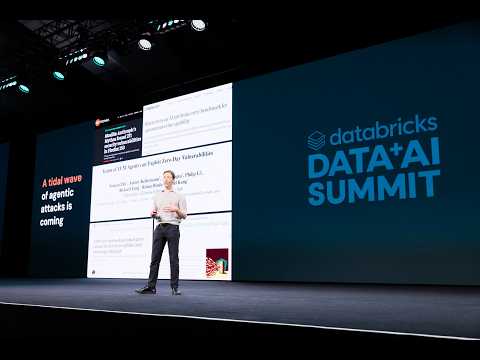
But I want to start with why. We probably all read about the latest LLM models being able to find previously unknown vulnerabilities in just about any piece of software out there today. Whether it's open source or closed source, what used to take nation-state level capabilities. You had to have teams of reverse engineers and hackers working for months or years to find these vulnerabilities, now anyone with access to the right LLM can find these things instantly.
And what's more is AI is actually automating the entire attack process, too. We're seeing this happening in reality today. Anthropic reported recently that hackers were using Claude to attack the Mexican government. And you can actually read the entire chat log. It's really fascinating. You can hear you can see the hackers ask the agent to go and search for vulnerabilities in a range of servers. It finds some. They ask it to attack one of the servers.
It's able to break in. Then they ask the agent to escalate privileges to root access. And the agent finds a vulnerability in a crop cron tab entry and gains root access. They ask it to go and search for sensitive data and in the end the hackers walk away with 200 million personnel records and gigabytes of sensitive data. So, now just about anyone with access to an LLM can put on an attack at a scale and speed that was previously unimaginable.
That's the world we live in. And the only way that we're going to be successful in defending against this is if security and data teams work together. Let me explain why. To start, most companies today have a security operations team that's tasked with defending them. And this team does three things. First, they ingest a bunch of data from a wide range of data sources. Think employee laptops, servers, identity and access systems, all of that telemetry data, log data comes into a central server.
2:29 Bringing security and data teams together
Then, they write detection rules on top of that data. So, these are queries for potentially malicious behavior. So, for example, if I were to log in from San Francisco today and then a couple minutes later log in halfway around the world, that might be a sign that my machine was compromised or maybe it's just a sign I was debugging. So, finally all of those alerts go to a incident response team, which is a team of analysts that are looking through every one of those and investigating whether this is a truly a threat or just a false positive.
If it's a real threat, they can take some remediating action like blocking my IP address or forcing me to reset my password. So, that's what these teams are doing. The challenge is the tools they're using are outdated. They typically use a system called a SIM, a security information event management tool, and these systems don't they're not designed for the scale of threat that we're facing today. The first problem is that you can't even get all your data in.
3:53 The trouble with legacy SIEM sytems
This is a mix of technical limitation and pricing problem. So, what security teams are doing is they do a number of backflips to reduce the amount of data coming into these SIM tools. For example, they'll throw away data that's older than 30 days cuz they can't afford to store years worth of data. Second, they'll run data filtering tools. This filters down the incoming data, taking away things that are maybe less valuable.
Hopefully, you're not missing anything by doing that. And then there's an entire class of data that today's solutions can't even ingest and can't consider. These are things like LLM logs, code, Jira, Slack messages. This is really valuable context that would help an analyst determine whether was using a VPN and maybe debugging a service or whether indeed my machine was compromised. The second issue is that the process today is incredibly manual.
If you look at these incident responders, the analysts who have to determine if a if a particular ticket is malicious or not, they were dealing with over 7,000 alerts a week in 2020. That number has gone up to over 30,000 alerts a week for a typical large organization. And it might take them 30 minutes to investigate one of those to see, you know, what was doing before this happened? Has he ever logged in from this location before?
What what did he do after? And so, you multiply that out, and already you would need a team of over 400 people to meet the number of alerts you're getting today. And this is only going to get harder and harder as we see more agentic attacks happening at larger scale and at faster speeds. So, the reality is that with the tools we have today, we don't stand a chance in meeting these agentic threats. We're dealing with incomplete data because we can't afford and we can't scale to bring it in.
6:06 Why existing tools fail in the agentic era
We're dealing with humans fighting agent attackers. And we're dealing with proprietary data silos where you can't analyze all the data because it's locked up in different locations. The solution here is a big data platform. And that's why we built Lake Watch, the agentic security lakehouse. This is built on top of the Databricks platform, so all of your data is stored in open formats. We make it very cheap and easy to bring in data in lots of different ways.
6:41 Introducing Lakewatch
On top of that, you have Unity Catalog, so you can govern access to the data, ensure compliance. And then we build in Agent Bricks and Genie on top, so you can automate all of these manual processes and workflows. And finally, we give you this in a nice UI that security teams are familiar with and can use easily. And so, the result is that you can leverage all of your data, whether it's structured, unstructured, semi-structured data, anything you need can come into your security lakehouse.
And then, we can apply agents at every step of the process. On the ingest path, we can have the agents automatically apply ETL on that data, do data normalization to make it easier to work with. If a schema changes, the agents can automatically correct the ingestion pipeline to ensure you don't have any interruption in your data that's coming in. On the detection path, the agents can help author can help author the queries in detection rules for you.
And on the investigation path, the agents can automatically investigate these incidents so that the analysts are presented with a full case and they can just verify that the agent did the right task and recommended the right action. And the result of all of this is that we can meet the scale and speed of threats that are coming in today. I'm going to hand it to our tech lead for Lake Watch, to give you a demo of the product. >> Good morning, folks.
8:24 Live demo: Lakewatch
So, I'm here inside Lake Watch. You uh when you have it enabled, speak to your account team, you'll see it show up here in the app switcher. And Lake Watch is our agentic security lakehouse and it's designed for the entire sum journey and that begins with data. So, over here on the data sources side, Databricks is already great at bringing data into your lakehouse, but Lake Watch adds dozens of security specific connectors that can bring all of your security data, including multimodal data, into the lakehouse for analysis.
Once that data lands inside the lakehouse, we also have tools to normalize that data into the Open Cybersecurity Schema Framework or OCSF. In fact, this is a new feature that we've added since our announcement at RSA, there's now an entirely automated Genie-powered normalization pipeline that will analyze your data and construct this entire normalization pipeline for you. And the benefit of having normalized data landing in your gold tables is that you can write your detections once and do your investigation in a single uniform way, even if you have products from multiple clouds and multiple different vendors that have data that is very heterogeneous.
Of course, once that data has landed in your lakehouse, uh Lakewatch is also designed for scalable detection. We support then tens of thousands of detection rules running against that data with features for managing those rules at scale such as MITRE tagging and MITRE coverage analysis, so you can really work out exactly where you need to improve your detection coverage. Of course, because I have brought a bunch of data into my lakehouse including information about my business and my code and so on, I can actually use Genie to automate the process of creating a detection rule, too.
This page here, when you come here to create a detection rule, this is something that would typically have taken a SOC analyst days, sometimes weeks to do. You have to go out and research a threat, you have to craft a detection, you have to validate it. It's an incredibly time-consuming process. But now, I can actually go in here and I can ask Genie, uh please research and write me ooh This is how you know it's live.
Write me a detection for Storm 2460. Storm 2460 is a malware, it's a fairly complex malware that has multiple steps in its attack chain. Genie is going to go out and it's going to kick off a background research agent that's going to go and search the web, look for articles and CVEs and analysis about how this particular attack pattern works. And in parallel, it's going to go and look at my data. Now, it understands my entire data pipeline.
It knows I have CrowdStrike connected, it knows that's flowing through my normalization pipeline into my process activity OCSF table. It's going to read that table, look at the schema, look at the data that I have in there, so it knows what it has available to construct this detection, uh and then it's going to go and combine that. Now, it's busy sampling it to make sure sure all of the data really actually is there.
And the web research has come back, so it's going to combine that with the web research and start to form some hypotheses for how this can be detected. So, building out a detection sequel. It's busy checking that I do indeed have the indicators in my data. Uh looks like I have lots of search util activity. Fortunately, it's all legitimate search util activity, so I haven't been breached yet, but that's the data that I need to detect this malware.
And now it's going to write the sequel. It's tested it's over the past 24 hours. No indication of attack. Now it's testing it over the last 30 days to make sure that it isn't getting any false positives, cuz often you may get false positives, and it would need to iterate on this, refine the detection sequel to make sure that I have a good trustworthy and valid detection. So, now it's come back. The detection is validated, zero false positives.
All of the data that this relies upon is present in my environment. It's now going to take that detection sequel and turn that into a rule, which means I've got the metadata that I need to manage this alongside thousands of other rules, and it's going to give me a little bit of a report here. This is how I'm detecting it. It's targeting all seven phases of this malware. You can see it's pre-populated my detection sequel for me here on the left.
And then it's also giving me an overview of the MITRE metadata that it has tagged this rule with so that I can sort of manage this in my corpus of detections. So, this is a massive acceleration for your SOC team. We've taken something that would have been a week, and it's now executed in a couple minutes. But, the security lakehouse and Genie doesn't just change how I author my detections, it also changes how I investigate and respond to what those detections produce.
If I go over here into my security cases, you will see that this star here shows that many of these have actually been investigated by Genie in the background. So, if I look here, this is a an alert from my WAF that's being a a rate-limiting surge, but Genie has filled out an entire report here. It's gone and found related cases, both a similar pattern attacking the WAF, but also similar uh sort of activities done by the same IP address.
It's gone and looked for these entities in the threat intelligence feed to see if this is a known malicious IP address. It's actually gone and looked inside my perimeter as well to see is there any indication that this IP has done something past the WAF, like did it breach in any way? And it's given me this whole report so that by the time an analyst opens a case, they don't have to repeat the same runbooks and the same sort of repetitive tasks.
All of that has been done for them. And in fact, Genie will learn from how analysts have investigated prior cases so that the next time a similar case comes along, it does the updated analysis on it. All an analyst needs to do is focus on the novel aspects of this case and focus on mitigating it. I can actually show you this in process. Uh if I go back to my cases and I look at informational, you see this one here that Genie has not investigated yet.
This is a suspicious API request. This is a very low-fidelity signal. The reality is when a SOC team is getting tens of thousands of alerts a week, they don't have time to investigate something like this where it's just a statistical differentiation from an established baseline. But with Genie, we now can. I can go in here. I can ask Genie to investigate this case. It's going to come in and pull up the event here and look through the event details and start to understand what's going on.
Looks like it's a post request. The reason it's suspicious is this read context parameter deviates from the established baseline. And it's now actually going to find the service that provides this endpoint and look through my source code and try and understand what is the significance of this new pattern of request. In parallel, it's also going to check my threat feed to see this IP address, is this known to be malicious or part of a kind of a known botnet or something like that?
It doesn't find anything on that side, so it's just going to keep looking through the code and understand what the significance of this is. Looks like it's found something here in the code. This read context parameter has a very specific pattern, and when that pattern is present, there's actually a hard-coded backdoor in the code. It skips all of the access control checks and directly returns the decryption key. So, this is, you know, this is an amazing finding.
It found this very rapidly. It's actually going to extend its investigation now and try and work out who introduced this into the code. When was it introduced? Does it exist in more places, or has this employee introduced other things into the code? And it finds it was committed a particular day, the same day that the suspicious request was made at 8:00 exists in two places in the code. It's now trying to work out, um, who this person's manager is, and if there's any Jira tickets that explains maybe why they did this.
What do they normally work on? And it's looking at the Jira tickets, and there's no Jira tickets related to this change. So, there's no good explanation for this. So, it's busy drafting up a report now. It tells me, "Actually, from the enrichment data, I can see this IP address comes from Google Cloud. Um, here's the exploit. Here's the context. I recommend escalating this to uh high severity and treating this as as a true positive."
So, this is really a pivotal moment in security. This is the first time in history that my capacity to investigate cases and my capacity to be thorough in investigating every single thing in my infrastructure is no longer bounded or limited by the size of my SOC team. With the power of Genie and the data that Lake Watch lets you bring into your security lakehouse, we can investigate anything at arbitrary scale without having to have everything being driven by humans sitting in front of their machine.
Thank you very much. I'll hand it. >> >> So, what just showed you is how with Lakewatch, you can now analyze all of your data. You're not limited by scale or cost concerns there. You can fight agents on the attacking side with agents on the defense. And you can break out of proprietary data silos because all of your data is stored in open formats in an open ecosystem, and you can load data from anywhere you like. We launched Lakewatch just a couple months ago, and we already have a number of marquee customers using it.
Just yesterday, we had the Cyber Forum, and we heard from Atlassian, Adobe, and NAB. But, to give you one example, Adobe wanted to analyze petabytes of data, which was too much for their existing legacy solution. They came to Databricks, loaded all that data, and they're now able to apply AI and ML techniques to find previously impossible to find threats. To sum it up, the only way that we can meet today's security threats is by having security and data teams work together.
18:11 How Adobe uses Lakewatch
So, if you are a data and AI expert, I want to encourage you to reach out to your security colleagues and see how you can help. And if you're on the security side, you should move to using an open security lakehouse so that you can analyze all of the data, and you can apply agents to find the latest threats. Thank you, and I'm going to hand it to tell you more about the Panther acquisition.
Learn more about the Databricks Data and AI platform.
The information provided herein is for general informational purposes only and may not reflect the most current product capabilities or configurations.