Data+AI World Tour for Government 2025 - Building an AI-Native Future for CMS
Summary
- AI-driven fraud prevention: This video shows how CMS uses Databricks to detect fraudulent provider entries before they reach patient-facing systems, preventing billing fraud and ensuring care is directed to legitimate providers.
- Modernized healthcare access: Learn how CMS is replacing outdated systems (paper directories, manual lookups) with AI-powered, real-time digital infrastructure that improves care speed and trust between patients and providers.
- AI-native government operations: Discover how the Centers for Medicare & Medicaid Services, the largest U.S. healthcare payer, leverages the Databricks Data and AI platform to democratize AI and modernize services at massive scale for 100M+ beneficiaries.
Data+AI World Tour for Government 2025 - Building an AI-Native Future for CMS
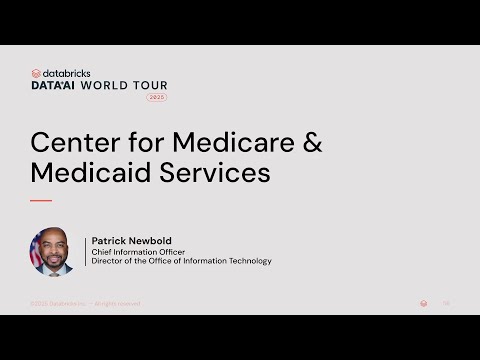
Patrick Newbold, Chief Information Officer for the Centers for Medicare & Medicaid Services (CMS) and Director of the Office of Information Technology, shares how CMS is building an AI-native future that delivers better care, strengthens trust, and safeguards resources. As the largest healthcare payer in the United States, CMS leverages Databricks to harness the power of its data to better serve beneficiaries and prevent fraud. From converting legacy SAS code using Databricks Assistant to identifying improper payments with predictive models, Databricks supports CMS’s need to deliver services at speed and scale.
Chapters
0:00Introduction to AI at CMS2:58Modernizing healthcare access5:05The scale of CMS operations7:15AI for fraud and security10:48Modernizing claims processing12:21Infrastructure and talent14:11Data interoperability16:35Results and future outlook
FAQs
What problem is CMS solving with AI and Databricks?
This video illustrates how CMS replaces outdated manual systems (paper provider directories) with AI-powered digital systems that instantly verify providers, flag fraud, and connect patients to legitimate specialists. This improves care speed, prevents fraud, and builds trust in the healthcare system.
How does Databricks help CMS scale AI to serve 100M+ beneficiaries?
The video demonstrates that Databricks' unified platform enables CMS to process massive volumes of healthcare data, run predictive fraud detection models, modernize legacy SAS code using Databricks Assistant, and deploy AI at the scale required to serve 100M+ beneficiaries efficiently.
What are the key benefits of CMS's AI transformation?
The video highlights: faster patient care (specialist referrals in seconds vs. searching old binders), fraud prevention (fake provider entries stopped before they cause harm), data democratization (making insights available to decision-makers), and efficient use of taxpayer dollars.
What infrastructure challenges did CMS address?
This video covers modernizing healthcare data infrastructure while maintaining security, compliance, and reliability for the nation's largest healthcare payer. It showcases how Databricks enables CMS to build an AI-native foundation supporting the full range of healthcare operations and AI capabilities.
Full transcript
0:00 Introduction to AI at CMS
Good morning, world tour. >> I look I am so thrilled um to be in what I believe is the most exciting place to be right now in the public sector today and uh the data and AI world tour. So just give your hands round of applause. Um, federal government, the CMS. Look, today I want to share about how CMS is building an AI native future. We're going to decommize, democratize AI and that with the goal of delivering better care, strengthen the trust and safeguarding our resources, our taxpayer dollars that we all um chip in on.
Um but CMS is not just modernizing it. We are impacting lives each and every day. And I'm excited to be here today to talk about where CMS is heading with our IT initiatives and how you all are essential partners in our journey. Uh we have a very special relationship with data bricks that helps us harness the power of our data in ways that matter including helping our beneficiaries and crushing fraud. So, let me ask you to picture this.
You're in a small rural clinic. A waiting room is full. A doctor is doing the very best with limited resources. A patient badly needs a referral to a specialist. That doctor reach reaches for the provider directory. It's a thick binder that hasn't been updated in months, years, or even decades. They flip through the pages, find a number, they dial it. But here's the problem. The number doesn't belong to a real provider.
It's fraudulent. Someone inserted a fake number, fake listing along the way, hoping to bill Medicare for services never provided. The daughter doesn't know that yet. The patient is waiting and care is delayed. All while frosters are waiting for a payday. Now imagine this. Imagine that same clinic but the tools we're building in CMS. Instead of old dusty binder, uh the doctor pulls up a unified digital directory. Every provider is instantly accurate, instantly verified and secure.
2:58 Modernizing healthcare access
Fraudulent entries are flagged before they even get into our system. The right specialist is identified in seconds. The patient gets the appointment for that day. Care is faster. Trust between the patient and provider is stronger. And CMS grows stronger all together. That difference between that binder, dust the old binder, and that shiny digital directory. It may feel small, but in reality, it's the difference between delay and timely care.
The difference between fraud slipping through the cracks and fraud being stopped at the door. Between a system that frustrates and a system that protects. This is what we mean about digital transformation at CMS. It's not just about it projects. It's real people, real clinics in real moments, moments that matter, but people who feel the impact of whether we modernize or not. It's also about protecting our taxpayer dollars from those and we have a lot of them who want to explore it.
This is the kind of transformation CMS is driving for each and every day. So, we are not one of those 20-year government agencies. Now, this was only one clinic in my example, one patient and one doctor, but we operate at a staggering scale. Check this out. CMS, we manage over $1. 7 trillion in health spending each and every year. larger than Apple and AWS if we have anybody from Apple and AWS in here. By revenue, we serve over 160 million Americans.
5:05 The scale of CMS operations
That is one out of every American in our country. We rely on a workforce of just 5,000 and partner with tens of thousands of contractors. And each and every week we defend against billions and billions cyber attacks against our systems from adversaries bad actors who would love to get our hands and their hands on our sensor data. CMS we not just a pair of claims. We are a national engine of healthcare. We set insurance rules.
We establish quality standards. We make payments to providers. Safeguard sensitive health information and protect taxpayers dollars. We balance the need for speed with responsibility to protect because every claim, every login, and every data transfer carries enormous weight. This makes us one of the most consequential agencies in all of federal government. And with this scale, standing still is just not an option for us.
CMS faces a critical challenge. We must crush fraud. We must secure our data and we must deliver faster all by relying and provide more reliable care. That is a daunting task. So to meet these demands, I want to talk to you about some ways that CMS is looking to transform and that's exactly what we're aiming to do in 26 uh calendar year 26 all while being anchored in a AI native operating model. Our 2026 strategy focuses on nine key priorities and you see them listed here.
7:15 AI for fraud and security
But these are not just technology projects that I mentioned earlier. They are our foundation of transforming health care nationwide. Each priority accelerates operational excellence, protects public trust, and modernizes how we do our programs. We're taking and talking about advance advanced cyber defenses, smarter claims processing, the unified provider directory, and yes, a workforce modernization to help do it all.
Let me dive deeper in just a few of what I find as our gamechanging priorities. Here you will see four that's going to reinforce another to deliver faster, safer, smarter health care for over those 160 Americans I talked about earlier. Each reflects not just what we're building, but why it matters to the people we serve. First, we are embedding AI across CMS to prevent fraud. And we want to detect anomalies and we want to support smarter decision-m.
CMS, as I mentioned, is a prime target. Billions of cyber attacks hit us each week. Cyber defense is not a project for us. It's a living discipline. Protect protecting CMS's sensitive data is my top priority. And this is why recently I issued a memo that requires all the contractors that do business with us to complete vetting prior to accessing our systems. No work that requires access to our systems can begin until everyone is cleared.
But that's exactly why we built um security into everything we do. Our approach includes zero trust architecture, advanced monitoring, automated responses that adapt to new threats. We expect those to kind of be built in the tools and platforms that we invest in. Now, let me touch on fraud prevention because that is very equally important in protecting the taxpayer dollars that I've been mentioning and preser preserving the trust in our system.
Fraudulent claims waste resources. We all know that it delays care and erodess the confidence in Medicare and Medicaid. So how do we tackle this challenge? Our approach combines three key AR AI cyber security tools. One AIdriven anomaly detection to flag suspicious activities and for our claims instantly. data matching algorithms that prevent duplicate billing to uncover fraud, such as the $106 million in improper payments that CMS and VA found together earlier this year.
And three, automatic triage to route cases to investigators quickly. We don't have time to wait once we those things are flagged. Every fraudulent dollar stopped becomes a dollar invested in care and trust earned in our citizens. That is why we have partnered with data bricks to identify improper payments through predictive models by comparing peer groups. This cyber defense is foundation and essential because it protects the integrity of our claims and our programs.
Which brings me to a second priority. We are modernizing our claims processing platforms so providers and beneficiaries can get faster and more accurate service. CMS processes over a trillion dollars in claims each year. As I mentioned earlier, yet legacy platforms are limiting our ability to adapt and slow up service. Our modernization approach is module, resilient, and cloud enabled. So with an AI mindset throughout, we're applying AI in four key ways.
10:48 Modernizing claims processing
One, smart routing that gets claims to the right system faster. Predictive analytics that catches errors before payments even go out. chat bots and virtual assistants that handle routine task. Freeing our staff for the more critical mission work and this results in faster more accurate payments to providers which is very important to our providers, better expenses to our beneficiaries. We want to bring the best experiences possible and the stronger stewardship of the taxpayer funds that we oversee.
But to accomplish all this, we must migrate off mainframe and modernize. And to achieve this transformation, we need the right infrastructure and the right talent foundation in place. Let me talk a little bit about that. So, we're building cloud platforms, shared services across the silos of our organizations, and a skilled in-house workforce in AI, cloud, cyber security to sustain these capabilities. None of these transformations succeed without the infrastructure and the people that power them.
12:21 Infrastructure and talent
CMS is embracing a multicloud environment for resilience, scalability, and flexibility. We are building enterprise shared services and platforms. They're no longer going to have several different platforms that's doing the same thing in our ecosystem. We need to reduce the duplication, accelerate delivery, and improve security by doing that. Most important is our workforce. No matter what technology we bring in house, it doesn't alone transform government.
Our people do. So we are investing in training and upskilling in AI engineering, cyber defense, cloud security and full stack development and data science. This ensures the teams can design, manage and sustain the platforms that we invest in. The outcomes that we hope to see is faster time to market to our tools. We can't wait more consistent services across CMS and a workforce that has prepared for these technology shifts that you've been seeing this morning.
This infrastructure and the workforce foundation enables my fourth and last priority that I want to share with you today. I have none and that's making sure that data flows seamlessly where it's needed the most. This brings us full circle to that rural clinic that I described in the beginning of this discussion enabling secure data interoperability and creating a unified national provider directory so that providers have never have to rely on an outdated binder again.
14:11 Data interoperability
I believe that data interoperability is not a technical luxury for us. It's a healthc care necessity. Our patients, our providers, our payers all depend on accurate, secure, timely data. One of our flagship initiatives that I talked about earlier is the national provider directory. What we aim to do with this initiative is create a unified digital directory that eliminates errors and referrals, reduce fraudulent billing by validating provider identity and improving patient experience so sharing care is not delayed due to inaccurate data.
An AI native approach, one that we're taking, makes interoperability stronger in three key ways. One, it validates provider data in real time so the information stays accurate. Two, it maps different data sets into reliable source so everything connects. And three, it spots gaps and inconsistencies early before they are a big issue and affect our care. The results, fewer errors, faster referrals, and a stronger trust between patients for and providers and the pay.
Together, these priorities, cyber defense, modernizing claim, scalable cloud, and interoperability form a foundation for an AI native CMS deliver faster, safer, and smarter healthcare. So, at CMS, uh, this impact for transformation is real. Um, the things I'm talking to you today, we are doing now. First, um the adoption of AI tools is strong at CMS. As of this morning when I checked my dashboard, 83% of our workforce is using AI every day.
16:35 Results and future outlook
That means our employees are saving on an average of six hours a week. That's time than I can spend on how viral work. Second, our fraud analytics is already paying dividends. You know, we flagged, as I mentioned earlier already, 106 million in improper payments between uh VA and CMS. That's money recouped. That's money redirected back to into patient care. And third, our shift to the cloud is enabling resilience and innovation across EMS.
It's not just about the technology, but it's about creating the flexibility foundation that lets us deliver services faster, scale when needed to keep our systems secure. For a specific example, we use data bricks assistant to migrate legacy SAS code and convert that over. This allowed us to modernize our systems and deliver better healthcare. This example shows that we cannot do it alone. We need strong industry partners like you.
So, as members of the data and AI community, I want to leave you with a few questions. One, are we building AI that solves yesterday's pain points or AI that reshapes how government delivers value for the next decade? I hope it's the latter. Let me know. Two, what would our agencies look like if every mission decision, every policy, and every operational workflow were powered by real time trustworthy data? Why isn't that our reality today?
The third question I have for you, if the public trust us with their most sensitive data, what must we do to earn that trust in how we use AI? As we look ahead to these priorities will take all of us, government, industry, working in partnership. We need mission specific innovations that drive outcomes, not flashy promises of new products and tools. Together, uh we have the power to transform healthcare. No doubt about that.
By uniting our talented people with cutting edge tools, we'll deliver exceptional care to that every citizen, including you and me and our loved ones uh expect and truly deserves. This is our mission. and together we will make it a priority. Thank you everyone.
Learn more about the Databricks Data and AI platform.
The information provided herein is for general informational purposes only and may not reflect the most current product capabilities or configurations.