DAIWT Paris 2025: Replay Keynote
Summary
- Platform unification: The Databricks Data and AI platform unifies data and AI with open-stack integration, featuring LakeFlow for ETL, DBSQL for analytics, and Lakebase.
- Agent-centric approach: AgentBricks simplifies AI agent development and deployment with Unity Catalog governance for data and AI assets.
- Unified governance: Unity Catalog provides centralized governance for all data and AI assets, addressing silos across enterprise systems.
DAIWT Paris 2025: Replay Keynote
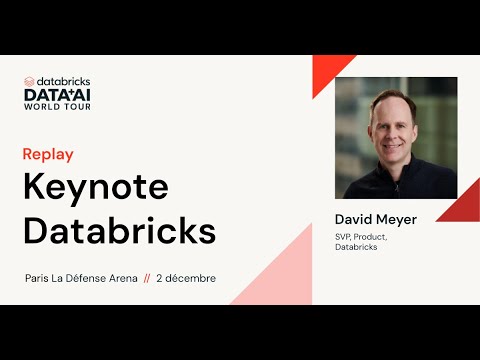
[Keynote en anglais] David Meyer, VP Produits chez Databricks, présente la Data Intelligence Platform: une plateforme unifiée qui simplifie le développement et le déploiement d’agents IA grâce à Unity Catalog pour la gouvernance des données et de l’IA, et une stack ouverte intégrée. La plateforme inclut LakeFlow (ETL), DBSQL (data warehousing) et le nouveau Lakehouse transactionnel, pour offrir l’analytics avancé et l’IA à tous les utilisateurs.
Chapitres:
Chapters
0:00<Untitled Chapter 1>0:06Introduction : l’IA et le problème des silos3:21Le concept Lakehouse et la gouvernance unifiée6:14Agent Bricks : simplifier les agents IA8:18La Data Intelligence Platform10:45Témoignage client : Flow Health19:15LakeFlow : moteur ETL principal25:02DBSQL : l’entrepôt de données29:57Lakebase : base de données dans le lakehouse35:20Applications Databricks et AI/BI41:24Conclusion
FAQs
What is the Databricks Data and AI platform?
The Databricks Data and AI platform is a unified system combining data warehousing, ETL, transactions, and AI capabilities with open-stack integration and governance. This video presents the vision.
What is AgentBricks?
AgentBricks simplifies AI agent development by providing unified governance and a simplified stack for building and deploying agents on Databricks Data and AI platform.
How does LakeFlow enhance ETL?
LakeFlow is the primary ETL engine that integrates with the platform for modern data pipeline development and orchestration. This video demonstrates capabilities.
What is Lakebase?
Lakebase brings transactional database capabilities to the lakehouse, enabling ACID-compliant operations alongside analytics. This video explores Lakebase features.
Full transcript
0:06 Introduction : l’IA et le problème des silos
Hello everyone. Apologies, I'm in English. Um, but this whole place is amazing. >> The largest indoor screen in Europe. >> So, uh, it's exciting to be here. Um, I'm a cold water swimmer. I swim in the bay in San Francisco and after the Olympics I thought I'd swim in the sen this morning. It was pretty chilly though and I prefer Delta Lake to Iceberg. That's a geek joke. Iceberg's cold. So I didn't swim in the sand but I'm really excited to be here with you.
Um, and we're talking about democratizing data intelligence, but it's really about as uh as Ghee uh was saying, data and AI. Um, and all of you are here because you know that AI will either set you apart or leave you behind and you definitely don't want to be left behind. So AI is transforming every industry. You've probably used AI from data bricks in some form already today. If you've used a credit card, odds are that the fraud detection involved data bricks.
If you uh got a drink order recommendation from Starbucks that had data bricks behind it. If you watched any streaming show last night that was recommended to you, odds are data bicks was behind it. Because whenever you're dealing with enormous amounts of data and trying to do high quality AI in production on it, you need a system with the fundamental characteristics that data bricks has. Now, we've seen success. You know, I talked to Seale executives all across the world and we've seen success in all of these industries, but it's still too hard.
Most people still struggle. And the reason it's so hard is you have all of these silos of information. You have a data warehouse over here. You probably have 10 data warehouses. There's probably four of them still on premise. some of which are out of support. You have machine learning systems over here. You have data science systems over here. You have a bunch of legacy databases. You have SAS apps which have a lot of your core data in it.
And you need all of these things to do AI. And all of these systems that are siloed by default store their data in a proprietary format. And beyond that, they have security policies in all of these systems. And that makes it even harder to stitch all of these things together. So back in 2019, data brick started talking about a fundamentally new approach and we called it the lakehouse. And back in 2019 when we talked about the lakehouse, we were universally ridiculed from every software vendor.
3:21 Le concept Lakehouse et la gouvernance unifiée
It's the mother of all anti-atterns. It will never work, etc. But the whole idea of a lakehouse is you take the data from all of these systems and you put it in lowcost blob storage in a place you can store all of your data um in open formats and then all of the governance in these systems you bring into a unified governance layer. So all of your data can be used zero copy between all of these different modalities of data and AI and it's universally governed.
But then in the last couple years, all of these platforms start having AI agents. Every software vendor you talk to, they'll tell you that they're the place to build all of your AI agents. So how do you rationalize that? Um, and it starts with a governance layer, believe it or not. So when we talk about unified governance in the lakehouse, it's not just about your structured data. When people think cataloges, they typically think tables, rows, columns, data, and you put policies on that data.
Databicks builds all of its products together with customers. And all of our customers were saying, "We need a new kind of catalog. We need a catalog that can govern not only tables, but the machine learning models built off the tables, the agents using these machine learning models. And you need unified governance for all of these assets in your in your life cycle. But then you have all these other capabilities that you rely on as well.
You want to understand how all the pieces are used across these systems and you want to understand the lineage between these systems. If your data changes, it can change your model which can change your agent performance and you need all of that super uh super clear and then cost controls, quality monitoring, etc. you needed to go across all of these systems and traditional cataloges and the newer catalog efforts like the Polarises of the world are just about the structured data.
But if you're only governing the structured data, you're missing the big picture and you miss all of the benefit of a unified governance layer which is critical to AI. Okay. So now that you have governance across not only structure to your models and agents, you can bring the agents down into a composable layer on top of this governance stack. So you can have composable agents using all of your data. You never have to copy your data.
6:14 Agent Bricks : simplifier les agents IA
You secure a column once. It's true in your chat interfaces. It's true in your data science interfaces. And we call this whole thing the lakehouse. Now with these composable agents, we bring a lot out of the box. So we'll be talking today and you'll see a demo later of how you could have custom agents. Um the the cornerstone here is the multi- aent supervisor where you can stitch together agents from other systems, MCP endpoints with all of our pre-baked agents.
There's a knowledge assistant where you can put all of your documents into it governed by Unity catalog and chat with it with very very high quality. We'll talk about that. There's document processing where you're getting PDF invoices and you need to extract the numbers from the PDFs in a high reliability, high quality way. But we also have a lot of pre-built agents. There's one for data analysts called Genie which lets you talk to any of your structure data and you can stitch that into other agent systems like your co-pilots etc.
And then we have a data science agent where you can literally say create me a notebook that does uh uh revenue forecasting based on all my historical revenue data and it'll build that all for you and your can go and look at that and verify it. So all of those agents are there and then you have the classical AI agents for the more math, the pregen AI, AI, the boring AI that's all in there as well. So you can do your fraud detection outlier analysis.
So we call this the collective thing the data intelligence platform as we've infused AI through the stack at the bottom layer whether you're using uh Delta or the colder one iceberg we love both. Um, we fully support both of those and we're uh we have the key architects and engineers at data bricks for both of those standards and we're working to bring them together. So you won't even be able to see the difference in uh in you know another year or so.
8:18 La Data Intelligence Platform
The unified governance layer we call unity catalog. It's probably the most strategic investment and the biggest investment within data bricks and it's going to continue to be so because it's so core to doing AI on top. And then we have the agent bricks layer which is these composable agents that we've talked about and you'll see a demo of in a minute. Now on top of these this foundation because of the open standards it's built on you can use any engines you want.
You can use any BI engines any data warehouse engines any machine learning you know AI stack but we have all of those fully integrated out of the box right on top of the data layer. There's the AIB AI infused BI layer. You can build any kind of apps leveraging the core compute and governance of this stack. We have a full ETL platform we'll talk about. We have a full data warehouse we'll talk about and we have a new offering called Lakebase which is very very exciting and I'll spend some time on that later in the talk.
So with this core capabilities there's three areas driving impact today. You all are here because you want to get your AI into production. And it turns out that's pretty hard. So, we're going to talk about simplifying production agents so everyone can get their agents into production and then embracing unified analytics across the whole stack and then how you implement data intelligence to really drive the next layer of productivity in your enterprise.
Okay. So, now we're going to switch to a video from Flow Health and going to talk about it. Flow is number one health and fitness application in the world. We support women's around the world with tailored insights. We have more than 80 millions of monthly active users. FL mission is to empower womens around the globe with personalized health insights. Previously before data bricks we had very fragmented data stack and basically it was very hard for us to find insights and sealed data sources.
10:45 Témoignage client : Flow Health
Once we on boarded data bricks we connected everything into one unified platform when all data is available and everyone can use this data for their own purposes. We got access to early version of AI agent bricks. We built like a new model based on tower techniques which basically use LLM judges and static data generation to improve open source models like llama and basically we are fine-tuning this large language models to make our product even better.
We are using agent bricks to double our medical accuracy and safety and basically we were able to get higher quality of the models and now we see much better accuracy much better safety privacy and security and it help us a lot to achieve our like high standards at the same time it's quite low cost for us and basically it means that we functionality. >> getting your agents in production. So um the things so people have been using the agent capability in data bricks that's been there for a couple years now to build these agents with expensive machine learning engineers across all of these industries and we've worked with them across all of these industries and they kept coming up with the same three things that were really difficult.
One is how do I manage my agent quality? It's very easy to vibe code an agent and test it with a few people and it seems like it's answering questions correctly. But how do you provably with an evaluation framework show that every single response to every single input is correct, high quality, etc. over time with model drift with uh data drift with all of these things and you know a wider variety of attack surfaces for people to even do try to do uh jailbreaking through their prompts and things like that and then you have the fact that AI is moving so fast if you think right now in your mind what's the best model for coding right it might be clawed code or something like that Um, in a couple weeks you'll have a different opinion of the best model for coding.
They're evolving so very fast. There's a different one on the leaderboard every few weeks. So, how do I know which of these models to use? And then there's all kinds of new techniques and chunking algorithms in your vector search. How do I know which of those to use? So trying to figure out how you can improve quality when you have a lowquality output is very difficult and it ends up being whack-a-ole for all of your ML engineers trying to figure out how to, you know, boost the quality.
And then with all of these tradeoffs, they affect cost. Models can differ by an order of magnitude or more in terms of cost per token. And some of them consume a ton more tokens for the same prompts. So, how do you rationalize that for your agent? So, the whole conceit of agent bricks is we're going to try to do all of that hard stuff for you. So the trick of agent bricks is we try to segment the problem to the business problem, the business definition and the underlying AI complexity and we let you control the business definition and we let you help us build all the LLM judges and machinery behind to constantly improve this.
So we beta this starting in the summer. It's moving very fast. Uh companies like uh the one you just heard from are using it in production. And there's everything from a multi- aent supervisor to these bakedin knowledge assistance where you can just point to all of your SharePoint or Confluence documents and build indexes off of it and do agents on top of that. And the way it starts is you state what you want to achieve in normal business language.
So build an agentic system that answers questions about say some emotives then is you'll point to the documents the PDFs the word docs the office docs the wikis etc. and maybe some of the data as well that defines your automobiles and we'll give you some prompts to refine what you're looking for and then data bricks will create LLM judges autooptimize the system and present at the end your cost quality tradeoffs. So let's just talk about LLM judges for a second.
These models are modeled after neural networks and things in your brain, right? And they're a lot like you in some ways. You can recognize a genius painting easier than you can paint a genius painting. And LLMs are the same. So you can get very lowcost LLMs as a judge that can look at every response in your chat and quality score it very effectively and you can do that over time and continuously improve the system. So we use all of that scoring to autooptimize the system and we know whether that means rechunking the vector index or maybe choosing a new state-of-the-art model for part of the agentic system and with that we can prevent uh present these cost quality options and the agent continues to learn.
So every time you use it it actually improves and it actually gets lower cost. And so for example um uh uh used this to significantly um outperform the standard cloud agent. So you look at the state-of-the-art model from one cloud, the state-of-the-art model from another cloud and then agent bricks immediately got a much higher score. But that's not the most exciting thing. with no additional business user input. A couple days later, it got a higher score.
A couple days later, it got a higher score at no additional cost. So, these techniques we've used from our AI research scientists really work in production to get your agents to improve with every iteration. And at Astroenica, they use these techniques. And if you look at this graph, it's important to note that the x axis is a log graph. Okay? So there's a lot of change in cost on the x-axis. And with agent bricks, they could get much lower than even VPT5 mini at a much higher quality.
And of course, you could spend astronomical amounts to get an even higher quality, but you don't need to do that because you're already so much higher than the threshold you need to roll this out into production at a much lower cost. And this is real data off 400,000 clinical trial documents. And these are the kinds of things you can do out of the box with agent bricks. So now I want to talk about the rest of the stack. some of the things above uh the pieces I've already talked about and we're going to have a demo of all of this once I'm done so you'll get to see it in action.
19:15 LakeFlow : moteur ETL principal
Um I'm going to talk a little bit about the piece we call LakeFlow which is our core ETL engine and for the first bunch of years from say until 2017 2018 we were primarily an ETL company. We started with something called spark. Now spark was created in the amp lab in by the founders of data bricks and it's basically how every large data system processes data at scale. In fact, it's one of the three largest open-source projects in the world.
The others are, I think, Linux and Kubernetes. Okay, so two billion downloads a year. So you'd think that it's all going great with Spark. But the problem is you need to be pretty pretty sophisticated to use Spark at scale. You need to use languages like Python, Scala, etc. And it's not really tuned to pull in data from databases and your SAS systems. So we want to make it a lot easier and make it a lot simpler to connect to these systems.
Now recently we took our entire declarative pipeline framework previously known as Delta live tables and we contributed it to Apache and made it part of Apache Spark and now that Spark declarative pipelines it's fully open source it's simple enough for anyone to use and it easily connects to all of your data. Now lakeflow as an umbrella term has four kind of key pieces. One is connect which lets you connect to all of these different systems.
One is the core job capability to run all of this ETL at scale and then this piece spark declarative pipelines I just referred to and a new piece designer which makes it really easy with AI infused for anyone. Now, datab brick spins up over 40 million machines a day across the various clouds to process these workloads and LakeFlow is behind all of this massive data orchestration. So, in this demo, I think you can see it on the screen.
It's the designer product. And in this example, there's a bunch of support cases and you want to join it with all of the support people to see who has the best case close rate and things like that. You're just saying that in in human language, saying what you want to do and is doing that in the tool and creating SQL on the back end. And this is an exciting part where you can say I want to transform it further and just take a GIF or a ping of how you want to transform it and it will write the code to transform your data into that table structure and you see that on the lower right if you can see it on the big screen and then behind all of that is just SQL it's just spark declarative pipelines and you can sync that with your git for all of your production workflow. etc.
So, it's very easy for business users to diagram out what they want and it's very easy for developers to verify that it has the fidelity to put into production. So, that's the designer experience. Now, let's talk about connect. So, you all use your company probably has a hundred SAS apps, right? and you have data in these SAS apps, customer records, financial records that you need to pull into your lakehouse. We connect to all of those SAS apps.
Now, you also have a bunch of file sources, all of your unstructured data and SharePoint and these other systems. We connect to all of that stuff. And then you have I guarantee 200 databases, 300, a thousand databases with elements of data you need to bring into your lakehouse. Now you can federate these things, but you can also connect to them using LakeFlow Connect and bring them in. Let's take a look at how easy that is.
So, you just go into the tool, you pick Salesforce in this example, you put your credentials in, and then once you're in Salesforce, you can pick all of the business objects in Salesforce. And some of these objects have a a billion, not a billion, a lot of columns. So, you can pick the columns you want as well. So, you're only bringing in the data you need. And after you figured out where you want to put that in your lakehouse and the data you need, you simply set the refresh schedule.
Maybe it's every hour. And then every hour, new updates into Salesforce or Service Now or these other systems get pulled right into your lakehouse for interstitial work with all of your AI agents, etc. So you can easily connect to all of your data. And then uh with that all of your systems that have all of the bits and pieces you need to compose your AI agents are available for you in the lakehouse. So in the first part of the talk I mentioned that in 2019 we came up with this idea of a lakehouse and the conceit of that again was you could put all of your data in the lake and you could do things like data warehousing in situ in place.
25:02 DBSQL : l’entrepôt de données
So formats like delta and iceberg build indexes and statistics around all of the data in these formats that are essentially parquet and make it so database and warehouse engines can be very fast against this data. So we call our warehouse DBSQL. It's based on open formats. In a lot of these other cloud data warehouses, by default, the data is in a proprietary format. When we talk about all of our performance benchmarks, it's all in an open format, either Delta or iceberg.
It's in your bucket. Whether it's S3, ADLS, or GCS in your cloud, you own and control it. We operate it on in on it in place, and you don't have to copy it. There's an open catalog on top. Uni Unity catalog supports all of the open standards. So any engine can read and write to that data whether it's iceberg or delta on top of Unity catalog. And there's an open ecosystem. So any data engine you can think of plugs into this framework.
Now because we've infused AI into the engine, I'll give you an example. it it's been proven in academia a bunch of years ago that uh a deep learning model could index data far more effectively than any partitioning scheme any v order any zord etc because it's a bespoke deep learning index on your data based on all the queries that have come in and are coming in every day. So using techniques like this, the same query you ran two years ago now runs five times faster.
And inherent TCO simplicity of the lakehouse, etc. , the consumption is taking off like wildfire. It's doubling every year. Our warehousing product is already north of a $1 billion US annual revenue. Um, and that's not the coolest part. The coolest part is it's unified with our AI system. So, you might have seen uh a blog post from OpenAI about a month ago where they talked about how they use AI at scale within OpenAI and they're using the data bicks interface in Azure data bricks to query their models using SQL.
Now they built all the models but SQL is a very uh effective way for engineers to do fast processing against these models. So any model whether it's Anthropic, Gemini, OpenAI, Llama, Deepseek, you can leverage in the system through SQL and then we use AI for these automatic performance improvements like the liquid clustering deep learning I talked about. And then the newest most exciting bit and we just published a paper how we got a higher quality score on this than any competing system at much lower cost is parsing documents.
The AI document parse from within SQL lets you do this at massive scale with a lot of user simplicity. And that's one of the things that uh the AI uh engineers were using in the in the in the blog post. So, your best data warehouse is a lakehouse. It's provable. It's simpler. There's literally no reason for you to take your OLAP data and copy it to a warehouse to do things like BI on top of it. You should do it in place.
Zero copy. But now I'm going to talk about something that I think will change your lives and your industries and your companies more in the next three years than the lakehouse has already. Almost every company has adopted the lakehouse pattern. Every software vendor touts their own lakehouse capabilities. But I want to talk about something we call lake base. And it sounds a little silly. Another weird term data bricks came up with lake base, but it's kind of obvious.
If a lake house is a data warehouse that's resident in your lake, zero copy, then a lake base is a database that's resident in your lake, zero copy. And it sounds pretty uh simple when you put it that way, but it has profound profound consequences. Databases have been around since the 70s and they've improved a ton. There's amazing databases out there, but they're fundamentally the same construct, right? They have kind of an onprem mindset. you spin up a database which is an expensive operation your d your all of your developers building AI they hate your databases they don't tell you because they don't want to you know make you mad but they hate your databases and I'll tell you why if you have a database and you want to make a copy of it to do some agentic stuff cloning a database at scale will take you hours not minutes, hours, and you need it right away.
29:57 Lakebase : base de données dans le lakehouse
So, they're built for this onrem mindset. And when you deconstruct it, when you separate compute and storage in this concept called the lakebase, everything changes from kind of the waist up. It's a transactional database engine, the most popular one on the planet now, which is Postgress. But from the waist down, it's been fundamentally rearchitected. And it's actually a lot harder to do with a database than it is with a data warehouse.
In a data warehouse, 100 milliseconds is pretty fast. In database, you need it to be 1 millisecond. 100 milliseconds is completely unacceptable. So the whole paging memory system of Postgres was rewritten. And now it doesn't store in a proprietary storage and copy it to the lake. It stores it resident as open- source files in the lake. So it's built on open source. It is Postgres. The what you're interacting with is Postgres with all the community extensions.
But it has truly separated compute and storage. And let me tell you what that means. That means when you create a lake base, it's available in less than a second. any size you need. Available in less than a second. If you clone it, the clones available in less than a second. When you stop using it, it just becomes data in your blob storage. You pay blob storage prices and the first query that comes in, it hydrates in less than a second.
It's fundamentally different than any database you've used. And that means it's built for AI. In fact, we've been working with this company Neon who created a lot of these core concepts for over two years and we recently acquired them. Neon databases 80% 80 plus percent of these databases are created by AI agents because when you're vibe coding sometimes the code is bad and bad code can corrupt your data. So you have to be working on a copy of the data and with separated compute and storage.
You can create a thousand clones for no money. All of them within a second and have a thousand agents working on these clones. And when you like what they've done, you can merge that branch of the database into the core. You can branch your database just like you branch code. It's a developer's dream. So now if you're building an app, we have data bricks apps we'll talk about in a second. If you're building an app, often times you need a little storage system for your app.
Instead of asking your DBA to spin you up a database, boom, it's right there in the lakehouse. But I guarantee you, you have developers in your company that are taking data out of your warehouse and copying it into a a memcache, a key value store, an operational database to do singledigit millisecond querying or feature serving or things like that. That's now automatic. No code has to be written by you. You can point to any schema of any data in your Unity catalog and spawn that data into a Postgres interface 9 millisecond reads.
Okay? Or you can go the other direction. I guarantee you have developers wasting time doing this as well. You can take data from your operational database and it's just literally available in real time in your Unity catalog schema. all secured the same way. Fine grain access policy is the same way. And all of this data from OLAP to OLTP is available real time zero copy to your agents and to your models and to the AI you're doing.
It fundamentally fundamentally transforms these things. Okay. So now you've basically got rid of the separation of lake house or the warehouse in the lake and lake base the database in the lake. Now let's talk about those other little pieces here. Um you're doing AI across your org. You're creating chat bots. You're creating document processors. And the way you want these things to show up to your employees are very bespoke.
35:20 Applications Databricks et AI/BI
They're very customized to you. You need to fully control them. So you want to write an app. Today you have to spin up an app server. You have to get a node or a Python environment from your IT, build your app, and then connect that to all of the data in your lakehouse. With data bricks apps, you can do that all in the same platform. You can build any app you want for any user community you want. All of your employees, all of your customers right in this fabric.
And it uses the serverless compute, the the governance and unity catalog to run. So it really lets you democratize all of these agents you're building into apps. And any of these agents or apps can be plugged into your other systems where your business users live. They might be in teams. They might be in Slack. They might be in Copilot. You can plug these things in, right to those systems with all of the governance preserved.
Now, when you're writing these apps, if you do it outside of a system like the lakehouse, you have all kinds of challenges. You vibe code your app. You're all happy. You're like, "Look what I built." And then it says,"Well, you have to integrate it with our SSO and our multiffactor authentication. You need to make sure all of the access is governed and audited and logged. You need to integrate it into our VPC or our ingress egress policies.
It goes on and on and on and on. And your vibecoded piece of genius never gets into production. If you build these things into uh data bricks apps, all of that stuff basically comes for free. And we're working with all of the primary uh vibe coding uh platforms like uh you know, Lovable, Replet, uh GitHub, Copilot, and these kind of things to make it so when you're working in those systems, you can autodeploy through point andclick into your data brick system.
And we'll be talking about a lot of those things in the coming months. So data bricks apps fully powered by data intelligence secure and governed out of the box. You don't have to think about it. If you are in a PCI, HIPPA, Fed ramp environment, that's taken care of. And it has this open ecosystem. any Pythonic framework, any node framework out of the box, you can pick that framework and get a templated app, whether it's a chat app, a uh a a data form app, etc. right in your system.
So, this is the fastest growing product we've ever released. Its growth over the last six, seven months has been tremendous and we'd love for you to check it out. Okay, so now you can build these apps. We haven't talked about this AIB layer. Now, you all use BI. You probably have all of the BIS in your company. I'm sure you use PowerBI. I'm sure somebody uses Tableau. Someone uses Domo. Someone uses Looker. You know, all of these different tools.
And a lot of these tools are incredible, incredible innovations in them. But we have kind of a different perspective. The different perspective is to just make that tool available for everyone in the platform. No user licensing costs. It's just available in the platform and it's all AI first. And because of this, we've had massive growth in our AIBI platform. You can analyze and visualize your data. You can start with uh uh English or or Portuguese sentence and it'll start to build your your your uh your dashboard for you.
It's incredibly fast because it's sitting in the engine and it's secure by design. Everything runs as viewer. You know exactly who looked at what data when in your audit logs which is important for your addestation later on for your compliance officers. But of course dashboards don't answer every question, right? So every BI system has AI built into it. Now we're not alone. But the difference is the difference is if you have BI on a separate layer, the AI built into it is restricted to what's in the BI layer, right?
So if you have billions of rows of data in your lakehouse, it's not going to have access to all of that to answer the questions. With AI in the stack, deep in the engine, you can go deeper and deeper and ask any of these questions. And we'll see a demo of this after after this section of mine. So inside these dashboards when you ask these questions we call that capability Genie. And now Genie is fully integrated through the APIs to all the other systems your business users use.
But you can get your deep questions answered. You can get all of the charts you need. And then as you want to go deeper and deeper, you can create your own bespoke view and put that into a dashboard. And datab bricks runs all of our forecast calls internally, 10,000 person organization using genie rooms. Finance closes the books using genie rooms. These answers can be provably correct through things like our metrics layer, etc.
I don't have time to go into that right now. So here is the data intelligence platform. You've heard that uh data bicks is complicated. You'll see in the demo that data bricks isn't complicated anymore. It can be usable by all of your business users. But also sometimes it's hard to get your hands on data bricks. And so this summer we launched the free edition. Anyone in the world can go to databicks. comfree and five seconds later be using datab bricks with all of the capabilities I've talked about.
41:24 Conclusion
In fact, if you have a regulated corporate system, you might not be able to try all of the new features in that. You can just go to databicks. com free and use it all there. And we've also uh invested $und00 million into a fund to bring this to universities worldwide. I know we have a bunch in France. I don't know them the top off the top of my head, but we want to make all of these tools available to the future data and AI practitioners to help accelerate your business when you hire them.
So, data bricks free is available for everyone. Um, and that concludes this part of the keynote. Thank you so much for your attention. Apologies for the English. It's been wonderful to be with you today.
Learn more about the Databricks Data and AI platform.
The information provided herein is for general informational purposes only and may not reflect the most current product capabilities or configurations.