AIA Group x Databricks: Turning Regulated Data into Real-Time Intelligence
Summary
- Scale across markets: AIA's Aaron Jones shares how building for scale, adopting product mindset, and aligning innovation with strategy helps AIA deliver data value across 18 regulated markets.
- Real-time intelligence: AIA Group leverages Databricks to transform regulated healthcare data into actionable insights for fraud detection and personalized health recommendations.
- Data-driven products: AIA One platform demonstrates how data systems enable business value—providing personalized coaching to agents to optimize their performance.
AIA Group x Databricks: Turning Regulated Data into Real-Time Intelligence
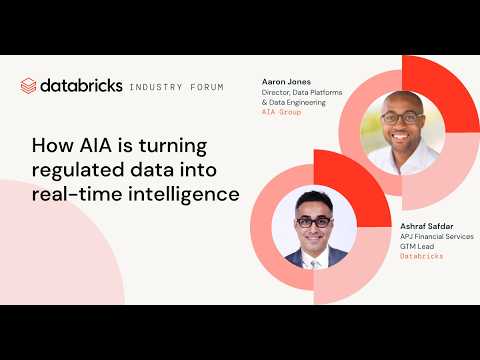
Step inside a fast-moving conversation where AI, innovation, and real-world impact collide.
Aaron Jones of AIA shares how his journey—from actuary to data leader—shaped a strategy built on scale, product thinking, and purpose. Discover how AIA navigates complex markets, unlocks value from data, and turns AI ambition into tangible outcomes, from fraud detection to personalized health.
Chapters
0:00Introduction to Aaron Jones0:27Career journey and philosophy2:00Scaling data across markets3:20Data governance and security4:37Innovation and business outcomes7:21Real-time data and investments8:11The future of agentic AI10:41Closing thoughts
FAQs
What are the key principles that guide Aaron Jones's data strategy at AIA?
Aaron emphasizes three principles: building for scale (designing solutions that grow over time), having a product mindset (iterative evolution), and aligning innovation with business strategy to ensure value for agents, customers, and employees.
What business challenges does AIA face operating across 18 different markets?
AIA deals with diverse regulatory requirements, cultural differences, and operational challenges across multiple regions. Despite these complexities, the company sees the dynamism as an opportunity to innovate.
How can organizations scale AI agents across teams and business units?
AIA Group demonstrates scaling AI agents by building on a unified data platform that provides consistent governance, lineage, and accessibility across all business units. By establishing centralized data standards and agent frameworks that multiple teams can leverage, organizations accelerate agent deployment while maintaining security and compliance. This approach enables business units to deploy custom agents for their specific use cases while sharing underlying data infrastructure and governance policies.
Can you give an example of how AIA uses data to drive business outcomes?
AIA One is an agency platform that provides personalized coaching and recommendations to help agents optimize their performance. This demonstrates how data systems can directly impact employee productivity and customer value.
Full transcript
0:00 Introduction to Aaron Jones
Good to see you again. Usually, I would say a man like yourself needs no introduction, but for the benefit of our audience, please tell us three sentences who you are. Yeah, hi. Thanks for having me and really excited to be here. So, yeah. I lead data platforms and data engineering for AIA Group. Essentially, my team's responsible for helping our business units get more value out of our data. All right, so let's get to it.
0:27 Career journey and philosophy
So much we want to unpack with you. , you know, you've had a storied career. You've led analytics, you've led health innovation across many different markets, including at Cigna before AIA. And really keen on understanding what that journey taught you and what you carry forward into your current strategy at AIA. Yeah. Thanks for the question. So, I started my career as an actuary. I always was kind of pulled towards math, so I love math.
And so then I got into startups. And then moved to Hong Kong and worked at Cigna as you mentioned. And I'd say really three things stuck with me on my journey. One was around building for scale. So, think about and design the solution that can grow over time. Second is to have a product mindset. So, really try to be incrementalist, so have a version one and then really continue to adapt and evolve the solution over time.
I think that's really helped me. And then the last was to align innovation with strategy. And this is one where, you know, something at AIA that we're really trying to do, our our focus is on making sure our strategy brings value for our agents, our customers, and our employees. We have a good example what we've done in Thailand, which we call AIA One, which is essentially an agency platform that gives personalized coaching and personal personalized recommendations to help those agents really optimize and maximize their performance.
So, yeah, those are kind of the three things that I, uh, know, I wanted to share here. That's awesome. And you you mentioned one example, but I can imagine that doing what you do across 18 different markets isn't isn't simple. You know, you've got regulatory, cultural, operational challenges, and tell tell me a bit about what's hard in doing this at AIA scale. And how are you how are you thinking about Databricks as a solution as part of this?
2:00 Scaling data across markets
Yeah, so it is there is there are challenges, but it's also exciting and dynamic. So, I want to want to start there. It's the dynamism of the region is very very exciting. Um, but I'd say two things that make it hard. And one you hit on. One is the regulatory nature. For example, Korea, that's a region where data has to stay within Korea. So, that comes with its own set of challenges, but what we have with Databricks our ability to manage and sort of customize the platform in our own way allows for us to stay within regulation.
And then I'd say the second one is just the variance in maturity levels um from a from a tech tech and sort of people point of view that we, uh, really try to cater with cater to. And I'd say the platform allows for us to take solutions in one market and deploy across other markets. So, we can uplift and make sure all the markets and all the platforms are at a very strong and high level of maturity when it comes to technology and our data platform.
3:20 Data governance and security
You you've actually touched on governance. Governance is a huge part of what we do in something we feel really strongly about, really proud of also. But tell me a bit more, like what role does, for example, centralized lineage or your fine-grained ask access controls or auditability on this platform give your risk and compliance teams when it comes to using the platform? How do how do you think about it? Yeah, I think first thing is just high standards when it comes to governance is just a table stakes item for us given, you the amount of we've got over policy holders with over 44 million policies and our individual policies and 16 million group policies.
So, we've got a large customer base and really governance and security is essential to what we do. But, I'd say one of the key items is is Unity Catalog. Really, Unity Catalog in terms of how we're able to have fine-grained access control and really understand um how every user is using the data um and making sure that we've got the platform that gives us the autonomy to uh really control what what what is used and what's not used and what's accessed and what is what and what's not accessed.
So, basically, we have the power to control and I think that really gives our security teams uh confidence in the platform. You must be trying many, many different things out like based on what you're describing, especially across these different markets. And I think that's that's going to be common across a number of insurers. There's no shortage of pilots, right? But, I think as as we've all discovered, the hard part is actually getting these models into production.
4:37 Innovation and business outcomes
Well, and then getting it to scale, right? Um and then getting concrete business outcomes and decisions to come out from using the platform. So, how is AIA approach this challenge? And you can choose sort of whatever theater you'd like to describe it, whether it's in fraud or underwriting or personalization or, you know, health interventions. Yeah, I I'd start with one of the phrases we use here is uh transforming AIA through innovation that matters.
So, that's a a phrase that we use that I I really like and really gravitate towards because we really are want to focus on the initiatives that are actually, as I mentioned before, tied to our strategy. And so, one of the ones that I I think about and I believe would be well, great to talk about here is our relationship with our our health insurtech entity, Amplify Health. So, we've got Amplify Health and that entity is really focused on delivering outcomes uh health outcomes across across Asia.
And so, our business units work closely with Amplify Health. And uh there's a couple components about Databricks that really help um us ultimately deliver this sort of improved health outcomes for our customers. One is actually just ability to share and share seamlessly. So, Delta Share and having that set up is a really core component. We can we can safely and securely share and do that very quickly across our business units to Amplify Health.
And then the second is uh the teams have really put together within Amplify Health a strong set of solutions that one help us collect data with within Asia the data from hospitals and providers. It looks different. Uh you got sort of handwritten notes, you got different types of forms. So, that ability to sort of have a platform that enables us to do sort of the data collection across the myriad of types of forms, put that in our platform, and then leverage that data for uh a few things.
One is our fraud, waste, and abuse capabilities. And then second is our um essentially ability we have models and the model serving endpoints and capabilities that we get from Databricks allow for us to really take the data, process that data, and then leverage that data for our for our decision-making. And you as you're doing this, is the data that you're taking are you taking it in batch or are you doing it in real time?
And tell me a bit more about that thinking you have there. Yeah, it you know, it varies, right? So, I we've got real-time use cases, we've got batch use cases. So, both exist. On the real-time side, one of the ones I I wanted to talk about is uh what we built for our investment teams. So, investment teams we have we have a hot a strong data platform that we take data from Bloomberg, from Aladdin, many different sources.
7:21 Real-time data and investments
And that data is used essentially to drive our fund and investment decisions. And so, that's really critical to sort of driving value for our customers, and I think what we've got within Databricks really helps us optimize that value. So, that's that's one of the use cases that has really been helpful for us in helping us drive value for our customers. I'm sure this is unstructured data as well as structured data, right?
And it's that magic that happens when you put both together. Yes. Yes, exactly. Awesome. So, let me ask you about one thing which is top of mind to so many execs around the world within financial services, and that's agentic AI. Mhm. So, for an organization like AIA, you know, it's got a footprint across health and wealth and protection, where do you see agents having the most impact? And maybe we start there, and then I've got a follow-on question for you.
8:11 The future of agentic AI
Oh, yeah, no problem. Yeah. So, really firstly, it spans the whole whole business. That's what I think is really exciting about AI from distribution to operations, even technology. So, AI is really nice to the here and spanning and sort of evolving all the functions within AI. Me personally, what I'm really excited about is this notion of conversational analytics. So, how can we, you know, a business user ask a natural language question and actually get really deep insights.
So, not just answering what questions, but what, why, and how questions. I think now with the capabilities of AI, we can put this into the hands of essentially the entire business to help them generate insights faster, um make more data-driven decisions, and ultimately free up time to focus on storytelling and figuring out ways to help bring more value to our customers. Yeah, definitely. And huge uplifts in productivity, which then translates into either an increase in revenue or a reduction in cost, right?
So Exactly. And if you if you were to look outside the industry, as an example, you look at all the various agentic AI use cases in use there, and you would have think you put your thinking hat on and say, "Hmm, if I were to take some of that and bring it into my industry, which is insurance, what what would you say would is the most interesting?" Yeah, I mean, personally, I think it's the the autonomous nature of some of the agents that are that are that are out there, and I think how we do that, you know, securely and properly and at scale is something that we really have to think about, and I think we'll take some time um to sort of get right within within our industry, but how can we sort of, you know, allow for autonomous decision-making, autonomous sort of, let's say, updates and operations?
I think that's where there's really power really a lot of power um to come, but, you know, we got to get that right and I got to think through that. Um but it's something that, you know, I'm personally really excited about. Awesome. And using the right platform to get there. Well, at time, but if I could ask you if there is one if there are one or two things that you want to leave our audience with, what would they be?
10:41 Closing thoughts
I would say one is our momentum within AIA has been really good. We've got really strong results, and data is really the foundation of improving that or sort of meeting those goals and objectives, and we feel really excited about what we have today and the great work our teams have done, but we're also really excited about the future. And so, we appreciate what we've gotten from Databricks, and we look forward to continue to grow and bring value to our customers.
Awesome. Thank you so much. Yeah, thank you. Cheers.
Learn more about the Databricks Data and AI platform.
The information provided herein is for general informational purposes only and may not reflect the most current product capabilities or configurations.