AI-Ready Data on Databricks: How TK Elevator Uses Context and Meaning to Make AI Agents Work
Summary
- AI-ready data foundation: TK Elevator harmonized fragmented IoT data and gave it common meaning through Unity Catalog to enable agentic AI at scale.
- Predictive maintenance: Processing 500 million data events per day enables ML models to predict equipment failures before they occur across their global service network.
- Agentic orchestration: AI agents now support field service workflows and portfolio decisions with humans in the loop, powered by unified, trusted data.
AI-Ready Data on Databricks: How TK Elevator Uses Context and Meaning to Make AI Agents Work
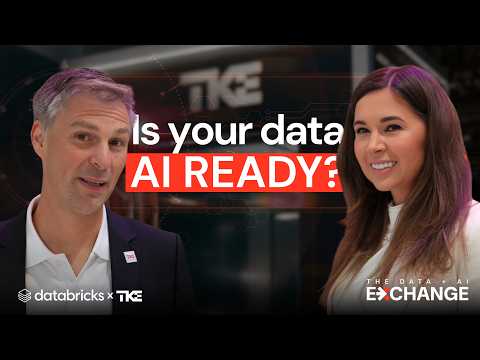
How do you bring AI to a decade of fragmented data across one of the world's largest elevator companies? In this episode of The Data + AI Exchange, Viktoria Semaan sits down with Matthias Gohl, Chief Digital Officer, and Christian Jung, VP of Digital, Data & AI Foundation at TK Elevator, to break down how they turned siloed IoT telemetry into agentic AI, processing 500 million data events a day to predict failures before they happen.
They get into the real work behind AI-ready data: consolidating a fragmented data lake with Unity Catalog and Medallion architecture, building a trusted and auditable foundation, and giving data a common meaning so both engineers and AI agents can use it. Plus conversational analytics with Databricks Genie, applying LLMs and RAG to unstructured contracts and service logs, and how intelligent agents now support field service and portfolio decisions with humans in the loop.
⏰ TIMESTAMPS
🔗 RESOURCES
Go deeper: TK Elevator's Data + AI Summit session on turning fragmented data into data-driven service: https://www.databricks.com/dataaisummit/session/how-tk-elevator-turning-fragmented-data-digital-data-driven-service
Try Databricks Free Edition: https://bit.ly/dbx-free-signup
#Databricks #AgenticAI #UnityCatalog #PredictiveMaintenance #TKElevator
Chapters
0:00Bringing AI to Physical Infrastructure1:21From IoT Telemetry to Agentic AI4:14Predictive Maintenance at 500M Events a Day6:28Data-Driven Field Service Workflows8:00Harmonizing Siloed Data with Unity Catalog9:49Building a Trusted, Auditable Lakehouse Foundation11:35Conversational Analytics with Databricks Genie12:23RAG and Agentic AI for Unstructured Data14:33The Roadmap for Agentic Orchestration15:11Advice: Engineering AI-Ready Data
FAQs
What makes data 'AI-ready'?
AI-ready data has common meaning, shared definitions and governance enabling both engineers and AI agents to understand it consistently. TK Elevator achieved this by consolidating fragmented IoT data, applying Medallion architecture and using Unity Catalog to harmonize data across the organization.
How does TK Elevator process 500 million events daily?
TK Elevator collects IoT telemetry from 1.4 million elevators and escalators worldwide through their MAX Box connectivity devices. Processing this massive data volume enables predictive maintenance ML models that forecast failures before they impact customer service.
What business outcome does predictive maintenance enable?
Predictive maintenance enables TK Elevator's 25,000 service technicians to prevent equipment failures proactively. This improves service quality, reduces downtime for customers and optimizes maintenance scheduling and resource allocation.
How do AI agents improve field service?
With AI-ready data in Databricks, intelligent agents can analyze IoT signals, predict maintenance needs, and support field service workflows with humans remaining in the loop. This combines the best of AI automation with human judgment for complex decisions.
Full transcript
0:00 Bringing AI to Physical Infrastructure
To build a common language based on Unity Catalog. We harmonized the data and gave it a common meaning. We call it all AI-ready data. >> How do you start? >> So, I think it's it's really >> The best technology is the one you never notice. An elevator arrives, the doors open, people step in, the doors close. Most of us never think about the engineering behind it. But behind the smooth experience, it's data, prediction, and AI.
And that's the story I'm exploring today with TK Elevator, one of the largest mobility companies. While much of the AI conversation is focused on chatbots, TK Elevator has been building data foundation and AI into the physical world. And they started long before generative AI became the headlines. First, I will speak with Matthias Goal, their Chief Digital Officer, about the four ingredients that make AI work beyond the hype.
Then we will look at how they build it with Databricks. Let's go. such a pleasure having you here. >> Thank you for having me. It's a pleasure. >>, I know the entire world in the past few years have been chasing IoT. It was such a big buzzword, right? And then with generative AI, it changed. Now we always hear about chatbots, and people really went hard into generative AI. But your company did something different, right?
1:21 From IoT Telemetry to Agentic AI
You still utilize a lot of this IoT telemetry data, and you merge data and AI. Can you tell me a little bit what it looks like to really build this mobility company? >> We have been on this journey for more than 10 years. Exactly 10 years ago here at the Hanover Fair, we inaugurated the MAX Box. That's our first connectivity device connecting the elevator to the cloud. That's our IoT device. In general, our company we're moving, as you said, 1.
5 billion people every day. And we service 1. 4 million elevators, escalators around the world. That's our passion. So, we improve the quality of urban life around the world through our passion for moving people. And that we do best with our service technicians. Now, we set out to continuously improve the service operations around the world. So, we have 25,000 service technicians and we support them with data and AI.
We started with a MAX Box connected to the cloud. We added our subject matter expertise to it. We added machine learning to it. We added digital operation centers to it. And all of this helped on predictive and preventive maintenance. It's not like a startup, right? We have 50,000 people. So, this is a long-term journey and we kept investing. We kept focusing. We kept really making sure that we create value. So, now with the emergence of more AI, gen AI, agentic AI, for sure we make use of that.
For sure we try to apply the technology where it makes sense. But we need to stay focused having the foundation, continuously evolving the foundation, and building on top of that. Otherwise, we jump from one hype to the other. And for us, AI, agentic AI, gen AI beyond the hype builds on four topics. One is really making use of this great technology. It's powerful. But adding to it our strong subject matter expertise.
We have service technicians that really know what they do. So, adding that to it. The third one is not doing a POC only, but to really going for scale. And for us, our most important big process that really adds value is service operations. So, we added it to service operations, and it's all grounded in high-quality, safe, and secure data. So, these are our four ingredients how we look at AI beyond the hype. >> Yeah, that's so impressive.
From outside, I think if we look at elevator over 100 years, nothing really changed. It just looks like a box, right? But from inside, a lot of things changed. Can you tell me a little bit more about 500 million events? Where is this data coming from? >> There's a lot of things happening. Just imagine for 1 second these cities or the airports without elevators, without escalators, or elderly people trying to move up to the 10th floor, no elevators.
4:14 Predictive Maintenance at 500M Events a Day
So, what we do is mission critical. And also the service is mission critical. So, whatever we can do to improve the service, that's what we do. So, we get the data from the elevator to your question. So, we have many, many elements in the elevator. So, if you want, we also have cameras for machine vision in the elevator to improve the safety, to help with the avatar inside. The 500 million data points, they come around the world because we connect the controller with the MAX box and send it to the cloud.
So, we see the movements, the operational movements. We see the doors opening and closing, but we also see all the error codes, all the fault codes that we get out and make sense out of it. And by analyzing that, we can see that the elevator might need service in next couple of weeks before there is a breakdown. And then we see thousands, hundreds of thousands of events that we analyze before something happens. The uptime is really an ultimate goal.
We want to provide best-in-class digital AI-enabled service. I was in New York a couple of months ago in one of the big buildings, 25th floor. And one of the service technicians came up to me and said, "Hey Matthias, what you did with this digital operation center is just great. That's the best thing you have done with digital and AI because with our digital operation centers, they are the AI supported expert hub behind every technician, we can see patterns in the data.
And then we can tell the service technicians in that building, "When you go there, don't go to floor one. Don't go to floor three. Just go to floor 25 because there might be an issue with the door in the next couple of weeks." So, we can give them tailored support. >> This is so interesting. So, walk me through this experience. Let's say there is this issue, right? On the floor 25. I'm technician and now I'm utilizing your AI-powered solutions.
6:28 Data-Driven Field Service Workflows
What does this experience look like for me? >> If you're the service technician, you have all the tools available to you that you need in terms of uh devices that can analyze the elevator, but also your normal field service management tool, your CRM, all these elements. What we now do, we ingrain in these operational processes our competency. So, we call them digital operation center tickets. So, what we see in the center, so where we have the data experts, the AI experts, the service technician experts, and the process experts sitting together in a digital operation center, so that they understand what challenges or what support the elevator might need in the future.
And they analyze it and then they create a ticket. And the ticket is written in the right language, so not in gold data language, it's written in service technician language. So, go to that floor, check the following door, it's a hoistway interlock challenge, or something else. So, but we see that in the data, we translate it into the real world and support, and then we send it as a ticket within the normal FSM CRM system to the service technician. >> So, your technicians have all the data that they need to really provide the support. just gave us a vision, but the question I now have, how did I actually build it?
So, next I will sit down with. He leads digital data and AI foundation, and his team has been working with Databricks since 2018. So, he's going to walk us through the solution they built on Databricks. I want to ask you more about how you actually build it. I know that TK Elevator grew through acquisitions, which means that you inherited a lot of different systems, data, disconnected silos, and then you built something that called CDP Nexus to provide this common language of data.
8:00 Harmonizing Siloed Data with Unity Catalog
Can you tell me more about this? >> Yeah, excellent question. So, as you heard, we know we did IoT, we started that 10 years ago and leveraged Databricks already for that as of like 2019. That brought us IoT data, which we started newly, but we needed to connect this IoT world with our corporate world, where we had the challenge that we grew a lot through acquisitions, which left us with more than 100 systems in over 50 countries, and not necessarily necessarily the same systems.
So, Databricks capabilities helped us in the CDP Nexus project to build a common language based on Unity Catalog that we then connected also to our IoT data. So, we we took basically everything that we learned from the elevator world and connected it with service operations, and only if you bring both together, you can create value in the field for our service technicians. >> Amazing. So, Unity Catalog really helped you to build a single source of truth and connect disconnected systems in one place. >> Exactly.
We harmonize the data and gave it a common meaning, which then also helped us for the next step. We call it all AI-ready data, because without that, if humans can't read it, how would agents read it? >> I love this AI-ready data. Can you tell me a bit more about your journey of building this data foundation? What it took, because you have several different companies. How did you approach this? >> It's not only a technical one, it's really how do you set this up?
9:49 Building a Trusted, Auditable Lakehouse Foundation
So, what we said is, yes, you need to write technology, but you also need to have the right partners within the organization. So, we partnered with our business organization, with our field organization. We brought in the right partners from a technology side, both Microsoft and Databricks, and then also had the right service providers to do that. And really leveraging a lakehouse and medallion architecture, first acquire the data as it is.
What's super important to us is lineage, so that everything is auditable. Cuz what we had before sometimes was very manual. On an aggregated level, people were questioning the numbers. There were many numbers for the same question. And we countered that now through getting it in in this lakehouse architecture, and describing it through Unity Catalog, and in creating more, better, auditable information that's aligned across the company. >> Yeah, so basically you built this Databricks metrics, right?
That are single source of truth for between different departments. Because very often the same kind of a KPI going from one department to another department, right? Might have slightly different number. >> Exactly. And then you get this question, but yesterday I saw a different number for the exact same KPI. And as you said, metric views are one of the capabilities that we used just recently to even describe it better and make it easier for our teams to build reports on top of that, but also make it usable for agents that leverage Genie and other technologies within Databricks. >> Okay, so now you're touching on something interesting.
So, once you build this data foundation with Unity Catalog, what was your next step to empower you on your AI journey? So, you mentioned just now Genie. Is it something that you're utilizing? >> We're exploring it. So, so one thing is and that was the original case, we automated the reporting. That made our CFO happy and also our our operational field people. But beyond that, there is also always this question, can I somehow interact in an easier way with the data?
11:35 Conversational Analytics with Databricks Genie
And that is what we further explored with Genie that we put Genie on top of uh this data lake and the data that shows up in reports that you can now interact with in a voice manner or in a you can just type in a question and get get an answer back about a KPI. >> And how about agentic AI? Are you utilizing any agentic AI capabilities? >> We heard it before and we really looked at this um actually before this and thought, there's a lot of tools out there that give you individual productivity, Copilot, other things, ChatGPT, but that cannot be the end of the story.
12:23 RAG and Agentic AI for Unstructured Data
So, we really looked at our overall journey. talked about this, all of the steps, and looked at, okay, what are the things that we have solved already in the last 10 years and where do we still have gaps? And where can agentic AI reasoning and orchestration help to make that even better? So, we leveraged everything that we did with our CDP Nexus journey, the data that we prepared, and now brought in context from unstructured information, namely PDF documents, either engineering manuals or also really contract information that was not sitting in our field service management and ERP systems, and then we put it into the context of the service technician and even prepare him now even better for the next maintenance visit.
Which then helps him to make better decisions. And it also helps him to afterwards let us know in the context that we just created what he actually did on site. >> Okay. So, you build what they call retrieval augmented generation agents to convert unstructured data, PDF documents into something that is very easy to retrieve for a technician and then basically provided them the right information right at the time when they needed. >> Exactly.
In the context that he needed and that then allows us to do the next thing which is the voice debriefing. So, we always had the challenge that technicians are very good. They're fixing their job, but they're focused on the task. They're not so much focused on documenting things afterwards. And now we have a voice agent that is asking the technician what they've actually done. Which then can be fed back in our in our data platform and can also be made available to the next service technician.
Which is more kind of a systemic knowledge rather than individual knowledge that we had before in our great service technicians. >> This is so exciting. Can you tell me what you're more excited going forward? Do you already have more agentic AI projects in mind that you want to solve and empower people? >> So, I think on the one hand side it's super important that we still focus on data quality and building out the data foundation that we have.
14:33 The Roadmap for Agentic Orchestration
But then the opportunities are limitless to even further integrate agents to that create more context and bring all of the information technically, commercially together to even more improve the experience for the service technicians and ultimately also for our customers. >> For someone who is watching this video and maybe they are just starting on their journey, can you give advice how they should approach their journey whether it is building Unity catalog or looking for one specific use case that they need to solve.
15:11 Advice: Engineering AI-Ready Data
How do you start? >> So, I think it's it's really a technology questions and an alliance question and understanding what is the problem that you want to solve. I would not start with everything all at once, but very specifically start with one small thing, but always keep in mind where you want to go and then keep modularity and building that in layers. And uh working with Databricks actually makes that possible, right?
You can first bring in the data, then model it out, describe it better, and then go the next steps to do more agentic and other things like that. >> What's your favorite Databricks feature? >> Uh I think it's Unity Catalog. I also like Genie a lot and nowadays also Genie code is quite awesome cuz even people that haven't been developing either for a long time or never had develop can also do dashboards and other things.
So, it's great feature. >> Thank you so much, uh. These conversations were a reminder that the real AI transformation starts long before AI model choice. If you're interested to get started with agentic AI solutions, find the links in the description and I will see you in the next episode. >>
Learn more about the Databricks Data and AI platform.
The information provided herein is for general informational purposes only and may not reflect the most current product capabilities or configurations.