Agentic Commerce and Retail Sovereignty: Building on Your Data Platform
Summary
- Four major hyperscalers announced at NRF their intent to sit directly between retailers and consumers through intent-based agentic search, raising urgent concerns about disintermediation and the potential loss of 15 to 30 percent margin per transaction.
- Retailers can defend their competitive position by treating proprietary consumer context, real-time inventory knowledge, product graph relationships, and dynamic pricing as a data moat that third-party platforms cannot replicate.
- Databricks Lakehouse and Unity Catalog enable retailers to collaborate across agentic platforms — including those from partners such as Salesforce and Hightouch — while retaining full data ownership, governance, and the ability to compose new applications rapidly.
Agentic Commerce and Retail Sovereignty: Building on Your Data Platform
Retail faces a pivotal shift driven by agentic commerce. While hyperscalers promise to sit between retailers and consumers through intent-based search, the real question is who owns the data and the consumer relationship. If retailers cede control to third-party platforms, they risk the same disintermediation that plagued food delivery and digital advertising, losing 15 to 30% margin per transaction and the ability to influence their own customers.
The path to sovereignty lies in building a unified data platform that enables real-time decisioning, natural language reasoning, and ecosystem collaboration without fragmentation. Learn why proprietary consumer context, real-time inventory knowledge, product graph relationships, and dynamic pricing become your competitive moat. Discover how Databricks Lakehouse, Unity Catalog, and open integrations with partners like Salesforce and Hightouch let retailers work across multiple agentic platforms while retaining data ownership, governance, and the ability to compose new applications rapidly as the technology landscape evolves.
📂 The Outlook in Retail and Consumer Goods: https://www.databricks.com/lp/economist-industry-reports/retail-and-consumer-goods?itm_data=solutions-retail-economist-impact-industry-report-feb25&itm_source=youtube&itm_category=solutions
🤝
Chapters
00:00Agentic Commerce at NRF01:06Data Ownership and Disintermediation03:33Five Operational Trends for Retailers05:12Understanding Agentic Commerce06:46Risk of Disintermediation08:40Knowledge Asymmetry: Your Advantage09:46Consumer Context as Your Competitive Moat10:51SaaS Platforms Evolving with AI12:41Proprietary Data Becomes an Asset13:29Unified Data Strategy14:19Structural Differentiators for Retailers15:06Lakehouse Architecture for Data Unity16:29The Urgency: Window to Build is Months
FAQs
What is agentic commerce and why does it matter for retailers?
Agentic commerce refers to AI-driven platforms that allow consumers to search for products based on intent rather than keywords, with hyperscalers positioning themselves as intermediaries between retailers and shoppers. Retailers face the risk of losing direct consumer relationships and up to 15 to 30 percent margin per transaction if they cede control to these third-party platforms.
How can retailers avoid disintermediation in the era of AI-powered commerce?
Retailers can avoid disintermediation by building a unified data platform that consolidates proprietary consumer context, real-time inventory knowledge, and product graph relationships into a competitive moat. Owning this data foundation allows them to engage with multiple agentic platforms on their own terms while retaining control of the customer relationship.
Why do companies like Abercrombie and Fitch and Ulta Beauty invest in AI-driven data strategies?
Abercrombie and Fitch grounded its transformation in customer insights and adaptability, achieving 11 consecutive quarters of growth. Ulta Beauty deployed AI to drive market share and customer loyalty rather than focusing solely on operational efficiency, demonstrating that data-driven AI strategies deliver measurable business results.
How does the Databricks Data and AI platform help retailers maintain data ownership?
The Databricks Data and AI platform, through Lakehouse architecture and Unity Catalog, provides open integrations with partners like Salesforce and Hightouch so retailers can participate in multiple agentic ecosystems without fragmenting their data. Governance, lineage, and access controls remain centralized, ensuring the retailer retains data ownership even as they collaborate externally.
Full transcript
[00:03] Hello. Thanks for joining today's event. Uh my name's Rob Saker. For those that don't know me, I lead the global consumer industries at Databricks. That's retail, consumer goods, travel, hospitality. Uh and today I want to share with you some insights that we learned at NRF and that we've heard from customers uh about
[00:18] where we think the industry is going this year. There's been some really interesting discussions in what are very key inflection point, I think, in the industry. So, I'm going to jump right in. The biggest announcement at NRF and that you've probably seen this year is this
[00:34] whole idea of agentic commerce. Uh it was everywhere. Uh we had four different hyperscalers announcing that they intend to sit directly between the retailer and consumer to engage those consumers and to help them
[00:49] to search base based on intent to find products and services that match their need. Now, the audience loved this. They loved the promise of frictionless commerce. Um but the real question that went on asked and that we've heard a lot of sense is
[01:06] in this era of agentic commerce, who owns the data underneath and who owns that consumer? And there's a real fear of disintermediation with the consumer. So, I'm going to talk a little bit more about that. In general, AI is having really an
[01:21] interesting moment. Um I think everybody sees the promise of it. Uh global AI spending projected to uh grow to $2.5 trillion uh in 2026. There's massive incremental value for retail and consumer goods, you know,
[01:38] almost a half a trillion dollars of impact at stake uh according to McKinsey. Um but on the flip side, companies are still struggling to figure out what this means and why it's happening. Merchants who reported uh using AI tools have had limited to no effect on their business so far.
[01:55] Now, the cause, in my opinion, is not bad bad AI, but rather it's fragmented data, messy systems, and a failure to scale. And I think we're trying to take an old mindset approach into this modern era
[02:11] and leading to these challenges. Now, some other great announcements at NRF. Um our friends over at Abercrombie & Fitch talking about grounding the trust transformation and customer insights and adaptability, delivering an incredible 11 consecutive
[02:29] quarters of growth. And if you remember what happened with that brand, what a great story. Uh Ulta Beauty deploying AI to drive market share and customer loyalty rather than just operational novelty. Ulta Beauty's one of those firms that is always on the forefront of using AI to
[02:45] drive consumer experiences. But another one who I think may have the best idea and the best strategy for for AI in retail is Dick's Sporting Goods. And they're integrating digital and physical spaces around a core customer as the athlete philosophy. They're definitely one you
[03:01] want to to to watch and see what they're doing in their space. And not to be outsold, REI looking at how do they emphasize that AI assists and augments and how to use human product knowledge um in areas where AI cannot replicate.
[03:18] So, the real question with retailers and consumer goods firms has shifted from should we invest to do we own what we're building on? Now, I think the five operational trends that we're going to see that will define retail in 2026. The
[03:33] first, especially in this economy, this barbell economy, um has to be about efficiency. We have over a trillion dollars of inventory distortion that is up uh for for resolution. If we can deal with real-time demand forecasting,
[03:49] real-time replenishment, and on-shelf availability. And AI can play a key role with the right data platform. With all the challenges that are going on, labor continues to be a major challenge. And we think that AI augmenting the staff can really lead to
[04:06] better customer satisfaction, better results, better employee productivity, and more. Great example of that Kroger with their Sage, uh you know, they're not replacing employees, they're making their employees better. An interesting area to to watch is about anticipation. Things like synthetic
[04:23] consumers. And how can we predict needs before articulation? The really fascinating thing about agentic commerce is that it changes the experience with the brands from searching for products and services to instead searching based on intent. And if we can anticipate that, that
[04:38] becomes extremely powerful in terms of our relationships with consumers. Now, of course, agentic commerce, I'm going to go on a lot more on this. But lastly, this we're still a physical retail environment. The majority of retail is sold through physical channels.
[04:54] But how can we digitize those stores and capture those signals and make them smarter? And we've been talking about this for years, but it feels like now we finally have a real ability to bring this information together and make sense of it for both offline and online channels.
[05:12] Now, the 15 uh trillion-dollar disintermediation uh event is agentic commerce. And I mentioned before, in the past, think about anytime you go and purchase, you go and search for clothes, and you search for shirts, and you search for pants, and shoes, and socks, and other things there.
[05:27] But you probably have something in mind for why you're buying an outfit. Maybe it's my kids are going back to school and I need to get them. Maybe my niece is getting married and I need to get an outfit. Maybe you're in a fraternity or sorority and you're going through rush and you want to get that look. Maybe you got a hot date.
[05:43] Maybe you're starting a new job. There is a reason that we go and search for new apparel and a gen to commerce allows us to meet that intent. And instead of selling me just a pair of socks, the promise is I can sell the entire outfit.
[05:58] I can capture the full share of wallet. We know this works. We've been seeing this with our own customers. furniture.com, great example of that. They won an award for doing their gen to commerce platform. Um we see 9x conversion
[06:15] higher than traditional keyword search. Because you're not searching for just a product, you're searching for the need. We see a higher likelihood to convert than organic search. Again, because you're satisfying the need. We see a higher incremental lift, a 5%
[06:30] increase in incremental lift. But also see a higher repeat. And the segments that are driving this, by the way, are the core segments that we want to land. It's millennials and Gen Zs. Now, part of the challenge with a gen to
[06:46] commerce that I alluded to that people are coming to the realization on is that if I give my relationship with my consumer to a third party, and that becomes the mechanism that they interact with me, I run the risk of dis- disintermediation.
[07:03] And there's strong precedence for this. If you think about food delivery in the QSR space, 15 to 30% margin loss per order. There's a story about how before the order aggregators came along, a burrito would
[07:19] cost you $8. Well, then now that same burrito in an order aggregated aggregator is $21. The restaurant only gets 4% of that value capture. And so, a lot of that's going to the order aggregator. And the relationship's going to order aggregator. And pretty soon, that
[07:36] restaurant, to stay relevant with the same consumers that used to come directly to them, they're going to have to pay for the privilege of advertising to capture those consumers. Go back a little bit further to digital ads. Before many people's time, probably on
[07:51] this call, but in the late 1990s, the majority of promotion spend between brands and retailers was going directly to the retailers. Now, we also had media and TV and radio and out of home and and other channels. But then Facebook and Google came along
[08:07] and and what they did was I could go and search on Google, I could get visibility to things, and I could go to the website. And so brands started shifting the dollars that they were spending with retailers instead to these distribution channels like Google and Facebook and
[08:24] others because they got greater efficiency and scale as a result of doing that. But that meant that that high-margin revenue shifted away from retailers. And we think that same challenge, that same risk is possible with a genetic AI if retailers do not approach this in the
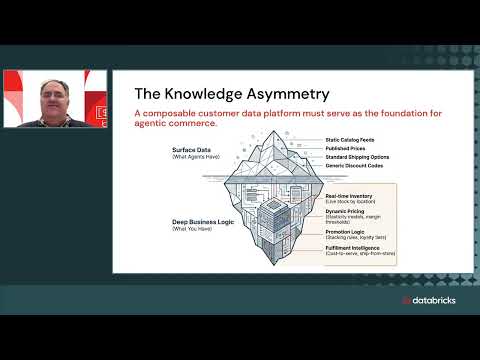
[08:40] right way. Now, one of the things that works in your advantage if you are a retailer is you have a knowledge asymmetry. There's a lot of information that you need to make available on an intelligent commerce platform. I need to have my catalog feeds, my published prices, my
[08:56] standard shipping options, discount codes, and more. But you have real-time inventory information. You have dynamic pricing. You have promotion stacking. You have substitutability rules. Do you really want to use somebody else's product graph, or do you want to have your own product graph
[09:13] that shows the relationship between things? There's a lot of information that retailers have that the intelligent commerce platforms never can have. And I think the key is going to be how do you have this in a way where you can work across multiple intelligent commerce platforms, but retain the
[09:30] ownership and the build of that information, that deep business logic within your own ecosystem. You know, it's different data types. I mentioned inventory positions, consumer contacts, fulfillment, product graph substitution, but the consumer context I think is the one that actually becomes
[09:46] the biggest moat for retailers. Yeah, we can work with different uh agenda commerce platforms using an MCP protocol to work with UCP and and uh and MCP. But
[10:02] our ability to develop a rich and deep understanding of the consumer, not just what they looked at, but what they did in the store, what they shopped, what they purchased, what they sent back, all of their preferences, that deep proprietary understanding are things
[10:19] that these agenda commerce platforms cannot scrape or replicate. And as you think about how do you go into this and avoid that disintermediation, I'd really be prioritizing how do we build strong direct engagement with our consumers
[10:35] to help support this information. Knowing that you're going to work with a variety of different agenda commerce platforms, you just cannot want to be solely dependent on any specific one. Now, in addition to the agenda commerce, another key thing that we're
[10:51] we heard a lot of is all these different companies that are coming out and uh they're layering in AI solutions on top of their stack. And I think the interesting thing that we'll have to watch for in this space is that
[11:06] the SaaS companies, the hyperscaler companies, these are consumption innovations. But they have a very narrow view of the actual business. If I put a an AI agent on top of a procurement system, it understands the information
[11:22] specifically within that procurement system. It doesn't understand the broader context of why things are happening in procurement. Maybe there's external threats or supply chain disruptions or other things that are impacting my suppliers and that's impacting my negotiation with
[11:37] procurement. These are things these narrowly defined solutions don't have. And I think what we're going to see is that the traditional SaaS modes are collapsing. So, AI is eating SaaS is the headline. I don't think that's necessarily the right
[11:52] way to phrase it. I would say that the SaaS providers are going to have to radically re-architect the way that they look about things uh in with their systems and their data to capture a more holistic view of the data. What this means to you as a company
[12:10] uh building your own data capabilities are there certainly modes that AI is destroying, you know, learned interfaces encoding business process logic in the in the user experience custom workflows the data parsing and tight integration
[12:25] um all these things. Those are going away because you can abstract that into the context layer with AI. But AI is actually reinforcing modes that I think become even better if they're governed. Your biggest advantage is your
[12:41] proprietary deep data in an integrated form. Think regulatory lock-in actually becomes an advantage for you. You think about traceability and lineage requirements. It's a lot easier to do that when you have one system than it is to do with nine different systems.
[12:59] The network effects become a lot easier when you have one thing to integrate to multiple partners. And the system of record evolution, I think platforms go from just recording to intelligent decisioning. And we're seeing this every day. We're
[13:14] seeing companies that are vibe coding new SaaS applications on their own once they have that information because they recognize this. But they're evolving their data strategy to really re-emphasize around these modes. And this the keep of it.
[13:29] In the past, you may have had dozens or hundreds. When I first started my my career, I remember I had 107 different applications that I had to manage, and many of them had point-to-point integrations between systems. And we spent a good portion of our budget just
[13:45] moving data back and forth. And that's non-value added work. But the new way to think about this is how do I bring all of my information into one unified data intelligence platform, have that central governance in the context, and build my AI on top of that. Bring my
[14:02] AI to the system to the the data. Don't bring my data to the the the system. And we're already seeing composable SaaS applications that are re-architecting in this type of environment. So, I think the structural differentiators
[14:19] that are going to convey that sovereignty into reality, as you think about building in this new composable approach, whether it's a gentle commerce, whether it's SaaS applications, whether it's any number of other things. First of all, openness and optionality become really key.
[14:34] None of us know who the winner is going to be in the next 5 years. The reality is it's going to be people that we don't know. It's going to be people that aren't even players right now. We see new models evolve every day and new startups. The most important thing is that you do not lock yourself into proprietary data
[14:51] technologies that limit your optionality to take advantage of new innovations. The second thing is that simplification of the architecture, moving away from the disjointed point-to-point integrations to a lakehouse oriented architecture where
[15:06] all your data is in one location, that makes it a lot simpler to do things, but that also allows us to do real-time decisioning. And then lastly, govern collaboration. We live in an ecosystem with thousands of suppliers and partners.
[15:23] And it becomes really critical that when we think about our data estate and our ecosystem, that that doesn't end at the four walls of our company, but rather we think holistically across the entire ecosystem. The Lakehouse delivers on this. You're going to hear a lot more about
[15:39] this today about how the Lakehouse is being used to bring the data together to help us to develop that rich and intimate understanding of consumers and why that's so critical as you think about building your moat in this era of agentic commerce and disruption of SaaS.
[15:57] You can centralize your information. You can manage and govern that information with Unity Catalog. The most important aspect of AI is the context and the data governance that gives the rich signals to the to AI to build upon. You can build all your all your
[16:13] applications on Databricks. You can work with key partners like Salesforce, Hightouch, SAP. You can also use any of the leading commercial or open-source inference models for running your AI applications, OpenAI, Gemini, Anthropic, Meta, and
[16:29] more. This is the year. The window to build your foundation is measured in months this year. The longer you wait, the more your company actually faces risk in terms of being disintermediated and disrupted by others in there. So, the most
[16:45] consequence consequential decision you can make in 2026 is not which agentic platform to adopt. It's what data platform you're going to build upon that. Hope you enjoyed this. I appreciate it. Enjoy the rest of the session. We'll
[17:02] talk soon.
Learn more about the Databricks Data and AI platform.
The information provided herein is for general informational purposes only and may not reflect the most current product capabilities or configurations.