How Agentic AI is Rewriting Healthcare | NVIDIA x Databricks
Summary
- Agentic AI in healthcare: This video explores how agentic AI and open-source technologies are transforming clinical workflows by automating complex patient journey orchestration and documentation.
- Platforms and applications: The discussion covers agentic companies that use NVIDIA's NeMo TraiN speech technology to automate clinical report generation, appointment scheduling, and medical trial matching.
- Drug discovery innovation: The Genesis Workbench collaboration between NVIDIA and Databricks Data and AI platform accelerates pharmaceutical research through intelligent data processing.
How Agentic AI is Rewriting Healthcare | NVIDIA x Databricks
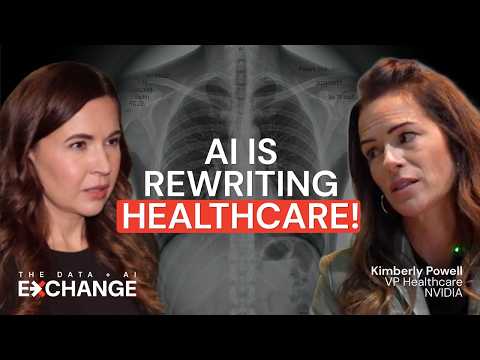
Welcome to the very first episode of The Data + AI Exchange Podcast: Unfiltered conversations with the leaders shaping AI.
In this debut episode, host Viktoria Semaan, Principal Technical Evangelist at Databricks, sits down with Kimberly Powell, NVIDIA’s VP of Healthcare, to explore the profound impact of Agentic AI and open-source technology on healthcare. Learn how a robust data foundation is the key to moving from simple insights to life-saving action at scale.
Resources to get started:
Pixels Medical Imaging Processing: https://bit.ly/pixels-dbx1
Genesis Workbench to Accelerate Drug Discovery: https://bit.ly/genesis-workbench2
Chapters
0:00AI in Healthcare: The Future of Saving Lives1:12How Agentic AI is Transforming Clinical Workflows5:02NVIDIA & Databricks Genesis Workbench for Drug Discovery6:51Unlocking Medical Image Reasoning with Pixels9:02Why Open Source is Critical for Healthcare AI10:54Hospitals of the Future: The Rise of Medical Robotics12:09Can AI Crack the Complexity of Cancer?14:49Getting Started with NVIDIA and Databricks
FAQs
How is agentic AI transforming healthcare workflows?
Agentic AI automates complex clinical tasks including patient communication, medical record population, appointment scheduling, and clinical trial matching. These agents reduce healthcare professionals' administrative burden and improve patient care coordination.
What role do NVIDIA and Databricks play in drug discovery?
The Genesis Workbench, developed through collaboration between NVIDIA and Databricks, leverages the Databricks Data and AI platform to accelerate pharmaceutical research by processing scientific data and automating research workflows.
How does open-source technology enable healthcare AI?
Open-source platforms like NVIDIA's NeMo TraiN provide accessible tools for companies to build agentic systems that process speech data and generate clinical documentation, lowering barriers to healthcare AI adoption.
What medical imaging capabilities does Pixels provide?
Pixels uses AI to process and reason about complex medical images, enabling physicians and researchers to extract structured insights from imaging data for diagnosis and research applications.
Full transcript
0:00 AI in Healthcare: The Future of Saving Lives
The right data. >> healthcare >> most influential voices in health AI. Let's go. >> agentic AI and open-source technologies are closing the loop between the digital world and the doctor's office. , we went from AI that creates to AI that thinks and reasons, now to AI that actually executes complex workflows. So, how do you see this innovation really powers, and maybe you had some kind of a use case where you were like, "Oh my god, this is a wow moment that I've never experienced before."
1:12 How Agentic AI is Transforming Clinical Workflows
Yeah, it's absolutely happening. It's so exciting. Um, there's two places where agentic AI for me is just profoundly changing the idea of what healthcare is going to look like. platforms and applications and companies that have to sort of help orchestrate a patient journey. Everything from the, you know, your first encounter with a doctor to scheduling your appointments to following up with your appointments. And the software platforms of the past, they were applications that were built for humans to use.
And we had to, unfortunately, um, consume a lot of our healthcare professionals' time unfortunately, they spend over um, just like you record conversations every day in the work that you do, there was a a big bloom of what they called AI scribe companies. But even there, they're turning themselves into agentic companies. So, they can take a lot of NVIDIA's open platform, everything from NeMo TraiN speech, so we can take spoken words and we can tokenize them into data.
Then they can generate clinical reports that the doctor has to write. They can then populate, automatically after the doctor checks it, the healthcare record. They can help the doctor make sure that you're pre-authorized for maybe an MRI that you need to get scheduled. They can maybe help schedule that appointment for you. And, unfortunately, if you are, you know, really sick, they can maybe help match you to a clinical trial.
And so, amazing companies like, um, Abridge is one amazing agentic clinical conversation platform that is taking agents not only in isolation, but connecting them together to do amazing, um, clinical workflows. So, that's that's one that's very, very exciting. Another one that is just taking people's breath away is AI scientist. The scientific method, it all starts with a whole long set of research that a scientist has to do.
They have to go read a ton of papers. They have to build a hypothesis. They're, you know, doing equations. They're They're talking to their other colleagues and they're testing and then they're writing up a scientific report. There's an amazing company called Edison who has an agentic AI scientist platform called Cosmos. And Cosmos is a a long-running agentic platform. And essentially, when you want to start a hypothesis, you can the Cosmos platform, essentially, can go spawn off 200 agents at once that cooperate with one another to go off and read 1,500 papers.
It can write, um, 40,000 lines of code and do essentially compress what is otherwise six months of research time into about 24 hours or less. Everyone can relate that in our work, we all have the tedious administrative tasks, right, that are taken away. But another thing, managing those environments. So, I know NVIDIA partnered with Databricks and created Genesis Workbench that helps scientists, instead of spending their time on setting up this environment, actually invest it agents and these applications now are built off of a lot of models that need to be connected together and then connected to the right data in order for a drug discoverer to do work.
5:02 NVIDIA & Databricks Genesis Workbench for Drug Discovery
And so, >> that they need to then just start getting right down to the work. What that means is that harness that we're talking about is, um, a whole bunch of tools that now can operate on data that's inside the platform and help them do their work much, much faster. And they don't have to think about where do I set up the GPU instance and where do How do I get my data organized? Like, we, you know, we've taken care of a lot of that grunt work.
So, now the workflow of drug discovery can more easily be deployed and they can live now, like, we almost call it a a computational dry lab as a scientist that is going to complement the wet lab. But now they can do a lot of work and a lot of discovery with these AI tools in these new workbenches, these harnesses. Yes. foundation, your AI is kind of like expensive experiment, right? And for agentic AI, you need to provide this contextual reasoning.
6:51 Unlocking Medical Image Reasoning with Pixels
A lot of medical data is locked in proprietary format. For example, for medical imaging, um, it's a DICOM format that was hard to analyze, right? And it's kind of like what's in silos. So, Databricks partnered with NVIDIA and built Pixels powered by NVIDIA MONAI. I would like to understand, now that we can unlock the insights from the thousands of images, ask quick question and get the answer, what's the next step? What it really unlocks? images, your lab work, it's sitting in all of these systems of record.
And what we're doing together is we're taking and building a new AI-ready data layer that is putting this data that and making it available for these agent systems that we just talked about. So, imagine that you're going and you're visiting a doctor and before you get into the visit, needed to sort of make that available. Or, a doctor might want to ask a question, are there other patients like, her age, who might have had this symptom and and are, you know, are there X-rays that kind of we can look at?
And what were the outcomes of some of those patients? So, we really need to unearth and bring up that data and put it into a data layer that allows for the agentic systems that are being built every single day. we have our Inception program is our AI startup program. We have over 5,000 AI healthcare startups. So, the companies, the investments that's going on there, but as you said, where would they be if they didn't have the ability to get access to the data.
So, your platform is really helping this amazing riches of knowledge be made available for these systems to really change, I think, how healthcare is going to reasoning? Why NVIDIA invest so much in open source? The majority of those startups I just described, they're built on open source. There's a lot of especially in healthcare and a lot of industries, a generalist model, it's not good at specialized tasks. So, of course, you know, just like in medicine, doctors usually specialize in a deep specialty.
9:02 Why Open Source is Critical for Healthcare AI
Well, we need to do the same thing with these models. We need to be able to customize them, domain optimize them, um, and then we need to do, uh, other things, which is cost optimize them. You know, we spend almost $5 trillion on healthcare here in the United States. And we know we need these agentic systems to come in and help close the gap between the supply and the demand, but if it's too cost prohibitive, then they wouldn't be able to adopt these technologies.
And just as described where you have agents calling agents, and that's just more and more inferencing, and it's you know, maybe it's a million times more compute that these systems are going to need. We need to make sure that we optimize it such that it can be afforded and it can be adopted deployed on the cloud, it can be deployed on prem. It's a very hybrid industry. And then we need to make sure that it's cost optimized, and we can really control all of that and give give that control to the developer through save lives, essentially.
Well, now I just have rapid fire questions. I'm going to ask you very quickly, and then just a one sentence. If you imagine going to a hospital in 10 years, what it would look like? Yeah, I'm actually really excited about that one. Robots everywhere, okay? We are building a physical AI data platform for health care robotics. good reason. The hospital itself is going to be a robot, you know, infrastructure itself is a robot.
10:54 Hospitals of the Future: The Rise of Medical Robotics
So, where you have vision agents looking over, orchestrating, ensuring safety. You're going to have service robots. So, somebody who's going to walk you down the hall and take you exactly where you need to go, so you feel comfortable and we are efficiently moving through the facilities. You're going to have clinical domain specialist robots. You're going to have robots that are assisting surgeons. You're going to have imaging robots that are an autonomous x-ray room where you're just going to walk in and be guided by a digital agent, and then a robot's going to come in and image you.
So, I imagine hospitals of the future to have lots of helpful robots. >> Yeah, I would like to be in the hospital like this. >> In your lifetime, if you had to pick one disease that AI would crack, what would it be? I guess cancer, and it's not one disease, and that's why it's doing incredible breakthrough when language models started making them multimodal, we introduced video, they understood more of the context, they became much more exquisite We're right at that moment with biology.
12:09 Can AI Crack the Complexity of Cancer?
And so, the problem with cancer is we don't understand the biology. We don't understand what's causing it. And so, with these new reasoning models and the models getting we're going to start to unlock a lot more clues around cancer, and that's what the whole mission is for our NVIDIA BioNeMo platform, and essentially, again, open source and making sure that the whole life sciences community has now this digital dry lab where they can go explore the immense possibilities and understand biology better.
Yeah. How would you suggest health care professionals to start right now if they want to start right now with agentic AI? What's one use case that they should immediately target to get return on investment? I would say go for these agentic scribing companies. I think every nurse would like not to have to log into a laptop every time they brought a patient medication, for example. That's just unnecessary friction in the work that they need to do and the and the personal connection they could have with the patient.
And so, when we can deploy speech systems throughout the hospital to essentially capture all of that really important information that you delivered the medication and the patient took it, but not have to burden somebody with typing on a keyboard, I think that agent living throughout the health care system is is essential. And what does it do? It actually tokenizes what's happening in the hospital without anybody having to do the work.
And when you tokenize, now that you've digitized more rich say opportunity to capitalize on that. Yeah, I love this. So, basically, we are moving from digitizing workflows to tokenizing workflows. >> Yeah. Thank you so much. >> Yeah, thank you. It was a pleasure. >> >> NVIDIA and Databricks are giving health care teams everything they need to get started to move from insight to action
Learn more about the Databricks Data and AI platform.
The information provided herein is for general informational purposes only and may not reflect the most current product capabilities or configurations.